Public Health Advertising
Public health advertising puts health messages in front of the people a program needs to reach, at the moment a decision is close: the pharmacy counter, a clinic waiting room, the gas pump, or daycare drop-off. PlaceBased Media plans and runs these place-based out-of-home (OOH) and digital out-of-home (DOOH) campaigns for public health as a fully managed service.
500,000+ locations · 300+ U.S. markets · Alliance for Audited Media (AAM)-audited delivery · English, Spanish + 15 more languages · Fully managed
PlaceBased Media is a place-based OOH and DOOH advertising network. We put health messages on posters, screens, and take-ones inside the trusted places where people live, learn, work, shop, and seek care. Many media companies specialize in impressions. We specialize in impact.
Who We Help
State and local health departments. Statewide programs, county and city health departments, and Tribal health programs that need to reach specific ZIP codes, counties, or communities.
Federal programs and their grantees. National efforts that need local placement and documentation that holds up in a grant report.
Nonprofits and community coalitions. Stretching a limited budget to the people who need the message most.
The agencies that serve them. If you're the agency of record, we work behind you. Your client stays your client, and reporting comes in your format.
Buying through a formal request for proposals (RFP) or a smaller quote? Our RFP and procurement guide covers scopes, vendor questions, and proof standards.
Campaign Topics
988 and mental health: awareness of the 988 Suicide & Crisis Lifeline and help-seeking. 988 campaign guide
Substance use, including fentanyl and opioids: overdose prevention and naloxone education. Substance use prevention guide
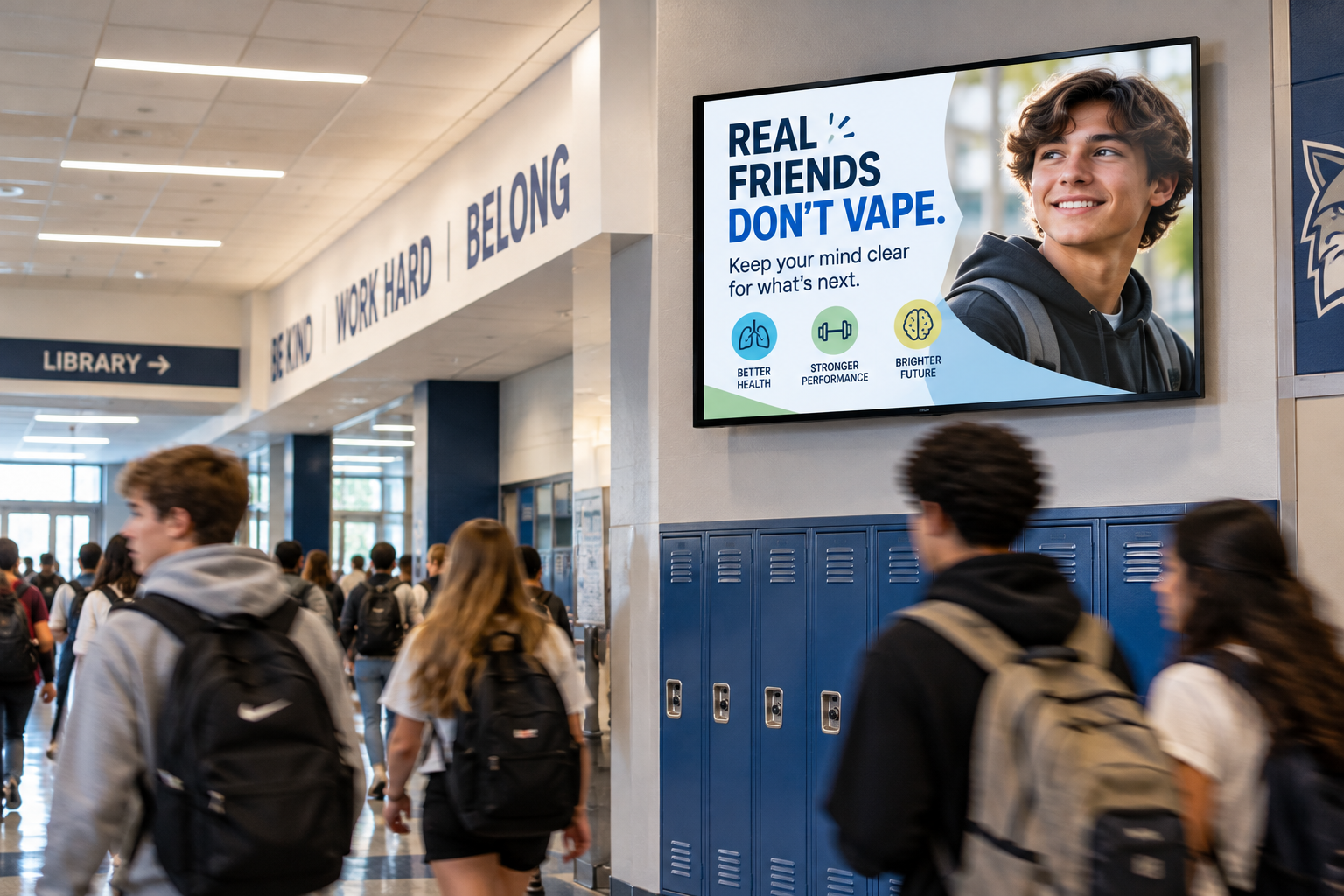
Tobacco and vaping prevention: youth prevention and quit resources. Vaping prevention campaigns
Vaccines and immunization: flu, respiratory syncytial virus (RSV), COVID-19, and routine childhood and adult vaccines. Vaccine and immunization advertising guide
Maternal and child health: prenatal and postpartum care and early childhood. Maternal health campaigns
WIC/SNAP and Medicaid enrollment: the Special Supplemental Nutrition Program for Women, Infants, and Children (WIC), the Supplemental Nutrition Assistance Program (SNAP), and Medicaid, reaching eligible families where they shop and get care. WIC enrollment · Medicaid outreach
Chronic disease and cancer screening: prompts to get screened and talk with a provider. Point-of-care for oncology
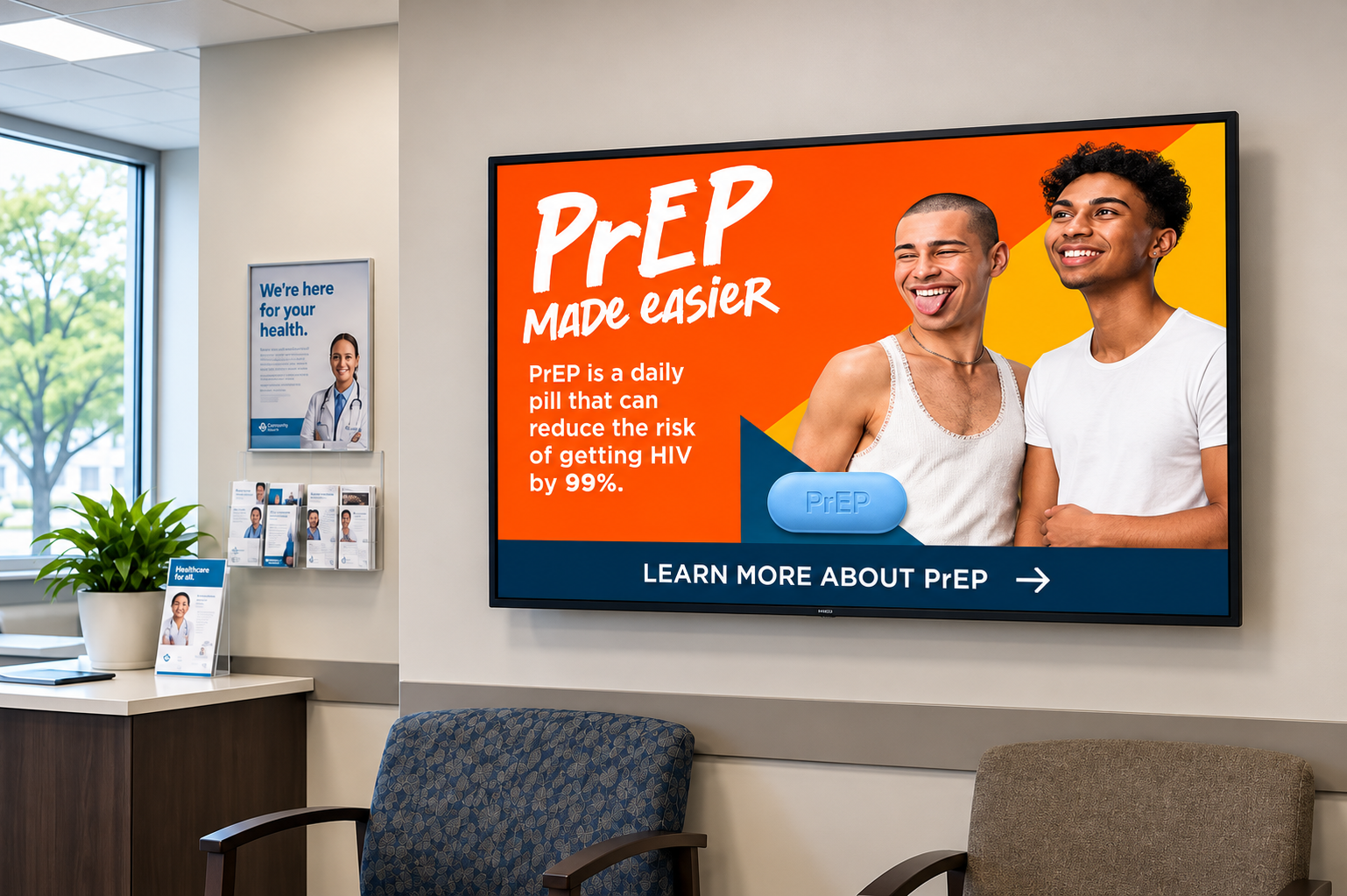
Sexual health: HIV prevention, pre-exposure prophylaxis (PrEP), and testing, delivered without judgment. HIV prevention campaigns
Rural and Tribal health: community hubs in places traditional media misses. Rural audiences · Tribal communities
Where Messages Run
The best venue isn't the one with the most traffic. It's the one where your audience already is, at a moment that fits the message. Trust matters too. In an April 2025 KFF poll, 83% of adults said they trust their own doctor or health care provider for reliable vaccine information, more than any other source tested (KFF). A message in a care setting borrows that trust.
Point-of-care: clinics, urgent care, hospitals Reach: Patients and caregivers in waiting and exam rooms, before they talk with a provider. Topics: Vaccines, cancer screening, chronic disease, maternal health, 988, Medicaid.
Pharmacies Reach: People picking up prescriptions, asking a pharmacist, or getting vaccinated. Topics: Vaccines, naloxone, tobacco cessation, sexual health, Medicaid and Medicare enrollment.
Gas stations and convenience stores: 29,000+ gas stations Reach: Drivers at the pump and shoppers inside, in town and on rural routes. Topics: Fentanyl and opioids, 988, tobacco and vaping, rural health.
High schools Reach: Students throughout the school day, with approved creative. Topics: 988, vaping prevention, substance use, sexual health, vaccines.
Colleges Reach: Students in unions, residence halls, dining, and recreation spaces. Topics: 988, substance use, sexual health, vaccines.
Community centers Reach: Families, young athletes, and seniors during weekly visits. Topics: Tobacco and vaping, chronic disease, WIC/SNAP, vaccines.
Grocery stores Reach: Weekly shoppers, including families using benefits. Topics: WIC/SNAP, Medicaid, nutrition and chronic disease, vaccines.
Bars and restaurants Reach: Adults 21+, including LGBTQ+ venues and veterans' posts. Topics: Sexual health and PrEP, overdose and naloxone, 988.
Daycare and childcare Reach: Parents of young children at drop-off and pick-up. Topics: Childhood vaccines, WIC, maternal and child health.
Healthcare professional (HCP) staff lounges and exam rooms Reach: Physicians, nurses, and clinic staff between patients. Topics: Screening recommendations, vaccine reminders, naloxone and 988 referral resources.
Tribal Community Centers, Indian Health Service (IHS) locations, and reservations Reach: American Indian and Alaska Native community members at care visits and community events. Topics: Overdose prevention, diabetes and chronic disease, vaccines, 988, maternal health.
Multicultural and In-Language Reach
More than one in five U.S. residents age 5 and older speak a language other than English at home (U.S. Census Bureau). A translated general-market ad rarely lands with them. We plan language at the start, not the end:
Creative in English, Spanish, and 15 more languages, culturally adapted, not just translated.
Bilingual versions given equal space and prominence.
Real families, foods, and settings, and no clichés.
Venues chosen for each community's makeup, like neighborhood markets and cultural centers.
See our multicultural advertising approach and audience pages for Hispanic and Latino, Black, Indigenous, and people of color (BIPOC), and Asian and Pacific Islander communities.
How a Campaign Works
Planning. We start with three questions: who needs to act, what you want them to do, and where they already spend time. You get a venue mix and a location-level list before anything is booked.
Production. We format your creative or help build it, handle translation and cultural adaptation, and produce materials in-house. Your team approves the creative and the plan, and each venue network signs off before posting.
Installation. We coordinate every venue, install the materials, check placements during the flight, and replace anything damaged or missing.
Reporting with photo proof. Every location gets time-stamped, geo-tagged photos. Reports break delivery down by ZIP code, county, venue type, and language. QR codes and vanity URLs track response, and a final wrap report closes the campaign. The documentation is built for grant reports and public-records requests.
Our planning guide recommends starting 6 to 10 weeks before launch, and earlier for statewide or multilingual programs.
Plan It, Then See the Proof
Public Health Media Planning Guide: budget ranges by campaign size, CPM (cost per thousand impressions) benchmarks, timelines, and a planning checklist.
A statewide 988 Lifeline awareness campaign across healthcare, college, library, and community venues.
A youth 988 campaign in high schools, colleges, and community spaces.
A national naloxone education and fentanyl awareness campaign that reached rural, college, LGBTQ+, and Tribal communities.
Public health advertising strategies: channels, venues, and measurement.
Building a budget or timeline? See our Public Health Media Planning Guide.
Frequently Asked Questions
Is PlaceBased Media a public health advertising agency?
We're a place-based OOH and DOOH media company that specializes in public health. We plan the media, recommend venues, produce and install materials, and report on delivery. We work directly with health departments and nonprofits, or alongside your agency of record.
Do you work with health departments directly?
Yes, at the state, county, city, and Tribal level. We also work through the agencies that serve them.
Can you run a statewide campaign?
Yes. Campaigns can cover a whole state or a handful of ZIP codes. Venues vary by market, so your plan lists exact locations before you commit.
How much does public health advertising cost?
It depends on geography, venues, formats, and campaign length. Our planning guide shows illustrative budget ranges from single counties to statewide programs, and we'll build a custom plan around your budget.
How do we know the ads actually ran?
Every location gets time-stamped, geo-tagged photo proof and delivery reporting. Our point-of-care program has also been independently audited by the Alliance for Audited Media.
Can we use federal grant funds?
Place-based OOH is an eligible paid media channel for many federally funded awareness campaigns. Always confirm against your specific grant terms.
Can campaigns run in languages other than English?
Yes. We produce creative in English, Spanish, and 15 more languages, and we can assign versions by market, location, or venue.
Do you use personal health data to target people?
No. We target by location, venue type, and geography. We never use individual health data.