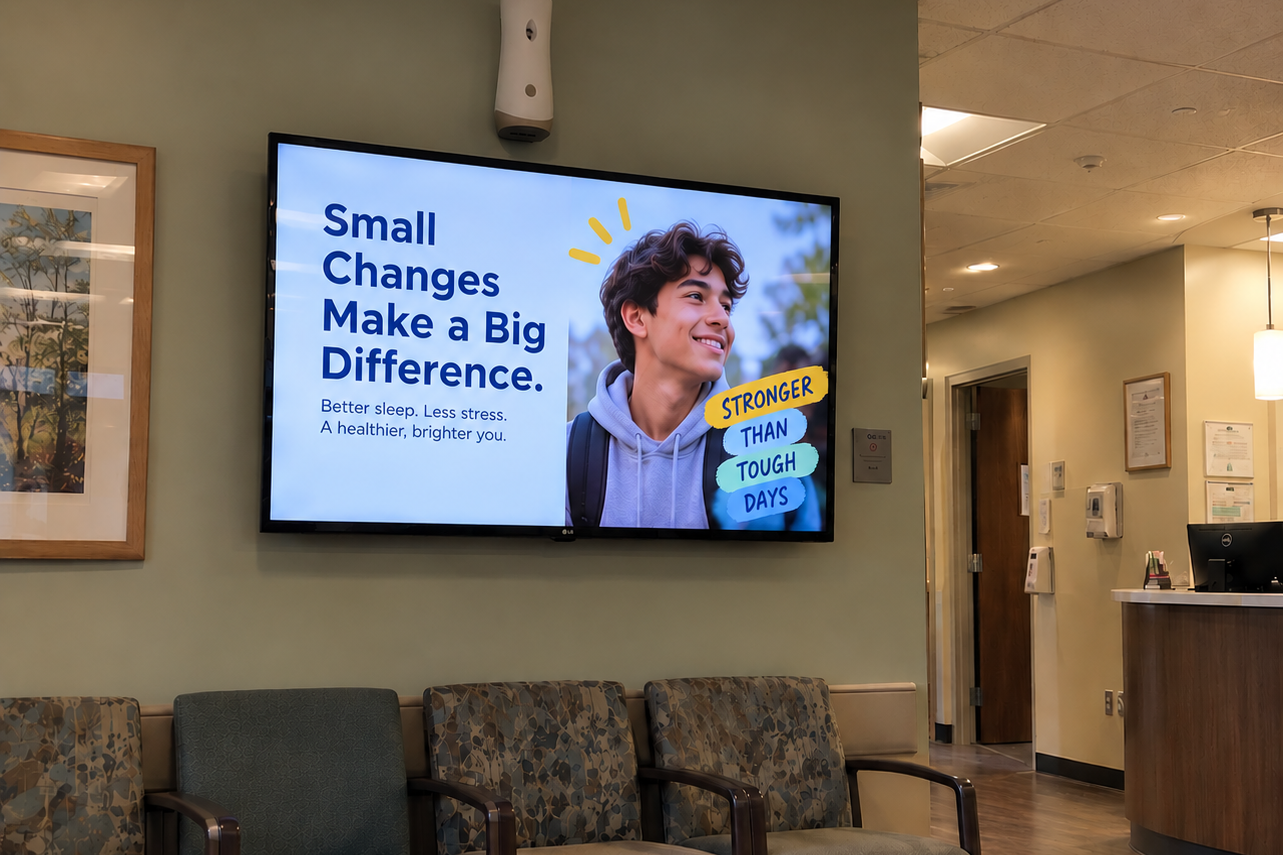
Where We Reach Patients
Learn more about our point-of-care advertising and pharmacy advertising networks.
Target by Specialty, Geography, and Language
A diabetes message belongs in endocrinology and primary care. A prenatal message belongs in OB/GYN offices. Our network spans 120 healthcare specialty types across 58 specialty groups, so the specialty does the targeting.
Specialty: choose the practice types that match your condition or program.
Geography: target by ZIP code, county, DMA, state, or nationwide.
Language: run creative in English, Spanish, and 15+ additional languages, with cultural adaptation, not just translation.
Community data: prioritize locations using public health, demographic, and coverage data, such as counties with low screening rates or high Medicaid enrollment.
Privacy-safe by design. Point-of-care media targets by physical location, medical specialty, and geography, never by individual patient health data. We don't collect or use protected health information.
Patient Advertising: Reach People Where Health Decisions Happen
Patient advertising puts health messages inside the places people go for care: physician offices, specialty clinics, community health centers, urgent care, hospitals, and pharmacies. PlaceBased helps public health agencies, health systems, health plans, pharmaceutical brands, nonprofits, and advertising agencies reach patients across 20,000+ healthcare facilities in 300+ U.S. markets.
Most people walk into that room at least once a year. In 2025, 84.7% of U.S. adults had a visit with a doctor or other health care professional, and physician offices logged about 1.0 billion visits in the most recent national survey (CDC, National Center for Health Statistics). Your message should be in that room too.
Get a Custom Patient Media Plan
Why Reach Patients at the Point of Care
Many media companies specialize in impressions. We specialize in impact. With patients, impact comes from three things that billboards and banner ads can't offer.
The right mindset. Patients in a waiting room or exam room are already thinking about their health, their symptoms, and the questions they want to ask.
A trusted setting. A message inside a clinic or pharmacy borrows the credibility of the place where people get care.
A next step that's close by. The provider conversation, the pharmacy counter, and the screening are steps away. A clear call to action can turn awareness into a question asked, a test taken, or a form filled out.
Patient Campaigns We Support
Public health and government - Vaccination and immunization awareness - 988 Suicide & Crisis Lifeline and mental health resources - Overdose prevention and naloxone education - Tobacco and vaping cessation - HIV prevention, PrEP, and STI testing - Cancer, diabetes, and heart health screening - Maternal and infant health - Medicaid, CHIP, and Medicare enrollment and renewal
Pharmaceutical and health brands - Disease-state awareness and unbranded education - Branded patient education - Patient support and savings programs - Medication adherence and refill reminders - Clinical trial awareness
Health systems and health plans - New services, locations, and telehealth options - Preventive care and member engagement
Patient Advertising Formats
Waiting room posters, digital screens, and TV
Exam room posters and displays
Wallboards and poster frames
Take-one brochures and condition guides
Interactive kiosks
Pharmacy counter displays and screens
Privacy-safe mobile extensions that reinforce in-venue messages (mobile advertising)
Primary Care & Family Medicine
- Patient Activities: Routine visits, screenings, chronic condition check-ins
- Advertising Formats: Waiting room screens, posters, take-ones
Specialty Practices
- Patient Activities: Condition-specific care, including cardiology, endocrinology, oncology, OB/GYN, pediatrics, dermatology, gastroenterology, neurology, pulmonology, and more
- Advertising Formats: Waiting room and exam room displays, condition guides
Community Health Centers & Rural Clinics
- Patient Activities: Primary care for underserved and rural communities
- Advertising Formats: Posters, digital screens, in-language take-ones
Urgent Care & Hospitals
- Patient Activities: Acute care, outpatient visits, lab and imaging waits
- Advertising Formats: Digital displays, wallboards, brochures
Pharmacies
- Patient Activities: Prescription pickup, pharmacist consultations, vaccinations, OTC purchases
- Advertising Formats: Counter displays, pharmacy screens, posters, take-ones
Behavioral Health Settings
- Patient Activities: Mental health and substance use treatment
- Advertising Formats: Discreet posters, brochure racks, digital screens
Fully Managed, Start to Finish
One partner handles media planning, venue selection, creative, production, compliance checks, installation, and reporting. Most point-of-care campaigns can be planned, produced, and deployed within 2–4 weeks.
Patient Advertising FAQs
What is patient advertising?
Patient advertising delivers health information and brand messages to people inside healthcare settings, such as physician offices, clinics, hospitals, and pharmacies. It reaches patients while they are thinking about their health and preparing to talk with a provider or pharmacist.
Is patient advertising privacy-safe?
Yes. Campaigns are targeted by venue, specialty, and geography. We never use individual patient health data to target anyone.
Can we target specific medical specialties?
Yes. Campaigns can run in specific specialties, such as cardiology, endocrinology, oncology, OB/GYN, or pediatrics, or across primary care for broad wellness messages.
Can patient campaigns run in more than one language?
Yes. We support English, Spanish, and 15+ additional languages, and different versions can run by market or location.
Who uses patient advertising?
State and local health departments, federal agencies, health systems, health plans, pharmaceutical and medical device brands, nonprofits, and the advertising agencies that represent them.
How are patient campaigns measured?
Through venue-level proof of posting, location and delivery reports, and response tracking such as QR codes and vanity URLs. Our healthcare delivery has been independently verified by the Alliance for Audited Media.
How long does it take to launch?
Most point-of-care campaigns launch within 2–4 weeks, depending on scope, creative, and venue availability.
One Message Across the Patient Journey
A patient may see your message in the waiting room, see it again at the pharmacy counter, and hear it once more at the grocery store or community center. We plan those touchpoints as one campaign, so the message builds instead of starting over. Pair point-of-care with grocery store, community center, and DOOH placements for reach beyond the clinic.
Verified Delivery You Can Report
Public dollars and brand budgets both need proof. Two consecutive Alliance for Audited Media (AAM) audits verified that PlaceBased delivered 113.3% and 111% of guaranteed distribution. The latest audit covered our 345-location Physician Office Patient Education Program. Read how the audit works.
Every campaign includes: - Venue-level proof of posting with time-stamped, geo-tagged photos - Location lists and delivery breakdowns by ZIP code, county, venue type, and language - Attribution options: QR codes, vanity URLs, UTM tags, and call or text short codes - A final wrap report with recommendations for the next flight
Let's Talk.
Tell us who you need to reach, where, and what you want them to do. We'll build a patient media plan around your specialties, markets, languages, and budget.