
Youth Social Media Settlement Funds:What States Can Fund and How to Reach Teens and Parents Offline

On this page
Last updated October 30, 2026. These settlements are new, and state spending plans are still taking shape. We update this page as states announce plans.
Billions of dollars from social media settlements are starting to reach state governments. In August 2026, Meta agreed to pay at least $12.1 billion, and up to $17.1 billion, to a bipartisan coalition of attorneys general over claims that Instagram and Facebook harmed young people's mental health [1][2]. Alabama has since reached the first state settlement with TikTok [6].
For state health departments, behavioral health agencies, and the advertising agencies and agencies of record (AORs) that run their campaigns, the question is moving from "how much?" to "how do we spend it well?" This guide explains where the money is going, what it can pay for, and how place-based media can help a settlement-funded campaign reach teens and parents in the real world, away from the screens the money is meant to address.
What are the youth social media settlements?
The Meta multistate settlement. On August 26, 2026, Meta settled the attorneys general case over addictive design and youth harms on Instagram and Facebook (California et al. v. Meta, N.D. Cal., part of MDL 3047) a week into trial. The coalition includes 47 states, the District of Columbia, Puerto Rico, American Samoa and the Northern Mariana Islands [1]. Chief Judge Yvonne Gonzalez Rogers entered the consent judgment the same day [4]. Meta does not admit wrongdoing [3].
- Money: at least $12.1 billion is guaranteed. It rises to up to $17.1 billion if Snap, TikTok and YouTube become bound to comparable terms [1][2]. The payment table (Exhibit B) allocates $16.68 billion across 51 jurisdictions, and a separate Exhibit E adds $459.3 million for Cambridge Analytica-related claims [5].
- Product changes for teens: a combined two-hour daily limit across Instagram and Facebook, "productive pauses," a midnight-to-6 a.m. block, no push notifications during school hours, stronger age assurance, and limits on beauty filters and visible like counts [2].
States outside the coalition.
- Texas reached its own Meta settlement of "over $1 billion" [8]. Bloomberg Law reports it as $1.05 billion, rising to as much as $1.335 billion [9]. → Texas guide
- New Mexico won its own court judgment of about $942 million, including a $567 million abatement fund [10]. Meta has said it will appeal, which could delay payment.
- Florida did not join [11].
- Note: one Kentucky legislative briefing says Texas and Guam "have since joined" by amendment [12]. We haven't seen an amended payment table, so treat national totals as subject to change.
Related settlements.
How much is each state getting?
Every coalition state gets ten annual installments, plus a one-time Cambridge Analytica payment in most states [5]. A few examples, using each state's guaranteed minimum and possible maximum including the Cambridge payment [5]:
| State | Guaranteed minimum | Possible maximum |
|---|---|---|
| California | ~$1.54 billion | ~$2.20 billion |
| New York | ~$819 million | ~$1.16 billion |
| New Jersey | ~$546 million | ~$772 million |
| Tennessee | ~$529 million | ~$752 million |
| Mississippi | ~$195 million | ~$277 million |
| Kansas | ~$140 million | ~$198 million |
| Alabama | ~$128 million | ~$179 million |
The maximums depend on the contingent payments described below, which have not been triggered in any state [13]. Figures come from the settlement's Exhibits B and E. See our state pages for details.
→ See state-by-state guides: Alabama · Kansas · New Jersey · New Mexico · Mississippi · Tennessee · Texas
When does the money arrive?
- By late September 2026: the first installment was due within 30 days of the August 27 effective date [5][13]. North Carolina reported receiving its first payment of about $45.2 million [14].
- January 15, 2027: the second installment. Installments continue each January 15 through 2035 [5].
- Early 2027: most legislatures are in session, and many states will decide how to appropriate the money then. Tennessee's General Assembly, for example, must appropriate its Children's Digital Protection Fund [15].
- Contingent payments: about 30% of each installment is paid only if Snap, TikTok and YouTube all become bound to comparable terms in that state. As of mid-October 2026, no state had met that trigger [13].
- State-court judgments: a few jurisdictions, including Alabama, Iowa, Mississippi, Montana, Nevada and the Northern Mariana Islands, set their payment instructions in separate state consent judgments, so their timing may differ [5].
What can states spend social media settlement funds on?
The settlement says states may use the money for "any lawful purpose consistent with the Attorney General's authority." It lists examples of remedial uses, including [5]:
- 988 and text-based youth crisis lines
- After-school and summer programs, and outdoor activities
- Public health advertising credits
- A digital wellness public education fund
- Youth mental health programming
- Digital literacy counselors and phone-free schools
- Training for health care providers
- Grants to school districts and local governments
These are examples, not requirements. Each state's own rules (the settlement's Exhibit C) decide where the money goes. Most states left most of the money to officials' discretion. One analysis estimated that about 70% is left to state officials, and about 23% is aimed specifically at youth mental health or social media harms [16]. In practice, that means decisions will be made by legislatures, governors and attorneys general over the next year.
Where the language most clearly fits public awareness campaigns [5]:
- Nevada: money goes out as grants, and eligible uses include "public awareness and communication strategies."
- Arizona: a 25% remediation share can fund a digital wellness public education fund.
- Delaware: 50% goes through the Governor's budget office for remedial uses, including a digital wellness public education fund.
- Massachusetts: names public health advertising credits and a digital wellness fund as permitted uses.
- New Mexico: its court judgment sets aside $33 million for awareness and prevention, including media campaigns, school education and pediatrician toolkits [10].
Who decides how the money is spent?
It varies by state, and in several states it's still being contested:
- Attorneys general hold the money at their discretion in many states, including Kansas, Colorado, Virginia and Alabama for its TikTok funds [5][7][17].
- Legislatures appropriate it in others. Examples include Tennessee (a dedicated fund), Kentucky, North Carolina and Minnesota [5][15].
- Proposed plans and pending legislation: Mississippi's Attorney General has proposed specific annual allocations, including youth mental health money for the Department of Mental Health [18]. New Jersey lawmakers have floated competing ideas [19][20].
- State health and behavioral health agencies will usually run the programs. Many already buy media through the agencies that handle their 988, suicide prevention and substance use prevention campaigns.
What this means for agencies and AORs: settlement money will mostly flow through the state agencies and contracts you already know. When it does, the media plan will need to reach young people and parents in ways that don't add to the screen time the money is meant to address.
Why offline, place-based media fits settlement-funded campaigns
These settlements exist because of harms tied to social media use. Building the response campaign mostly on social media ads sends a mixed message. It also gives the money back to the platforms that paid it. Place-based media reaches the same people in the places where they live, learn, wait and shop:
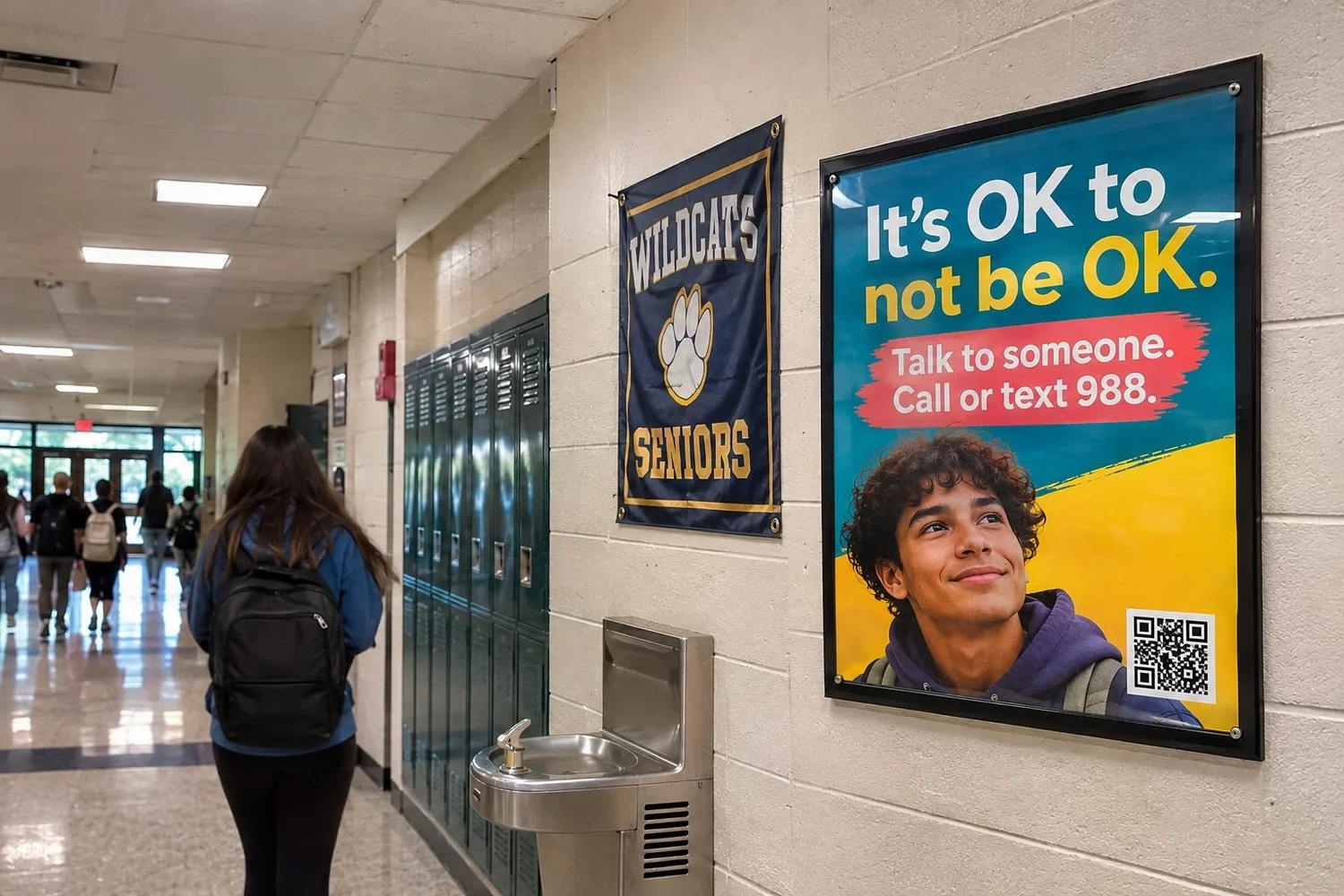
- K-12 schools and colleges. Elementary school, middle school, high school and college placements for digital wellness, phone-free school and 988 messaging aimed at students and staff.
- Daycare and childcare centers. Daycare placements reach parents of young children at drop-off and pick-up, which is the right moment for early screen-time and parental-controls messages.
- Pediatric and primary care offices. Point-of-care and pediatric point-of-care placements in waiting rooms and exam rooms of 7,500+ pediatric offices reach parents when they're already thinking about their child's health. Placements in clinic staff lounges and break rooms reach the providers that settlement-funded training programs are meant to equip (HCP advertising).
- Community and recreation centers. Community center placements reach teens and families during after-school programs, sports and weekend activities, away from the feed.
- Gas stations and convenience stores. 29,000+ gas station locations reach teens and parents on everyday errands in rural, suburban and urban markets.
- Native American communities. Native American community locations can carry messaging that's culturally relevant and developed with the community.
- Substance abuse treatment centers. Treatment center placements support crisis line and family-support messaging where co-occurring needs are common. Formats vary by center and are mostly posters and take-ones.
Every PlaceBased Media campaign is fully managed, from planning and in-language creative adaptation to installation and proof-of-performance reporting. For our point-of-care network, delivery is verified by the Alliance for Audited Media.
How PlaceBased Media works with settlement-funded programs
PlaceBased Media is the offline, place-based media partner for state programs and their agencies. We work with state programs and the agencies that run their campaigns to plan and deliver the offline part of the media plan:
- Plan: map the program's audience (teens, parents, educators or providers) to venues by county, ZIP code or school district.
- Create: adapt the campaign's creative to each venue, in English, Spanish and 15+ more languages.
- Place: handle production, printing, installation and digital delivery.
- Prove: provide the proof-of-performance reporting that settlement-funded programs will be asked to show legislators and the public.
Get a media plan → · Download the sample settlement-funded media plan →
Lessons from the opioid settlements
The opioid settlements are the closest precedent. More than a dozen companies are expected to pay state and local governments more than $50 billion over nearly two decades [21]. In 2024, about $237 million of trackable spending went to prevention, and some of it went to projects experts questioned [21]. In one New Jersey township, a state comptroller found $632,000 spent on two "awareness" concerts [22]. The lesson for social media settlement money is to tie awareness spending to a defined audience, an evidence-informed message and measurable delivery. → Read: Lessons from opioid settlement media campaigns
Frequently asked questions
01How much is the Meta settlement with the states?
Meta will pay the coalition at least $12.1 billion, and up to $17.1 billion if Snap, TikTok and YouTube adopt comparable terms. It is paid in ten annual installments plus a one-time Cambridge Analytica-related payment to most states [1][5].
02How can states spend Meta settlement money?
For "any lawful purpose" consistent with the attorney general's authority. The settlement lists example uses: 988 and youth crisis lines, after-school programs, public health advertising credits, a digital wellness public education fund, youth mental health programs, digital literacy counselors, provider training, and grants to schools and local governments. Each state's own terms and laws decide how its share is handled [5].
03Can settlement funds pay for public awareness or advertising campaigns?
The settlement names "public health advertising credits" and a "digital wellness public education fund" as example uses, and Nevada's terms explicitly allow grants for public awareness and communication strategies [5]. Whether a given campaign qualifies depends on the state's own terms and on how its legislature or attorney general directs the money.
04When will states receive the money?
The first installment was due about 30 days after the August 27, 2026 effective date. Later installments arrive each January 15, starting in 2027 and running through 2035 [5]. Some states with separate state-court judgments may receive money on a different schedule [5].
05Which states are not part of the Meta multistate settlement?
Texas reached its own settlement of over $1 billion [8]. New Mexico won its own court judgment of about $942 million [10]. Florida did not join and is pursuing its own case [11].
06What is the Alabama TikTok settlement?
On September 25, 2026, Alabama settled its lawsuit with TikTok. The state receives at least $100 million in restitution and remediation, and up to $300 million total if enough other states reach similar agreements. TikTok must also add teen protections in Alabama, including a two-hour daily limit [6][7].
07How does PlaceBased Media work with settlement-funded programs?
PlaceBased Media is the offline, place-based media partner for state programs and their agencies. We plan and deliver the offline part of the media plan, in 7,500+ pediatric offices, K-12 schools, community and recreation centers, daycares, gas stations and more. Contact us or email hello@placebased.media.
Planning a settlement-funded campaign?
Tell us the audience, the state and the timing. We'll build a place-based media plan, covering K-12 schools, pediatric offices, community and recreation centers, daycares, gas stations and more, that your team can drop into the larger campaign.
Sources
- NY AG press release, Aug 26, 2026: https://ag.ny.gov/press-release/2026/attorney-general-james-secures-171-billion-and-groundbreaking-reforms-meta
- Utah AG press release (product changes; $12.2B/$17.1B): https://attorneygeneral.utah.gov/utah-meta-settlement/
- Consent judgment, recitals ("Meta denies the allegations"): https://www.attorneygeneral.gov/wp-content/uploads/2026-08-26-META-23-05448-ECF-572-1-Exhibit-1-MDL-Consent-Judgment-FINAL-Settlment-Agreement-Fully-Executed.pdf
- Order entering the consent judgment (MDL Dkt.): https://storage.courtlistener.com/recap/gov.uscourts.cand.419868/gov.uscourts.cand.419868.575.0.pdf
- Consent judgment and settlement agreement: Sec. VI.C (installments), VI.D (contingency), VI.G.1 (uses), Exhibits B, C and E: https://www.attorneygeneral.gov/wp-content/uploads/2026-08-26-META-23-05448-ECF-572-1-Exhibit-1-MDL-Consent-Judgment-FINAL-Settlment-Agreement-Fully-Executed.pdf. Per-state figures are taken from Exhibits B and E as compiled in /workspace/meta-settlement/meta-settlement-tracker.xlsx. Table check: https://settlementinsight.com/news/meta-settlement-exhibit-b-51-jurisdictions-16-68-billion-texas-florida-no-number
- Alabama AG press release, Sept 25, 2026: https://content.govdelivery.com/accounts/ALAG/bulletins/42c948f
- WSFA (AG chief counsel on use of funds; $116.2M): https://www.wsfa.com/2026/09/25/multimillion-dollar-settlement-reached-with-tiktok-inc-alabama-attorney-general-announces/ ; tier structure: https://allaboutlawyer.com/alabama-tiktok-settlement/
- Texas AG press release: https://www.texasattorneygeneral.gov/news/releases/attorney-general-ken-paxton-secures-over-1-billion-meta-historic-settlement-protects-texas-kids
- Bloomberg Law: https://news.bloomberglaw.com/litigation/texas-billion-dollar-side-deal-ranks-high-in-meta-settlement
- NM DOJ press release: https://nmdoj.gov/press-release/court-orders-meta-to-pay-942-million-and-overhaul-protections-for-children-on-facebook-and-instagram-in-landmark-new-mexico-ruling/ ; Final judgment: https://nmcourts.gov/wp-content/uploads/2026/08/D-101-CV-2023-02838-Final-FOFCOL-and-Judgment-of-the-Court.pdf ; Santa Fe New Mexican (appeal/stay motion): https://www.santafenewmexican.com/news/local_news/meta-asks-new-mexico-court-to-stay-enforcement-of-942-million-judgment-pending-appeal/article_40aca50f-aee2-4b7a-8c23-d80c21d0c543.html
- MLex (Florida case): https://www.mlex.com/mlex/articles/2539834/florida-loses-injunction-bid-against-meta-in-social-media-case
- Kentucky legislative briefing, Sept 15, 2026: https://apps.legislature.ky.gov/CommitteeDocuments/366/44471/09%2015%202026%206A.%20Duncan%20-%20Meta%20Settlement%20Legislative%20Briefing.pdf
- Settlement Insight state tracker (contingency status as of Oct 12–20, 2026): https://settlementinsight.com/meta-state-settlement
- NC Newsline, Oct 1, 2026: https://ncnewsline.com/2026/10/01/nc-receives-first-45-2m-payout-from-meta-child-safety-settlement/
- Tennessee SB2061 bill info: https://wapp.capitol.tn.gov/apps/BillInfo/Default?BillNumber=SB2061&ga=114 ; Chalkbeat: https://www.chalkbeat.org/tennessee/2026/09/11/who-gets-to-spend-meta-settlement-how-much-is-meta-settlement/
- Arkansas Democrat-Gazette (citing NYT analysis): https://www.arkansasonline.com/news/2026/oct/18/best-use-for-meta-settlement-funds-point-of-debate/
- Topeka Capital-Journal (Kansas funds): https://www.cjonline.com/story/news/politics/government/2026/08/26/meta-to-pay-17-1b-to-kansas-others-for-social-media-harm-to-children/91474700007/
- Mississippi Today, Sept 16, 2026: https://mississippitoday.org/2026/09/16/fitch-mississippi-meta-settlement/
- NJ AR160: https://www.njleg.state.nj.us/bill-search/2026/AR160
- NJ A5438 (withdrawn Sept 24, 2026): https://www.njleg.state.nj.us/bill-search/2026/A5438
- KFF Health News: https://kffhealthnews.org/public-health/opioid-settlements-addiction-sock-hops-concerts-mma-local-spending/
- NJ Office of the State Comptroller: https://www.nj.gov/comptroller/news/2025/approved/20250708.shtml
- PlaceBased venue facts: https://placebased.media and /workspace/website-redesign/launch/llms.txt (29,000+ gas stations, AAM audits, 15+ languages, venue list).
Settlement funds by state.
Alabama
Alabama's TikTok and Meta settlements could bring the state more than $228M for youth harms. What's known about the funds, who decides, and how to reach families.
Kansas
Kansas gets $134M+ from the Meta settlement. Who controls the money, where the plan stands, and how to reach Kansas teens and parents offline.
New Jersey
New Jersey will get at least $545M from the Meta settlement. What AR160 and other proposals say, who decides, and how to reach NJ teens and parents offline.
New Mexico
New Mexico's $942M Meta judgment sets aside $33M for awareness and prevention, including media campaigns. What's known and how to reach NM families offline.
Mississippi
Mississippi's $189M Meta settlement plan sends $6.8M a year to youth mental health, plus parks and afterschool. What's in it and how to reach MS teens offline.
Tennessee
Tennessee's Meta settlement money goes to the new Children's Digital Protection Fund. What the law allows, who decides, and how to reach Tennessee families.
Texas
Texas's separate Meta deal pays over $1 billion for youth mental health, crisis resources and digital literacy. What's known and how to reach Texas families.
How Can States Spend Meta Settlement Money?
The Meta settlement lets states use funds for "any lawful purpose." See the example uses, who controls the money in each state, and where awareness fits.
Lessons From Opioid Settlement Media Campaigns
What opioid settlement awareness spending got right and wrong, and five lessons for states planning campaigns with Meta and TikTok settlement money.
Plan your next campaign.
Reach your audience in the clinics, schools, pharmacies, gas stations, and community places they already visit.