Advertising to Asian American Communities: In-Language, Culturally Adapted Place-Based Media

Advertising to Asian American communities means reaching one of the most diverse audiences in the U.S. (dozens of origin groups, languages, faiths, and immigration stories) with messages that feel like they were made for them. The approach that works isn't one "Asian American" ad. It's in-language, culturally adapted creative placed in the grocery stores, restaurants, clinics, pharmacies, campuses, and community venues each community already trusts.
This guide explains who the audience is, why general-market media and simple translation fall short, how place-based Out-of-Home (OOH) and Digital Out-of-Home (DOOH) close the gap, which venues and languages to prioritize, and how to measure results. It's written for public health departments, government agencies, nonprofits, and brands.
Who You're Reaching
Pew Research Center's analysis of Census Bureau data gives the outline:
The U.S. Asian population grew from 11.9 million in 2000 to 24.8 million in 2023, rising from 4% to 7% of the U.S. population.
The largest origin groups are Chinese (5.5 million), Indian (5.2 million), Filipino (4.6 million), Vietnamese (2.3 million), Korean (2.0 million), and Japanese (1.6 million). Together they make up 86% of the Asian population.
54% of Asian Americans are immigrants.
63% of Asian Americans ages 5 and older speak a language other than English at home. The most common are Chinese, Filipino or Tagalog, Vietnamese, Korean, and Hindi.
74% are English proficient overall, but that falls to 59% among Asian immigrants.
More than half (54%) live in five states: California, New York, Texas, New Jersey, and Washington.
Here's the planning takeaway. "Asian American" is a census category, not a media audience. A Vietnamese grandmother in Houston, a Korean American college student in New Jersey, and a Filipino nurse in Seattle need different languages, different messengers, and often different venues.
A Note on Terms
People often say "AAPI" (Asian American and Pacific Islander), and our Asian Pacific Islander audiences page covers both. But Native Hawaiian and Pacific Islander communities have their own histories, languages, and health priorities, and they deserve campaigns planned for them specifically. This post focuses on Asian American communities. When in doubt, use the community's own name for itself: Hmong, Bangladeshi, Korean American, Filipino American.
Why General-Market Media Falls Short
Language access. With 41% of Asian immigrants less than proficient in English, an English-only campaign misses a large share of the people who most need public health and benefits information.
Translation isn't enough. Literal translation can be confusing, overly formal, or simply wrong in context. Health terms and idioms rarely carry over word for word.
Averages hide need. Pew reports a median household income of $105,600 for Asian-headed households, but some origin groups are far lower: $54,300 for Mongolian and $67,600 for Burmese households. Planning to the average leaves communities behind.
Trust is local. Many communities rely on in-group networks, community organizations, and in-language providers for information. A message carries more weight in those settings than in a generic feed.
Why Place-Based Media Works
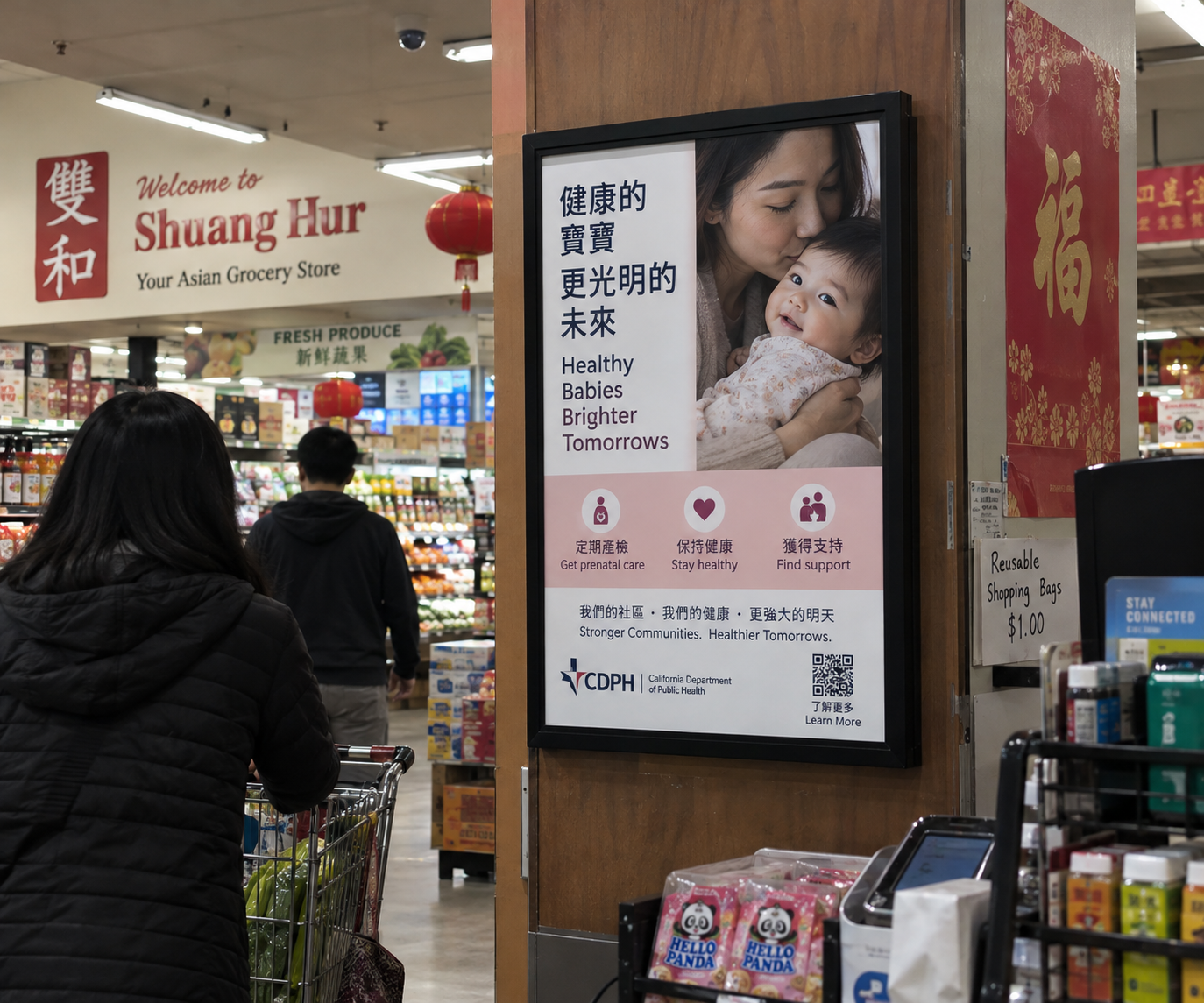
Place-based media reaches people where they live, shop, gather, and seek care. For Asian American audiences, that means:
Cultural proximity. Creative inside an Asian grocery store, a neighborhood restaurant, or a community center fits into daily life instead of interrupting it.
Language precision. You can run Vietnamese creative where Vietnamese speakers shop and Korean creative where Korean speakers gather, instead of buying one language across a whole DMA.
Credibility by association. A message in a trusted community space feels endorsed by that environment.
Reach across generations. Placements in family venues reach immigrant elders and U.S.-born young adults in the same trip, and bilingual creative can speak to both.
Venue Strategy
Asian grocery stores and supermarkets: Who you reach: Families, household decision-makers, elders; Notes: Weekly trips, strong cultural visibility
Restaurants and cafes: Who you reach: Young adults, families, workers; Notes: Social settings with dwell time
Clinics and pharmacies serving multilingual communities: Who you reach: Patients and caregivers; Notes: In-language point-of-care materials
Community centers and cultural organizations: Who you reach: Elders, families, new arrivals; Notes: Trusted neighborhood settings
College campuses: Who you reach: Students, international and first-generation students; Notes: High concentration in many markets
Gas stations and c-stores in priority neighborhoods: Who you reach: Commuters and local residents; Notes: Everyday reach outside the core venues
Grocery Stores
For many families, the Asian supermarket is a weekly anchor, a place to shop, run into neighbors, and stay connected to home. Grocery store advertising in these stores reaches household decision-makers and multiple generations at once.
Clinics and Pharmacies
In-language health messages at the point of care reach patients when they're already thinking about their health. PlaceBased produces point-of-care materials in English, Spanish, and 15+ additional languages, with cultural adaptation, not just translation.
Community Centers and Cultural Organizations
Senior programs, language schools, cultural associations, and community centers are where many elders and recent immigrants get information they trust. These placements work especially well for benefits enrollment, Medicare outreach, and preventive health.
Campuses
College and campus OOH reaches Asian American and international students on mental health, sexual health, voter information, and recruitment, often in English with culturally specific visuals and messengers.
Languages: Plan by Market, Not by Category
Our API audience page lists Mandarin, Cantonese, Korean, Vietnamese, and Tagalog among the languages commonly used in place-based campaigns. The right mix depends on the market:
Start with local data. Use American Community Survey language data for your counties and ZIP codes.
Pick written forms carefully. Simplified vs. Traditional Chinese characters matter. So does whether your audience reads Mandarin- or Cantonese-oriented copy.
Transcreate. Work with native speakers from the community, not just a translation vendor, and test key lines with community members.
Keep bilingual versions equal. Same size, same placement, same quality.
Match the call to action. If the poster is in Vietnamese, the hotline, landing page, and clinic staff on the other end need to support Vietnamese too.
Creative That Respects the Community
Be specific, not generic. Real foods, family structures, places, and celebrations from the community you're reaching. Avoid pan-Asian visual shortcuts.
Skip stereotypes. That includes the "model minority" frame, which hides real needs in communities facing poverty, language barriers, or health disparities.
Use trusted messengers. Community doctors, pharmacists, elders, and local leaders carry weight.
Mind cultural sensitivities. Stigma around mental health, for example, may call for softer framing ("stress," "rest," "family well-being") and a private next step.
Invest year-round. May's Asian American and Native Hawaiian/Pacific Islander Heritage Month is a moment, not a strategy. Lunar New Year, Diwali, Tết, and other celebrations matter to different communities, and none of them is a stand-in for all.
Common Campaign Types
Public health: preventive screenings, chronic disease such as diabetes and hypertension, hepatitis B awareness, mental health, tobacco cessation, and immunizations.
Benefits and coverage: Medicare and Medicaid outreach, especially for immigrant elders. Pew puts the median age of Asian immigrants at 46.1, compared with 19.0 for U.S.-born Asians.
Civic engagement: census participation, voter information, and public safety.
Brands and retail: product launches and seasonal promotions in community venues.
Measurement
Proof of posting with time-stamped, geo-tagged photos at every venue.
Delivery by language, ZIP, venue type, and community.
Language-specific QR codes and vanity URLs, so you can see which languages and venues drive response.
Brand lift or intercept surveys in-language where budgets allow.
Independent verification: PlaceBased's distribution has been confirmed in two consecutive Alliance for Audited Media (AAM) audits, at 113.3% and 111% of guaranteed distribution.
How PlaceBased Helps
We're a multicultural media team, and we run in-language campaigns as a fully managed service: venue and language planning, transcreated creative, production, installation, compliance monitoring, and proof-of-performance across 300+ U.S. markets. See our multicultural advertising approach and related guides on Hispanic marketing and new American and immigrant marketing.
Frequently Asked Questions
What is the best way to advertise to Asian American communities? Plan by origin group and language, not by one broad category. Then place in-language, culturally adapted creative in venues each community trusts, such as grocery stores, restaurants, clinics, pharmacies, community centers, and campuses.
Which languages should an Asian American campaign use? It depends on the market. Nationally, the most common non-English languages Asian Americans speak at home are Chinese, Filipino or Tagalog, Vietnamese, Korean, and Hindi. Use local census data to choose, and decide on Simplified or Traditional Chinese based on your audience.
Is translation enough? No. Transcreation adapts the message to the culture and context. Test it with native speakers from the community, and make sure your call to action works in the same language.
Should Pacific Islander communities be included in the same campaign? Native Hawaiian and Pacific Islander communities have distinct languages, histories, and priorities. They're best served by campaigns planned for them specifically.
Let's Talk
Tell us which communities you need to reach and in which markets. We'll build a plan by language and venue, and we'll show you where every placement ran.
Sources
Pew Research Center, "Key facts about Asians in the U.S." (May 1, 2025): 11.9M (2000) to 24.8M (2023); 4% to 7%; origin-group sizes; 86% in six largest groups; 54% immigrants; 63% speak a non-English language at home; most common languages; 74% English proficient overall, 59% of immigrants; 54% in five states; median household income $105,600 (Mongolian $54,300, Burmese $67,600); median age 46.1 (immigrants) vs 19.0 (U.S.-born). https://www.pewresearch.org/short-reads/2025/05/01/key-facts-about-asians-in-the-us/
Pew Research Center, "English proficiency of the Asian population, 2023" (chart): https://www.pewresearch.org/chart/english-proficiency-of-the-asian-population-2023/
PlaceBased API audience page (languages commonly used): https://placebased.media/audiences/asian-pacific-islander-marketing
PlaceBased point-of-care page (15+ languages): https://placebased.media/point-of-care-advertising