
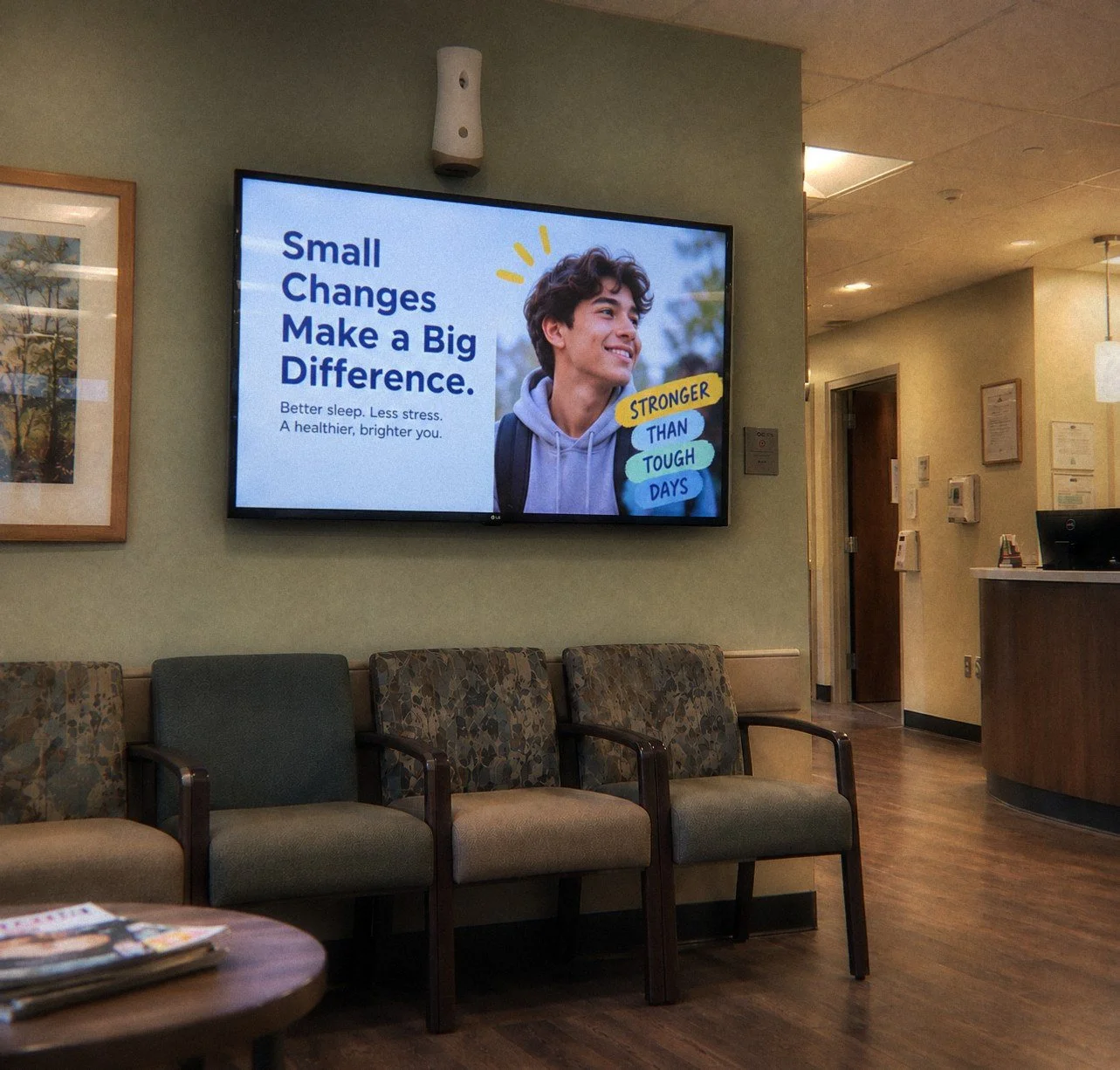
Urgent Care Advertising: Reach Walk-In Patients and ParentsThe unplanned visit, with a plan.
Urgent care advertising reaches people at walk-in centers that treat injuries and illnesses that are not life-threatening, from sprains to sore throats. Visits are unplanned and often include a parent with a sick child. Urgent care centers were on the healthcare venue list of PlaceBased Media’s SAMHSA naloxone education and fentanyl awareness campaign.
- 500,000+ locations
- AAM-audited delivery
- English, Spanish + 15 more languages
- Fully managed
How many people walk into urgent care.
of people in the U.S. had at least one urgent care center visit in the past 12 months (2024).
Source: CDC NCHS, Data Brief No. 562, “Urgent Care Center and Retail Health Clinic Use: United States, 2024,” May 2026.of children aged 0 to 17 visited an urgent care center in the past 12 months (2024).
Source: CDC NCHS, Data Brief No. 562, “Urgent Care Center and Retail Health Clinic Use: United States, 2024,” May 2026.of adults aged 18 to 64 had at least one urgent care visit in the past 12 months (2024).
Source: CDC NCHS, Data Brief No. 562, “Urgent Care Center and Retail Health Clinic Use: United States, 2024,” May 2026.Urgent Care Message Ideas
| Topic | Who it reaches | Message ideas |
|---|---|---|
| Respiratory season | Patients with colds, flu and other respiratory illness | Vaccination reminders, when to stay home, hand hygiene |
| Injury prevention | Active adults, parents and athletes | Sports safety, helmets, heat illness, safe driving |
| Finding a regular doctor | Patients without a primary care home | How to choose a primary care provider, why follow-up matters |
| Antibiotic awareness | Patients and parents | When antibiotics help and when they don’t, finishing prescriptions |
| Coverage | Uninsured and underinsured patients | Enrollment and renewal reminders, using benefits |
| Overdose prevention | Adults and families | Naloxone education, safe medication storage |
Urgent Care Use Across America
Suburbs lead
Among adults aged 18 to 64, 31.5% in large fringe metro (suburban) counties visited urgent care, compared with 26.6% in large central metro counties. (CDC NCHS Data Brief 562)
Small metros, too
30.6% of working-age adults in medium and small metro counties had an urgent care visit, versus 26.1% in nonmetro areas. (CDC NCHS Data Brief 562)
Older adults
21.9% of adults 65 and older had at least one urgent care center visit in the past 12 months. (CDC NCHS Data Brief 562)
Estimates come from the 2024 National Health Interview Survey. They are background data, not PlaceBased campaign results.
Built for Acute, Unplanned Care
CDC NCHS describes urgent care centers as freestanding facilities designed to treat acute, non-life-threatening injuries and illnesses, most staffed by a full-time, onsite licensed physician, with services such as X-rays and stitches (CDC NCHS). Patients arrive without an appointment and wait to be seen.
An urgent care visit gives a campaign three short windows:
Check-in
patients and parents register and settle in, often worried about the problem that brought them in.
The wait
time in the lobby and exam room is a chance to see a vaccination, prevention or coverage message.
Discharge and follow-up
take-home materials encourage a primary care visit, a vaccine or a prevention step after the acute problem is treated.
Who Sits in an Urgent Care Lobby
- Parents with sick or injured childrenchildren were among the most likely age groups to use urgent care in 2024 (CDC NCHS).
- Working-age adultsfitting care around work and family schedules.
- Suburban and small-metro residentswhere working-age adult use of urgent care was highest in 2024 (CDC NCHS).
- Physicians, physician assistants and staffin break rooms and staff areas.
Who Advertises in Urgent Care
- 01Health departmentsrespiratory season, vaccination and injury prevention campaigns.
- 02Health plans and Medicaid programsenrollment, renewal and benefits reminders, including finding a primary care provider.
- 03Federal programsnational prevention efforts like the SAMHSA naloxone campaign.
- 04Safety and prevention nonprofitssports safety, heat illness and safe driving messages.
Match the Urgent Care Seasons
Urgent care messages can follow the seasons, lining up with fall and winter respiratory illness, back-to-school sports physicals and summer activity and injury months. Book printed placements as flights with creative changes between them, and where an urgent care center has digital displays, refresh the message by season without reprinting.
Urgent Care Formats
Posters, wallboards and brochure and take-one displays are the standard at most urgent care centers. At select centers, waiting room digital displays, waiting-room TV, HCP lounge placements and Mobile POC are also available, depending on the facility.
Exam-room and waiting-room posters and wallboards (patient- and family-facing)
large, quick-to-read prevention messages for a short visit, at most locations.
Brochure and take-one displays (patient- and family-facing)
follow-up cards for vaccines, finding a doctor or coverage, at most locations.
Waiting room digital displays (patient- and family-facing, at select centers)
seasonal health messages in rotation, with rotation by market or language.
Waiting-room TV (patient- and family-facing, at select centers)
health and wellness programming with ad placements while walk-in patients wait to be seen.
HCP lounge placements (staff-facing, at select centers)
posters and screens in staff lounges and break rooms for physicians, physician assistants and nurses.
Mobile POC (at select centers)
privacy-safe, geofenced mobile ads that follow up after the visit, with no sensitive health data.
Format options appear by center in your plan. See the complete list of point-of-care advertising channels.
Creative for a Short, Stressful Visit
- Big type, few wordsPeople in urgent care are often distracted or unwell, so headlines should read at a glance.
- Reassure, don’t alarmA calm tone fits a room full of worried parents and patients.
- Make the take-home usefulCards with a QR code or short URL help patients act on the message once they feel better.
- Review stays with youYour team signs off on all creative and claims. PlaceBased does not write or add health claims.
Read our guides to advertising in clinics and pharmacies and healthcare marketing compliance.
Targeting Urgent Care Patients
Target urgent care centers by state, DMA, county or ZIP code, with extra weight in suburban and small-metro markets where use is high. Pair with pharmacies for prescription pickup messages and with primary care clinics for follow-up.
Measurement covers AAM-audited delivery, proof of posting with time-stamped, geo-tagged photos, delivery reports by geography and language, and optional QR code and URL tracking.
Healthcare Venues That Pair With Urgent Care
Urgent care is one of the healthcare venues in the SAMHSA campaign. Add the settings below, see specialty offices on the point-of-care advertising page, or add substance abuse treatment centers for overdose prevention.
Urgent Care Advertising FAQs
01What is urgent care advertising?
Urgent care advertising places health messages in walk-in urgent care centers. Formats depend on the specific center. Posters, wallboards and brochure and take-one displays are at most locations, and select centers add waiting room digital displays, waiting-room TV, HCP lounge placements and Mobile POC.
02How many people use urgent care?
According to CDC NCHS, 27.6% of people in the U.S. had at least one urgent care center visit in the past 12 months in 2024.
03Who is most likely to visit urgent care?
Children (28.5%) and adults aged 18 to 64 (28.9%) were more likely to visit urgent care than adults 65 and older (21.9%) in 2024. Among working-age adults, use was highest in suburban and small-metro counties.
04What is the difference between urgent care and a retail health clinic?
CDC NCHS describes urgent care centers as freestanding facilities for acute, non-life-threatening injuries and illnesses, mostly staffed by an onsite physician. Retail health clinics are located in pharmacies, grocery stores or supercenters.
05What messages work in urgent care?
Respiratory season and vaccination reminders, injury prevention, finding a regular doctor, antibiotic awareness, coverage and overdose prevention.
06When is the best time to run urgent care ads?
Fall and winter respiratory season is the most common flight, with back-to-school sports and summer injury months as other options.
07Is patient information used for targeting?
No. Campaigns are planned by location, venue type and geography, never by individual patient or health data.
Pair it with
Primary care
Checkups and follow-up after the visit.
Explore primary care →Pharmacies
Counter, shelf and screen, at pickup.
Explore pharmacies →Point of care
Specialty waiting rooms and HCP lounges.
Explore point of care →Community health centers
Neighborhood care in many languages.
Explore health centers →DOOH
Digital screens across every venue type.
Explore DOOH →See every media solution.
All media solutions →Planning a respiratory season push? Read our vaccine awareness advertising guide, compare DOOH advertising screens, or browse every OOH and DOOH media solution.
Let's talk.
Tell us the season, the message and the markets. We’ll pull the urgent care centers in your area, list the formats at each and give you a clear-eyed estimate of what your budget can cover.