
Prepaid Wireless & Telecom Media Planning Guide - 2027Won one neighborhood at a time.
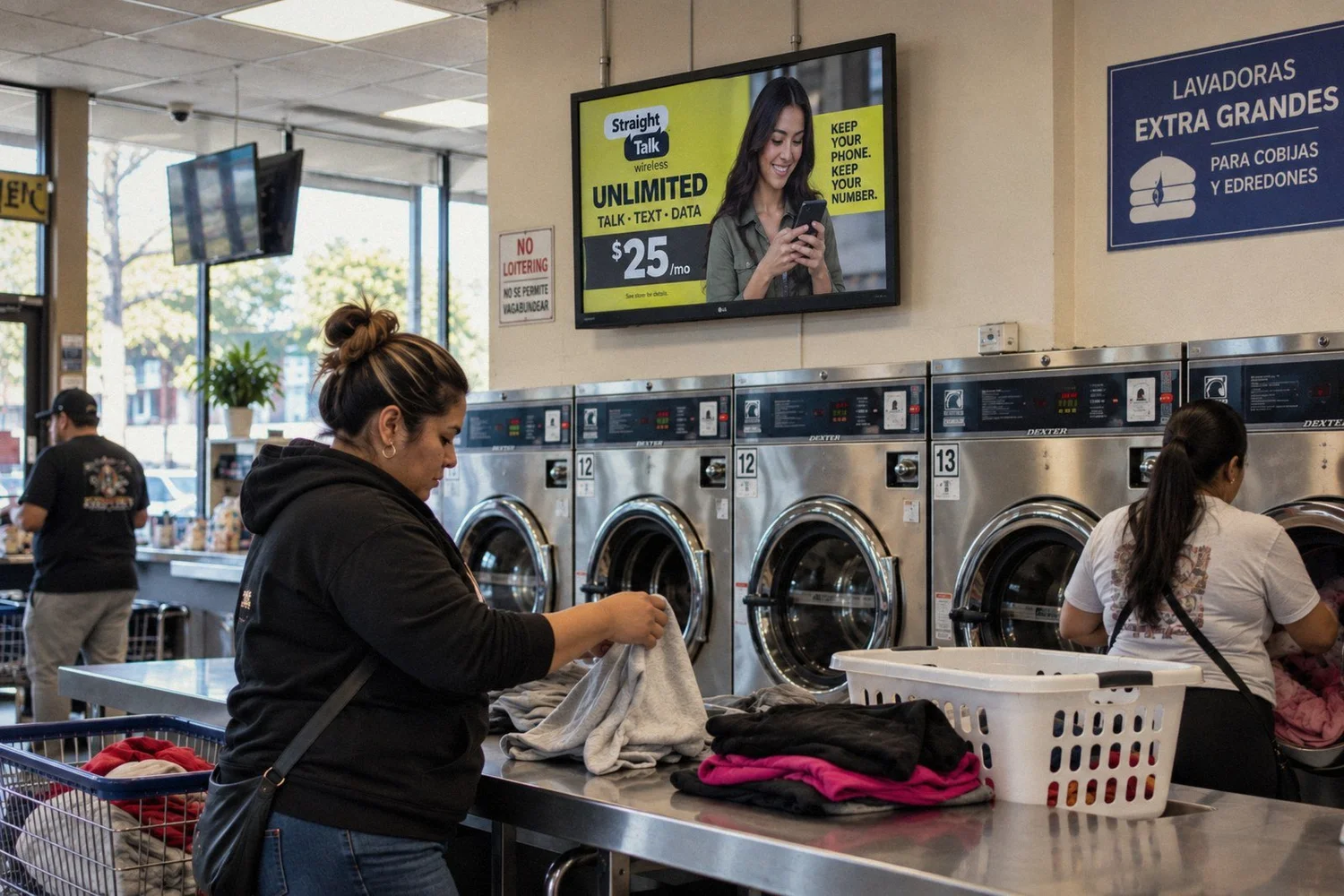
A prepaid wireless offer on a laundromat screen, seen while customers wait out the wash cycle. Laundromats, barbershops and neighborhood stores put a price point in front of people who are already waiting.
- 500,000+ locations
- AAM-audited delivery
- English, Spanish + 15 more languages
- Fully managed
OOH & DOOH Advertising Strategies for Prepaid Carriers and MVNOs
Audience Strategy
Multicultural Audience Strategy
Multicultural advertising should weigh audience, environment, language, and creative together, rather than translating a general-market ad.
Hispanic and Latino households: neighborhood markets, laundromats, convenience stores, community centers, and Spanish-language urban panels. See Hispanic advertising.
Black communities: barbershops and salons, neighborhood grocery and convenience stores, community centers, and urban panels. See Black, Indigenous, and people of color (BIPOC) advertising.
Asian American and immigrant communities: ethnic grocery stores, cultural venues, and in-language placements in specific ZIP codes. See Asian American advertising.
PlaceBased Media Planning Guide
Prepaid wireless advertising works best near the moment someone decides to switch: at the gas station, the neighborhood grocery store, the sidewalk outside a phone store, and the laundromat or barbershop. Place-based out-of-home (OOH) and digital out-of-home (DOOH) media put prepaid carrier and mobile virtual network operator (MVNO) offers there, in the customer's language.
The Opportunity
Prepaid wireless is won one neighborhood at a time.
National TV, streaming, and social can tell a market that a low-cost plan exists. They can't always reach the value-minded shopper who is three blocks from a store, standing at a pump, or waiting on a dryer.
Prepaid customers also switch more often. One national carrier's mid-2026 filing reported average monthly churn of 3.59% for core prepaid customers versus 0.92% for postpaid phones, nearly four times higher (company filing with the U.S. Securities and Exchange Commission (SEC)). The brand a shopper sees in the neighborhood each week is the one that comes to mind when it's time to change plans.
This guide gives prepaid carriers, MVNOs, and their agencies a practical framework for audience, venues, language, timing, targeting, budget, and measurement.
Campaign Strategy
Common Prepaid Wireless Advertising Objectives
Switching and Acquisition
Reach shoppers where your coverage, price, and retail footprint give you an edge.
Bring Your Own Phone and Porting
"Keep your phone and number" is a simple message that works at a glance.
Device and Plan Promotions
Support price points and limited-time deals with digital creative that can change quickly.
Retail and Dealer Traffic
Drive visits to company stores and authorized dealers in their trade areas.
Multicultural Market Growth
Build familiarity in Hispanic, Black, Asian American, and immigrant communities with in-language creative.
Brand Presence Between Promotions
Stay familiar in priority neighborhoods so the brand is top of mind when a customer is ready to switch.
Audience
Who Prepaid Wireless Customers Are
Public data on prepaid users specifically is limited, but related indicators point to the audiences many prepaid brands serve: value-seeking, credit-cautious, multicultural, younger, and mobile-first.
- 01Many rely on their phone for internetIn 2026, 16% of U.S. adults were "smartphone dependent," with a smartphone but no home broadband. The rate was 29% in households earning under $30,000, 24% for adults ages 18 to 29, 23% for Hispanic adults, and 19% for Black adults (Pew Research Center).
- 02Many don't use traditional banking or creditIn 2023, 4.2% of U.S. households were unbanked, 14.2% were underbanked, and 15.7% had no access to mainstream credit (Federal Deposit Insurance Corporation (FDIC)). No-credit-check, pay-as-you-go plans fit these households.
- 03Unbanked rates are higher in some communities10.6% of Black households and 9.5% of Hispanic households, compared with 1.9% of White households (FDIC).
- 04Hispanic consumers are a large, young marketThe U.S. Hispanic population reached 70.1 million in 2025, 21% of the country, with a median age of 31.1 (U.S. Census Bureau), versus 39.4 nationally (U.S. Census Bureau).
- 05Immigrant households are a growing shareThe foreign-born population reached a record 50.2 million in 2024, 14.8% of U.S. residents (U.S. Census Bureau), and more than one in five residents age 5 and older speak a language other than English at home (U.S. Census Bureau).
Planning principle: "Prepaid customer" isn't one audience. A bilingual family, a college student, and a cash-paying worker on a rural route need different venues and creative.
Place-Based Strategy
Why Place-Based Media Works for Prepaid Wireless
Closer to Purchase
Prepaid plans are often bought, refilled, or switched in person. Place-based media reaches shoppers near the stores and dealers that sell them.
Reaches Mobile-First Audiences Offline
A screen or poster in a familiar place reaches phone-reliant customers without competing for space on the phone itself.
Repeat Exposure
People return to the same gas station, grocery store, laundromat, and barbershop every week, building familiarity.
Local Precision
Plan by designated market area (DMA), ZIP code, store trade area, language, and venue instead of buying a whole market.
Static + Digital Flexibility
Static keeps a price point visible all flight. Digital rotates offers and languages.
Planning Framework
How to Plan a Prepaid Wireless OOH & DOOH Campaign
1
Define the objective: switching, porting, a promotion, store traffic, or brand.
2
Prioritize geography: start where coverage, retail presence, and audience overlap, then map store trade areas.
3
Select the right venues: match them to the audience and the path to purchase.
4
Plan language early: decide which markets, ZIP codes, or venues need Spanish, bilingual, or other in-language creative.
5
Match format to timing: static for steady visibility, DOOH for time-sensitive offers.
6
Plan measurement early: set up test markets, QR codes, and promo codes before launch.
Venue Strategy
Best OOH & DOOH Venues for Prepaid Wireless Advertising
| Venue Type | Planning Role | Why It Matters |
|---|---|---|
| Gas stations and convenience stores | Everyday, purchase-adjacent reach | 29,000+ gas stations in our network, with pump-top, in-store, and gas station TV. Many convenience stores also sell prepaid phones and refills. |
| Grocery stores | High-frequency household reach | Weekly trips, including neighborhood and ethnic grocers. |
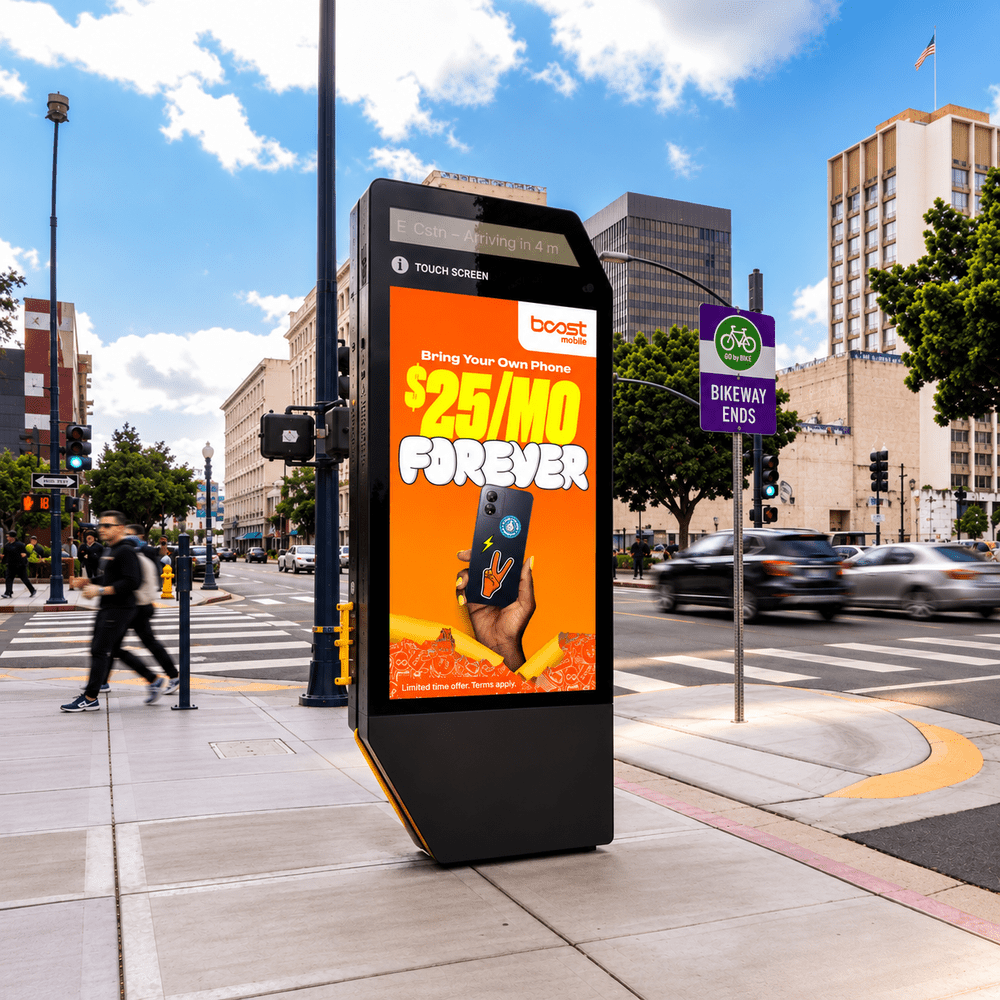
| Urban panels | Street-level metro awareness | Eye-level static and digital panels near transit, shopping districts, and phone stores. |
| Multicultural venues | Community-level trust | Neighborhood businesses, cultural venues, and ethnic retail. |
| Laundromats | Long, repeat dwell time | Customers wait through wash and dry cycles, often weekly. A strong fit for Hispanic and immigrant neighborhoods. |
| Barbershops and salons | Trusted community hubs | Long visits and word of mouth, especially in Black-owned neighborhood businesses. |
| Bars and restaurants | Adult social reach | High-dwell leisure time for adults 21+. |
| Colleges | Younger, budget-minded adults | Students choosing their own plan for the first time. |
| Community centers | Family and neighborhood reach | Families, young athletes, and seniors on weekly visits. |
| Mobile extension | Carry the offer onto the phone | QR codes and location-based mobile ads extend the same message to the device. |
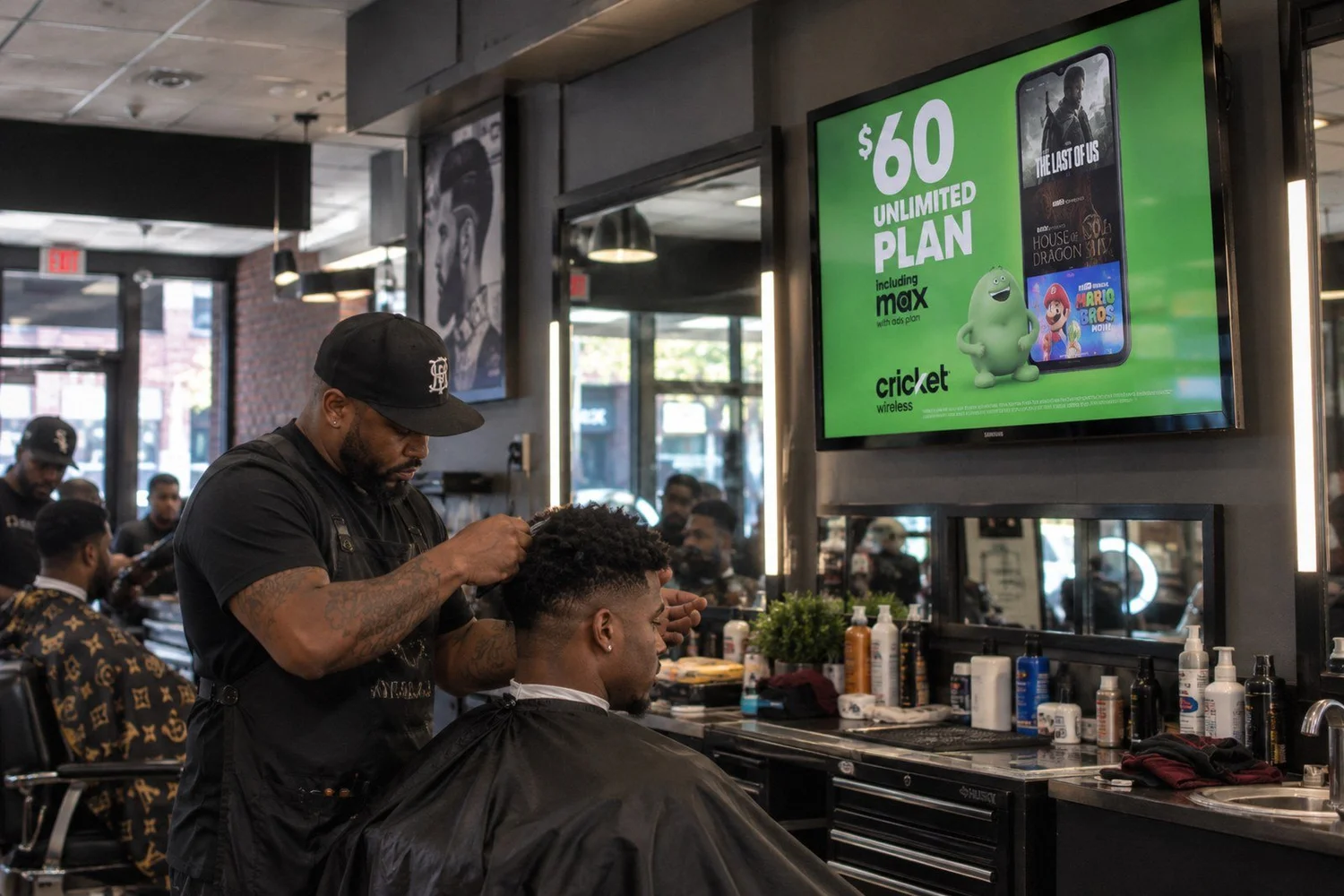
A wireless plan ad on a barbershop screen. Barbershops and salons are trusted neighborhood hubs where customers spend real time. Example shown for illustration.
Creative Strategy
In-Language Creative
Choose language by place
Assign Spanish, bilingual, or English creative by market, ZIP code, or venue.
Rotate languages on digital
DOOH screens can run English and Spanish versions in the same loop.
Go beyond Spanish
We produce creative in English, Spanish, and 15 more languages.
Adapt, don't just translate
"Keep your number" or "no credit check" should read naturally in each language, with real people and places.
Timing
Seasonality and Planning Windows
| Window | Why It Matters | Planning Approach |
|---|---|---|
| Tax refund season (February–April) | Refunds fund upgrades and switching. Through early May 2026, the Internal Revenue Service (IRS) issued 99.1 million refunds averaging $3,276 (IRS). | Lock inventory in December–January. Lead with device and switch offers. |
| Back-to-school (July–September) | Families add lines; students set up their own plans. | Pair family neighborhoods with colleges. |
| Fall device launches | New phones arrive and older models drop in price. | Keep DOOH flexible so offers can change. |
| Holidays (November–December) | Gifting and year-end deals. | Book early; rotate holiday creative. |
| Always-on | Prepaid shoppers are in the market all year. | Keep a baseline in priority ZIP codes between bursts. |
Lifeline and ACP: The Affordable Connectivity Program (ACP) ended June 1, 2024, and the Federal Communications Commission (FCC) warns consumers about marketing that still advertises it (FCC), so leave ACP out of creative. Lifeline remains active, with up to $9.25 a month off for eligible households, or up to $34.25 on Tribal lands (FCC). The FCC proposed Lifeline reforms in February 2026 (FCC), so confirm current rules before running Lifeline messages.
Targeting
Targeting: DMA, ZIP Code, Language, and Venue
DMA
where coverage, distribution, and growth goals align.
ZIP code or trade area
neighborhoods with the right audience and nearby places to buy.
Language
which areas and venues need in-language creative.
Venue
places the audience visits often enough to see the message more than once.
Budget
How Much Should a Prepaid Wireless Place-Based Campaign Cost?
Market size, number of DMAs, venue mix, formats, flight length, and production all affect cost. Fund each priority market well before adding more. The ranges below are illustrative planning ranges for consumer venue types.
| Campaign Scope | Approximate Planning Range |
|---|---|
| Focused local market test | $15,000–$25,000 |
| Targeted DMA presence | $25,000–$50,000 |
| Competitive single-DMA campaign | $50,000–$100,000 |
| Market-saturation strategy | $100,000–$250,000+ |
| Multi-market expansion | Custom |
These are planning ranges, not fixed pricing.
Industry CPM Benchmarks
Solomon Partners' 2025 cost per thousand impressions (CPM) comparison, published by the Out of Home Advertising Association of America (OAAA), estimates (OAAA):
| Media Type | Illustrative CPM |
|---|---|
| OOH bulletins | $3–$10 |
| OOH posters | $3–$13 |
| Digital place-based | $7–$16 |
| Transit shelters | $2–$8 |
| Social media | $2–$8 |
| Digital display | $5–$6 |
| Radio | $4–$8 |
| Digital video | $11–$13 |
| Streaming | $23–$34 |
| Broadcast TV, primetime | $45–$49 |
Why CPM alone can be misleading: For prepaid wireless, being near a store, the right language, and weekly repetition in the right ZIP codes can matter more than the lowest cost per thousand.
Flight Length
How Long Should a Prepaid Wireless Campaign Run?
| Campaign Type | Planning Approach | Primary Consideration |
|---|---|---|
| Price or device promotion | Short flights matched to the offer | Use DOOH where offers change. |
| New market or store launch | Approximately 4–8+ weeks | Build frequency around the location. |
| Seasonal push | Approximately 4–12 weeks | Start before the season peaks. |
| Brand and switching | Longer or always-on | Shoppers can switch any month. |
Sample Plan
Prepaid Wireless Media Plan Example
A hypothetical $50,000 single-DMA switching campaign aimed at value-minded and Hispanic households:
| Allocation | Media Category | Example Environments |
|---|---|---|
| 35% | Gas stations and convenience stores | Pump-top and in-store in priority ZIP codes |
| 25% | Multicultural community venues | Laundromats, barbershops, neighborhood grocers |
| 20% | Urban panels and DOOH | Rotating English and Spanish near transit and phone stores |
| 10% | Grocery stores | Family neighborhoods |
| 10% | Mobile extension and testing | QR follow-up and test cells |
This is illustrative, not a recommended allocation for every campaign.
Creative
Prepaid Wireless OOH Creative Best Practices
- Lead with one offera price, "keep your number," or "no credit check."
- Keep the hero line to seven words or fewerso it reads in seconds.
- Use one clear actionscan, visit a store, or text, with a QR code or vanity URL for tracking.
- Design for the environmenta laundromat screen allows more detail than a sidewalk panel.
- Keep offers and disclosures currentand leave time for legal review.
Measurement
How to Measure a Prepaid Wireless OOH Campaign
| Metric | What It Helps Measure |
|---|---|
| Impressions and location count | Delivery and footprint |
| Proof of performance | Time-stamped, geo-tagged photos and reports showing placements ran |
| Geo-lift | Activations, port-ins, or sales in campaign areas versus similar areas without media |
| QR codes and promo codes | Response and redemptions by venue, language, or creative |
| Store-visit attribution | Aggregated, privacy-safe location data on store visits by exposed audiences |
| Branded search | Lift in branded demand in campaign markets |
Checklist
Prepaid Wireless OOH Planning Checklist
- Is the primary objective clear?
- Who is the audience, and what languages do they speak?
- Which DMAs, ZIP codes, and trade areas matter most?
- Which venues are close to places to buy?
- Is the offer readable at a glance, with terms reviewed?
- Static, digital, or both?
- Is each market funded before adding more?
- Is the flight long enough to build frequency?
- Are test markets, QR codes, and promo codes set up?
- Is there enough lead time for seasonal windows?
FAQ
About PlaceBased Media
PlaceBased Media helps advertisers and agencies reach priority audiences through out-of-home and place-based media. Many media companies specialize in impressions. We specialize in impact. Prepaid wireless plans can combine static OOH, digital OOH, gas stations, grocery, urban panels, multicultural venues, colleges, and mobile, all as a fully managed service.
Next Steps
Planning a Prepaid Wireless Campaign?
Tell us your markets, audience, and offer. We'll come back with venue recommendations, a location list, and an honest read on what your budget can do.
Independent Verification. Greater Accountability.
PlaceBased Media uses independent auditing and proof-of-performance practices to strengthen campaign accountability. AAM recently featured our approach to verified campaign delivery, transparency and building advertiser trust.
Read the AAM Media Matters Feature →
Frequently Asked Questions
01How much does prepaid wireless OOH advertising cost?
Place-based campaigns typically range from about $15,000 for a focused local test to $250,000 or more for market saturation, with custom budgets for multi-market programs. These are planning ranges, not fixed pricing.
02What is a typical CPM for place-based media?
Industry estimates put digital place-based media at about $7–$16 per thousand impressions and OOH posters at about $3–$13. Weigh CPM alongside audience fit, location, language, and frequency.
03Which venues work best for prepaid wireless?
Gas stations and convenience stores, grocery stores, urban panels, multicultural venues, laundromats, barbershops and salons, and colleges are strong starting points.
04Can we target specific neighborhoods or ZIP codes?
Yes. Campaigns can be planned by DMA, ZIP code, store trade area, language, and venue type.
05Can campaigns run in Spanish and other languages?
Yes. We produce creative in English, Spanish, and 15 more languages, assigned by market, ZIP code, or venue, or rotated on digital screens.
06When should prepaid wireless campaigns run?
Tax refund season, back-to-school, fall device launches, and the holidays are key windows. Many brands also keep a baseline presence between bursts.
07How do we measure results?
Combine proof of performance with geo-lift, QR codes, promo codes, store-visit attribution, and branded search, comparing campaign markets with similar markets without media.
08Can place-based media promote Lifeline offers?
Yes, but confirm current FCC Lifeline rules first. The Affordable Connectivity Program ended in June 2024 and should not appear in creative.
09Do you work with agencies?
Yes. We work directly with brands or alongside your agency of record. About Us
Pair it with
Multicultural
In-language, in-culture, in-neighborhood.
Explore multicultural →Grocery stores
Entrance, aisle, cart and checkout.
Explore grocery stores →Urban panels
Eye-level street displays in dense neighborhoods.
Explore urban panels →Gas stations
Pump toppers, gas station TV and c-store screens.
Explore gas stations →DOOH
Digital screens across every venue type.
Explore DOOH →