Originally published April 18, 2024. Updated July 29, 2026.
Public health advertising uses paid media, strategic messaging, and community outreach to raise awareness, influence behavior, and connect people with essential health resources.
Unlike traditional brand advertising, public health campaigns often need to overcome stigma, misinformation, limited healthcare access, distrust, language barriers, and low awareness. They may also need to reach populations that are difficult to engage through digital media alone.
The strongest campaigns do more than distribute information. They identify a specific audience, define the desired action, develop culturally relevant messaging, and place that message in environments where people are most likely to notice, trust, and act on it.
PlaceBased Media helps government agencies, healthcare organizations, nonprofits, and advertising agencies execute public health out-of-home (OOH) and digital out-of-home (DOOH) campaigns across more than 300 U.S. markets. Campaign messaging can be placed inside clinics, schools, colleges, pharmacies, grocery stores, community centers, libraries, nightlife venues, multicultural businesses, military and veteran locations, and other trusted community environments.
This guide explains how public health advertising works, what makes campaigns effective, how OOH and DOOH support behavior change, how to select venues, and how campaign results can be measured.
What Is Public Health Advertising?
Public health advertising is the strategic use of paid media to promote behaviors, services, and resources that improve individual or community health.
These campaigns may be developed by:
Federal agencies
State and local health departments
Healthcare systems
Universities
Nonprofit organizations
Community coalitions
Public health foundations
Advertising agencies working on behalf of government clients
Private organizations supporting a public-health objective
Public health advertising can address nearly any health or safety issue, including:
Mental health and suicide prevention
988 Suicide & Crisis Lifeline awareness
Opioid overdose prevention
Naloxone education
Fentanyl awareness
Tobacco cessation
Youth vaping prevention
Vaccination
Maternal and infant health
WIC and Medicaid enrollment
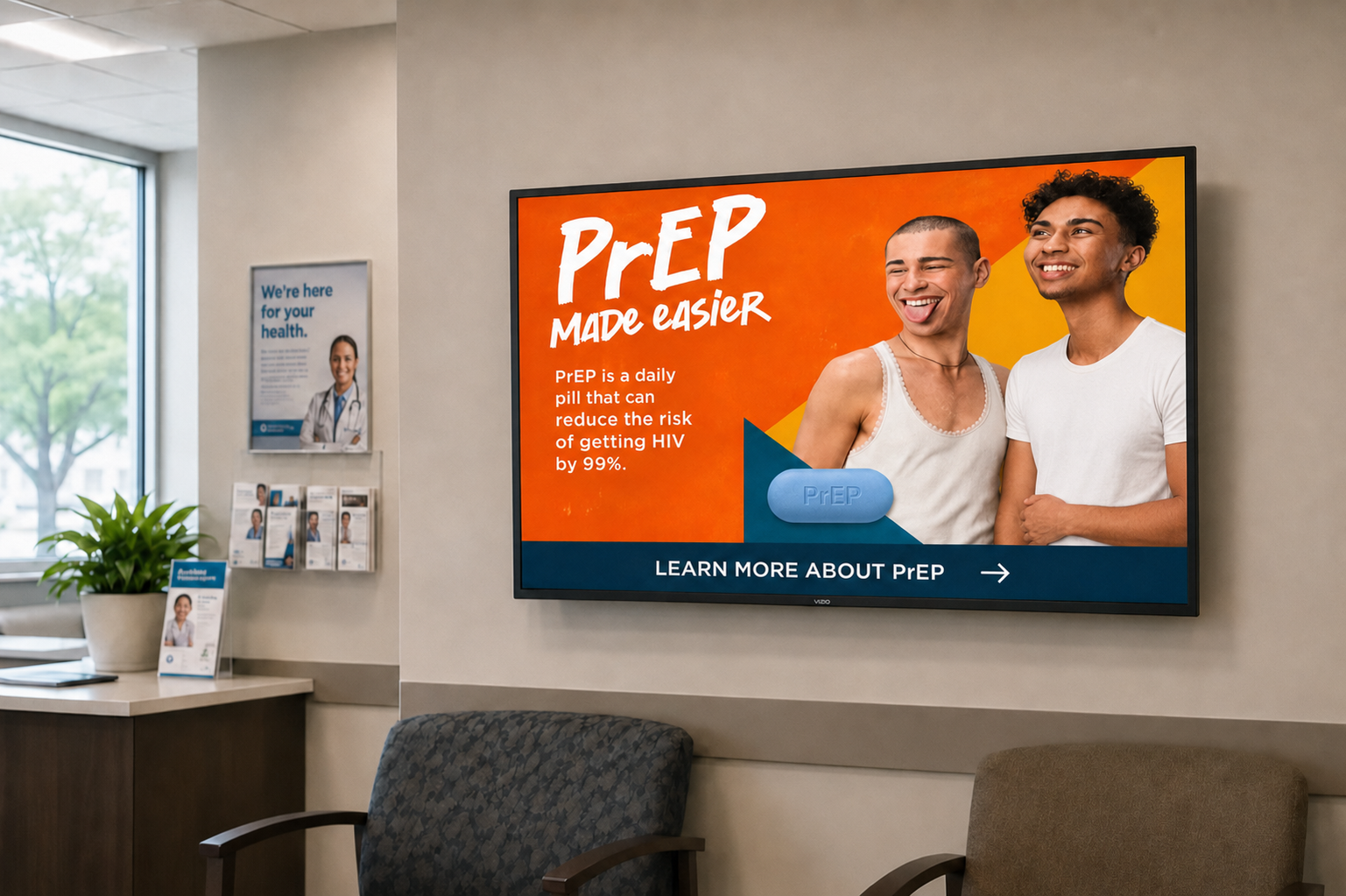
Sexual health and HIV prevention
Chronic disease prevention
Nutrition and physical activity
Health insurance enrollment
Safe firearm storage
Impaired-driving prevention
Environmental health
Emergency preparedness
A public health campaign may seek to introduce a resource, change an individual behavior, reduce stigma, correct misinformation, or shift a broader social norm.
Most campaigns combine more than one of these objectives. For example, a 988 campaign must first make people aware of the number, but it must also make them comfortable using it. A naloxone campaign may educate people about overdose risk while encouraging them to locate, carry, and administer naloxone.
Public Health Advertising vs. Public Health Marketing
The terms public health advertising and public health marketing are related, but they are not exactly the same.
Public health marketing is the broader strategy. It can include audience research, message development, community partnerships, media planning, public relations, outreach, events, program design, and evaluation.
Public health advertising is the paid-media component of that strategy. It distributes campaign messages through channels such as:
Television
Radio
Print
Search advertising
Social media
Connected television
Traditional OOH
Place-based OOH
Digital out-of-home
Point-of-care media
Advertising gives a public health organization control over where, when, and how often its message appears. Marketing ensures that the message, audience, media channels, community partnerships, and campaign objectives work together.
Organizations developing a campaign from the ground up can also use our complete guide on how to plan a public health campaign.

Why Public Health Campaigns Require a Different Approach
Commercial advertising generally encourages someone to choose a brand or purchase a product. Public health advertising often asks people to do something more difficult.
A campaign might ask someone to:
Admit they need help
Change a long-standing habit
Discuss a stigmatized subject
Get tested or screened
Call a crisis line
Carry naloxone
Quit an addictive substance
Vaccinate themselves or their child
Trust a healthcare institution
Find and use a government service
These actions can be influenced by fear, addiction, stigma, cultural beliefs, transportation, healthcare access, language, cost, mistrust, or simple lack of awareness.
That is why public health advertising cannot rely on reach alone. It must combine reach with relevance, repetition, credibility, accessibility, and a clear next step.
What Makes Public Health Advertising Effective?
Although every campaign is different, effective public health advertising generally shares six characteristics.
1. A specific behavioral objective
“Raise awareness about opioids” is a broad topic. “Encourage friends and family members of people who use opioids to carry naloxone” is a behavioral objective.
The second objective makes it easier to determine the audience, message, call to action, media placement, and measurement strategy.
Before developing the campaign, define what people should know, feel, or do after encountering the message.

2. A clearly defined audience
Age and location are useful, but they rarely provide enough information by themselves.
Strong audience planning may also consider:
Cultural background
Language
Income
Insurance status
Caregiver status
Health risks
Readiness to change
Healthcare access
Rural or urban location
Trusted community institutions
Places the audience visits regularly
A campaign targeting college students experiencing mental-health challenges requires a different message and venue plan than one targeting older rural adults managing chronic conditions.
PlaceBased develops audience-focused campaigns for populations including youth and teenagers, Hispanic and Latino communities, LGBTQ+ audiences, military members and veterans, and rural communities.
Evidence That Public Health Advertising Can Change Behavior
Public health media campaigns have demonstrated measurable effects when they combine compelling creative, sufficient reach, sustained frequency, and an accessible resource.
The CDC’s Tips From Former Smokers campaign is one of the most extensively evaluated examples. According to the CDC’s campaign-impact findings, the campaign was associated with more than 16.4 million quit attempts and approximately one million successful quits between 2012 and 2018. The CDC also estimates that the campaign helped prevent 129,000 early deaths and saved $7.3 billion in smoking-related healthcare costs during that period.
Youth tobacco-prevention campaigns also demonstrate the power of sustained public education. Truth Initiative reports that youth cigarette smoking dropped from nearly 23% in 2000 to 2.3% in 2021. Policy changes, public education, prevention programs, and campaigns such as truth all contributed to this broader decline.
These examples reinforce an important lesson: an advertisement is most effective when it is part of a sustained strategy—not a single placement or isolated message.
Public Health Advertising Channels
No single media channel is right for every campaign. Channel selection should reflect the audience, geography, campaign objective, budget, and desired action.
Digital and social media
Search, display, video, and social media can provide precise targeting, rapid optimization, and measurable engagement. These channels are especially useful when an audience is digitally active and the campaign has a strong online destination.
However, digital-only campaigns may miss people with limited internet access, low digital literacy, ad blockers, fragmented media habits, or little trust in online advertising.
Television, radio, and print
Traditional media can build broad regional awareness and lend legitimacy to a campaign. Television and radio can be especially valuable during statewide launches, seasonal health initiatives, and urgent public information efforts.
These channels may be less precise when a campaign needs to reach a narrow population or a limited set of high-priority communities.
Traditional out-of-home advertising
Billboards, transit advertising, and other traditional OOH formats provide broad geographic visibility and repeated exposure. They are effective for simple messages, short calls to action, and high-level awareness.
Place-based OOH and DOOH
Place-based OOH delivers messages inside specific environments selected because of the audience, context, or behavior associated with the location.
Examples include posters, brochures, standees, digital displays, window clings, counter cards, pharmacy materials, table tents, and other formats placed inside:
Healthcare facilities
Schools
Colleges
Pharmacies
Grocery stores
Libraries
Community centers
Recreation facilities
Nightlife venues
Multicultural businesses
Veteran organizations
Workforce centers
Rural community locations
Digital out-of-home advertising can also allow messaging to be updated by location, audience, language, season, or campaign phase.
Why Place-Based OOH Matters in Public Health
Place-based OOH fills the space between mass media and individual outreach. It allows campaigns to reach specific audiences at scale without depending on personal health data, online tracking, or individual digital identifiers.
Its value comes from context. A vaccination message inside a pharmacy appears when someone is already thinking about health. A 988 poster in a high school can provide immediate, confidential support information where students see it repeatedly. A WIC message in an OB-GYN office or grocery store reaches families at key healthcare and shopping moments.
Place-based media can support public health campaigns in several ways:
It reaches people during relevant moments
The environment gives the message additional meaning. Health information delivered in a clinic, pharmacy, school, or community organization is connected to what the audience is already doing or considering.
It extends campaigns beyond the digital divide
Physical placements can reach people regardless of whether they use social media, have reliable broadband, accept cookies, own a smartphone, or fall within a digital advertising platform’s targeting data.
It supports health equity
Campaigns can prioritize ZIP codes, counties, rural regions, healthcare-access points, Title I schools, FQHCs, multicultural businesses, Tribal communities, or other locations serving populations experiencing health disparities.
It creates sustained local visibility
Posters, digital screens, and educational displays can remain visible throughout the campaign, creating repeated exposure among employees, patients, students, customers, caregivers, and community members.
It can connect offline exposure with online action
QR codes, vanity URLs, short codes, text lines, and call tracking can turn a physical placement into a measurable response channel.
For a closer look at this approach, read why place-based OOH is valuable for government health campaigns.
Choosing Venues by Public Health Topic
The best venue is not always the location with the highest overall traffic. It is the environment where the intended audience is naturally present and the message is contextually appropriate.
Mental health and 988 awareness
Effective venues may include:
High schools
Colleges and universities
Behavioral-health clinics
Primary-care practices
Community centers
Libraries
LGBTQ+ venues
Veteran Service Organizations
Military locations
Pharmacies
Coffee shops
Rural community locations
Sensitive mental-health messaging benefits from trusted environments and repeated exposure. Campaign creative should be approachable, supportive, and easy to act on.
Overdose prevention, fentanyl awareness, and naloxone education
Potential venues include:
Community health centers
FQHCs
Behavioral-health clinics
Pharmacies
Colleges
Community centers
Workforce centers
Nightlife venues
Multicultural locations
Tribal communities
Rural health facilities
Campaigns may need separate creative for people at risk of overdose, friends and family members, healthcare patients, young adults, or community members who can carry naloxone.
Tobacco and youth-vaping prevention
Relevant environments may include:
Community and recreation centers
School athletic facilities
Gas stations and convenience stores
Healthcare facilities
Pharmacies
Youth-serving organizations
The creative may focus on prevention, quitting resources, social norms, flavored-product awareness, or the health effects of nicotine use.
Maternal health, WIC, and family services
Relevant venues may include:
OB-GYN practices
Pediatric clinics
Family-practice offices
Community health centers
Daycares
Pharmacies
Libraries
Community organizations
Multicultural businesses
These settings can reach expectant mothers, parents, caregivers, and families during moments connected to nutrition, healthcare, and household decisions.
Vaccination and preventive care
Potential venues include:
Primary-care practices
Pediatricians
Pharmacies
Urgent-care facilities
Senior centers
Grocery stores
Community centers
Colleges
Multicultural venues
Rural healthcare locations
Point-of-care advertising can be especially useful when the campaign seeks to encourage patients to discuss vaccination, screening, or preventive care with a provider.
Sexual health and HIV prevention
Potential venues include:
LGBTQ+ venues
Nightlife locations
Colleges
Community health centers
Primary-care practices
Pharmacies
Multicultural businesses
Community organizations
Messaging should be inclusive, confidential, culturally relevant, and free of judgment.
Chronic disease and healthy-lifestyle campaigns
Potential locations include:
Clinics
Pharmacies
Grocery stores
Fitness centers
Senior centers
Libraries
Community and recreation centers
Multicultural businesses
Campaigns can reinforce screening, nutrition, physical activity, medication adherence, and condition-management resources in environments connected to those behaviors.
Learn more about community and recreation center advertising and the role these trusted facilities can play in health education and outreach.
Public Health Advertising Case Studies
Real-world campaigns demonstrate how audience, location, creative, and media format can work together.
988 Suicide & Crisis Lifeline awareness
PlaceBased Media supported a statewide campaign designed to increase awareness of the 988 Suicide & Crisis Lifeline among adults, young adults, veterans, underserved communities, and individuals seeking healthcare or behavioral-health services.
Messaging appeared across healthcare facilities, behavioral-health clinics, colleges, libraries, community centers, pharmacies, LGBTQ+ venues, Veteran Service Organizations, and neighborhood businesses. Static and digital formats reinforced the message across multiple community touchpoints.
View the 988 Suicide & Crisis Lifeline campaign case study.
Youth 988 awareness
A youth-focused 988 campaign reached teenagers, college students, parents, and educators through schools and trusted community environments.
Placements included posters, digital displays, and table tents inside high schools, colleges, healthcare facilities, libraries, behavioral-health clinics, community centers, and coffee shops. The campaign used repeated exposure to normalize mental-health conversations and make 988 easier to remember before or during a crisis.
View the Youth 988 Awareness Campaign case study.
SAMHSA-funded naloxone education and fentanyl awareness
PlaceBased Media executed a national place-based campaign delivering naloxone education, fentanyl awareness, and overdose-prevention messaging across healthcare, education, community, cultural, and specialty environments.
The strategy reached people at risk of overdose, friends and family members, rural communities, college students, LGBTQ+ audiences, American Indian and Native American communities, healthcare patients, and people seeking community services.
Placements included community health centers, FQHCs, behavioral-health clinics, urgent-care facilities, pharmacies, colleges, community centers, workforce-development locations, LGBTQ+ nightlife venues, multicultural businesses, and reservation-based communities.
View the SAMHSA Naloxone Education & Fentanyl Awareness Campaign case study.
Explore more public health advertising case studies
Measuring Public Health Advertising Results
Public health measurement should move from delivery to engagement and, when possible, to behavior.
Media-delivery metrics
These confirm whether the campaign was executed as planned:
Locations activated
Markets, counties, and ZIP codes reached
Campaign flight dates
Estimated impressions
Audience and venue distribution
Languages deployed
Media formats installed
Proof-of-posting photographs
Added-value placements
Replacement or venue-approval records
Engagement metrics
These indicate whether exposure generated interest:
QR-code scans
Landing-page visits
Custom URL traffic
Text-message activity
Resource downloads
Social engagement
Search lift
Event registrations
Behavioral and program outcomes
These connect the campaign to the intended public-health action:
Hotline calls
Screening appointments
Vaccination appointments
Naloxone pickups
Quitline activity
WIC or Medicaid enrollment
Treatment-locator usage
Resource requests
Changes in awareness or intent
Community partner feedback
Not every campaign can demonstrate direct attribution. Public health outcomes are often influenced by several programs and media channels simultaneously. The goal is to choose a credible combination of metrics that reflects the campaign’s objective and available data.
Frequently Asked Questions About Public Health Advertising
What is the purpose of public health advertising?
Public health advertising raises awareness, shares credible information, connects people with services, and encourages behaviors that protect individual and community health. Campaigns can address prevention, treatment, crisis resources, enrollment, screening, health equity, or social norms.
What makes a public health advertisement effective?
An effective advertisement addresses a clearly defined audience, communicates one primary idea, uses culturally appropriate language and imagery, provides a practical call to action, and appears in media channels the audience trusts and uses.
What is place-based public health advertising?
Place-based public health advertising delivers messages inside locations selected for their audience or context, such as clinics, schools, pharmacies, grocery stores, libraries, community centers, nightlife venues, and military or veteran organizations.
What is the difference between OOH and DOOH?
OOH includes physical advertising formats outside the home, such as posters, transit advertising, billboards, and venue signage. DOOH uses digital screens to deliver out-of-home messaging. Place-based campaigns can combine static and digital formats.
How should a public health campaign choose media channels?
Channel selection should be based on the audience’s daily habits, trusted environments, geographic distribution, media consumption, barriers to information, and desired action. Most campaigns benefit from combining digital, traditional, community, and place-based channels.
How long should a public health campaign run?
The appropriate length depends on the objective, geography, budget, media channels, and urgency. Short campaigns can support launches or emergency communication, but campaigns seeking awareness or behavior change generally benefit from sustained exposure and repetition.
Can public health advertising be geographically targeted?
Yes. Place-based OOH and DOOH campaigns can be planned by state, DMA, county, city, ZIP code, neighborhood, venue category, healthcare specialty, school type, language, or audience profile.
How is a place-based campaign verified?
Verification may include venue-level placement records, proof-of-posting photographs, campaign dates, inventory tracking, impression reporting, geographic summaries, replacement logs, and a final campaign report.
Plan Your Next Public Health Campaign
PlaceBased Media helps government agencies, healthcare organizations, nonprofits, and agency partners reach priority audiences through trusted community environments across more than 300 U.S. markets.
Campaigns can be customized by geography, audience, health topic, language, venue type, and media format. Available options include posters, standees, brochures, take-one displays, counter cards, window clings, table tents, pharmacy materials, and digital screens.
Whether your objective is increasing 988 awareness, preventing overdose, promoting vaccination, reaching families eligible for WIC, reducing youth vaping, or supporting another public-health initiative, our team can develop a targeted media plan designed around the people and communities you need to reach.
Contact PlaceBased Media to start planning your public health campaign.
Campaign Spotlight:
One notable example is the "Truth" campaign, launched by the American Legacy Foundation in 2000. This campaign aimed to educate and discourage young people from smoking by exposing the tobacco industry's deceptive practices. Through a combination of powerful visuals, persuasive storytelling, and relatable messaging, the "Truth" campaign successfully reduced smoking rates among teenagers and young adults.
Campaign Spotlight:
Another impactful public health advertising campaign is the "5 A Day" initiative, implemented by the National Cancer Institute in the United States. This campaign sought to increase fruit and vegetable consumption by encouraging individuals to incorporate at least five servings into their daily diet. The "5 A Day" campaign effectively raised awareness about the importance of a healthy diet by utilizing catchy slogans, colorful visuals, and engaging advertisements. It contributed to improved dietary habits across the nation.