The Accountability Gap in Place-Based Advertising
Why Independent Audits Should Be the Industry Standard
Key Facts
AAM-verified delivery: 113.3% and 111% of guaranteed distribution across two consecutive Alliance for Audited Media audits.
Most recent audit: Three-month period ending February 28, 2026 · 345-location Physician Office Patient Education Program.
Network scale: 20,000+ healthcare facilities · 120 healthcare specialty types across 58 specialty groups · 300+ markets.
Typical CPM: $5–$10 in healthcare environments.
Partners include: the U.S. Centers for Disease Control and Prevention (CDC), the Department of Health and Human Services (HHS), the Substance Abuse and Mental Health Services Administration (SAMHSA), the Food and Drug Administration (FDA), Johns Hopkins Medicine, and Coca-Cola.
Place-based out-of-home advertising is entering a new era of accountability. While other media categories — print, broadcast, digital, traditional billboard — have long-established standards for independent verification, third-party distribution audits in place-based OOH have historically been voluntary and uncommon. That is starting to change. PlaceBased Media has now passed two consecutive Alliance for Audited Media (AAM) audits, delivering 113.3% and 111% of guaranteed distribution. This article explains what those numbers verify, why independent audits matter for media planners, public health agencies, and pharmaceutical brands, and where the place-based OOH category is headed on accountability.
The framework already exists. The Alliance for Audited Media has been verifying media distribution claims for nearly a century. AAM audits are independent, methodology-driven, and recognized across publishing and broadcast as the gold standard for accountability. They are voluntary — which is part of why adoption in place-based OOH has been uneven, and part of the opportunity for the category now.
How is verification evolving in place-based OOH?
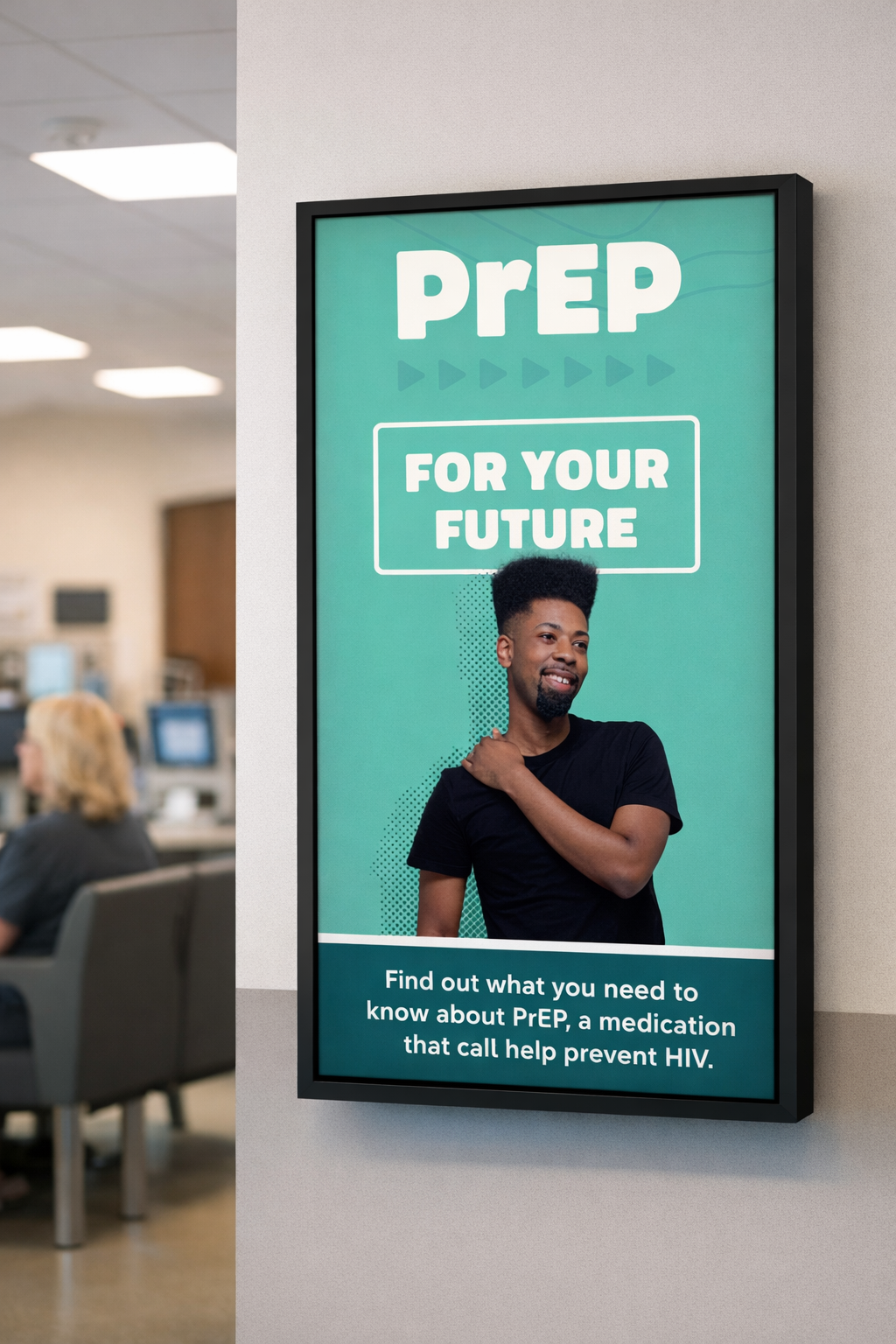
Most place-based OOH campaigns are still sold and reported on a self-attestation basis. A media company tells a buyer their network reaches a specific number of venues — clinics, gas stations, bars, schools, community centers. The buyer signs a contract for distribution to a guaranteed number of those locations. The campaign runs. The media company sends a post-campaign report confirming the campaign delivered as promised. In most cases, no independent third party verifies the result.
Self-attestation has been the default in place-based OOH, in part because the channel has historically been smaller and more relationship-driven than print, broadcast, or digital. As place-based has grown into a multi-billion-dollar category, buyer expectations have grown with it. The data buyers want today — verifiable, defensible, third-party attested — wasn’t routinely produced a decade ago, and the infrastructure to produce it is still being built across the category.
The demands on place-based OOH have evolved. In 2026:
• Federal and state public health agencies are required to demonstrate responsible stewardship of program dollars. The CDC, HHS, SAMHSA, and state health departments need defensible documentation, not vendor dashboards.
• Pharmaceutical brands are subject to MLR review and FDA scrutiny. A distribution claim without third-party verification is a documentation gap that creates risk during regulatory submission.
• CFOs and CMOs at Fortune 500 companies expect the same accountability from OOH partners they get from digital ones.
• Agencies are answering to clients who increasingly require audit trails for every channel in the media mix.
Closing this gap is an immediate priority for buyers who need defensible, third-party-attested numbers — and a near-term opportunity for place-based companies willing to invest in independent verification.
What is an AAM audit, and how does it work?
An AAM audit is an independent, third-party verification of a media company’s distribution claims, conducted by the Alliance for Audited Media. AAM is a nonprofit organization that has independently verified media data for nearly 100 years. Originally founded to audit newspaper and magazine circulation claims, AAM today verifies distribution and audience data across print, digital, and out-of-home media.
An AAM audit is not a self-assessment. It is not a confidence interval calculated from internal records. It is a structured, methodology-driven review by a neutral third party with no financial stake in the outcome.
How an AAM audit works — step by step
1. Audit scope is defined. AAM and the media company specify which program, which time period, and which distribution claim is under review.
2. Source records are examined. AAM reviews invoices, shipping confirmations, venue rosters, distribution logs, photographic evidence, and any other documentation that supports the distribution claim.
3. Delivered distribution is compared to the guarantee. AAM verifies, location by location, what the company committed to deliver against what it actually delivered.
4. An independent statement is issued. AAM publishes a verified statement confirming whether the company met, exceeded, or fell short of its guarantee. The result is a number, not a narrative.
The audit category most relevant to place-based OOH is Print, or Other Non-Fixed Asset with Guaranteed Distribution. This is the AAM classification for media placed in physical venues with a contractually guaranteed number of distribution points — which is exactly how most place-based programs are sold.
What did PlaceBased Media's AAM audits verify?
PlaceBased Media has now passed two consecutive AAM audits of its Physician Office Patient Education Program — the program that places targeted health education materials in physician waiting rooms and exam areas across the country.
AUDIT METHODOLOGY · AT A GLANCE
Auditor: Alliance for Audited Media (AAM), an independent nonprofit verifying media data since 1914.
Program audited: PlaceBased Media’s Physician Office Patient Education Program.
Most recent audit period: Three months ending February 28, 2026.
Most recent guaranteed claim: 345 physician office locations.
Audit category: Print, or Other Non-Fixed Asset with Guaranteed Distribution.
Verified results: 113.3% (most recent audit) and 111% (prior audit) of guaranteed distribution delivered.
Two facts deserve emphasis.
First, exceeding the guarantee is the point. Hitting exactly 100% of a guarantee is the contractual minimum. Exceeding it means buyers received additional reach beyond what they paid for, at no additional cost. For a public health campaign placing condition-awareness materials in clinic waiting rooms, the 13.3% over-delivery in the most recent audit translates directly to additional patient impressions in venues where engagement is uniquely high.
Second, consistency matters more than any single result. A one-time over-delivery could be explained by a favorable quarter, an unusually compliant venue partner, or simple luck. Two consecutive audits — both showing material over-delivery against contractual guarantees — points to something different: an operational process designed to systematically over-deliver, with quality controls strong enough to produce repeatable outcomes.
Repeatability is what buyers actually need. Anyone can have a good quarter. Verified, consistent over-delivery audited by an independent third party is what justifies a long-term media partnership.
What do verified audit results mean for media buyers?
If you are a media planner, a public health program manager, or a brand marketer evaluating place-based OOH partners, the practical implications of an AAM audit are concrete.
For media planners: Verified over-delivery means your media plan went further than the contract obligated. The 11–13% bonus reach is impressions you did not pay for. When you report results to your client, you can cite an independent third-party number rather than a vendor-provided one — a meaningfully stronger position in any client review.
For public health program managers: Federal and state grant reporting increasingly demands evidence of responsible stewardship. AAM-verified distribution data is documentation that holds up to audit, GAO scrutiny, and Congressional inquiry. It is far stronger than a vendor screenshot. For agencies operating under cooperative agreements with the CDC, HHS, SAMHSA, or FDA, this distinction is not cosmetic.
For pharmaceutical brand managers: MLR review committees evaluating place-based or POC media benefit from third-party verification of any distribution claim made in submission materials. AAM-verified data reduces the documentation burden during MLR cycles and provides defensible numbers for post-market reporting.
For agencies and CMOs: When a place-based OOH partner can produce AAM-audited results, the conversation about transparency is over. The numbers are independently verified. The work shifts to strategy and creative, where it should be.
For everyone: Choosing an AAM-audited partner sends a market signal that buyers value accountability. The more buyers ask for AAM verification, the faster the rest of the industry will follow.
How large is PlaceBased Media's place-based network?
Independent verification is most meaningful at scale. The PlaceBased Media network operates across more than 20,000 healthcare facilities in the United States, and the audited Physician Office Patient Education Program is one component of a broader place-based platform spanning 300+ markets.
Network at a glance
• 20,000+ healthcare facilities. Physician offices, specialty clinics, hospitals, urgent care, pharmacies, and allied health environments across all 50 states.
• 120 distinct healthcare specialty types across 58 specialty groups — including oncology and hematology/oncology, endocrinology, OB/GYN, pediatric medicine, psychiatry, infectious disease, cardiology and interventional cardiology, dermatology, gastroenterology, nephrology, neurology, pulmonary disease, rheumatology, and the major surgical sub-specialties.
• Typical CPM range of $5–$10. Place-based media in healthcare environments delivers efficient reach against high-attention audiences.
• 300+ markets covered. Supporting both national programs and regionally targeted public health and disease-state campaigns.
• Free compliance monitoring on every campaign. Independent verification is the headline; ongoing monitoring is the day-to-day discipline that makes verification possible.
The audited program operates within this larger platform, and the AAM verification reflects the operational discipline applied across the network.
Which organizations rely on verified place-based media?
PlaceBased Media partners with leading public health agencies, federal regulators, academic medical centers, and global brands — organizations whose own accountability requirements make verified distribution data especially valuable. Partners include:
• The Centers for Disease Control and Prevention (CDC)
• The U.S. Department of Health and Human Services (HHS)
• The Substance Abuse and Mental Health Services Administration (SAMHSA)
• The U.S. Food and Drug Administration (FDA)
• Johns Hopkins Medicine
• Coca-Cola
These are organizations whose own reporting standards require defensible, independently verifiable data. Their continued investment in place-based OOH at scale signals where the category is headed.
How does accountability compare across media categories?
Other media categories settled the verification question decades ago. Place-based OOH is where the standard is currently developing.
| Media category | Verification standard | Auditor / standard body | Adoption |
|---|---|---|---|
| Circulation audits | AAM (since 1914) | Industry standard | |
| Broadcast TV/radio | Audience measurement | Nielsen, Comscore | Industry standard |
| Digital advertising | Viewability + delivery | MRC accreditation, IAB standards | Widely adopted |
| Traditional billboard OOH | Impression measurement | Geopath | Widely adopted |
| Place-based OOH | Independent distribution audits | AAM (where used) | Voluntary — emerging |
The pattern is clear. Print circulation has been independently audited for nearly a century. Broadcast ratings are measured by independent third parties. Digital advertising has the IAB’s measurement standards, MRC accreditation, and a growing body of viewability and attribution conventions. Even traditional billboard OOH is measured by Geopath. The tools are imperfect, but the principle is settled across the rest of the media landscape: serious media gets independently measured.
Place-based DOOH is where verification standards are still developing. The category has grown faster than its accountability infrastructure, and the question now is how quickly third-party verification will become routine across the industry.
Should independent audits be the place-based OOH industry standard?
Yes. The next two years will likely be a sorting period: place-based companies that move toward independent verification will be best positioned for buyers with serious procurement requirements, and audit-trail expectations are increasingly appearing in RFP language across the category.
The path forward isn’t complicated. AAM audits are available to any place-based OOH company willing to submit to them. The methodology is established. The infrastructure exists. What’s emerging now is the industry-wide commitment to make verification the default rather than the exception.
PlaceBased Media has made its choice. We believe the rest of the industry will move in the same direction — because the place-based category will be stronger, larger, and more credible when buyers can trust the numbers across every vendor in the space.
If you’re a buyer evaluating place-based OOH, independent verification is worth raising in every conversation. Ask each potential partner whether their distribution claims are third-party audited — and what the methodology is. The answer should be specific.
Glossary: key terms in this article
Working definitions used throughout this piece. These align with industry-standard usage across AAM, OAAA, IAB, and trade publications.
AAM (Alliance for Audited Media)
An independent nonprofit organization that has verified media distribution and audience data since 1914. AAM is the recognized third-party auditor across print, digital, and out-of-home media.
Guaranteed distribution
A contractual commitment from a media company to deliver a campaign to a specified number of physical locations within a defined time period. Guaranteed distribution is the foundation of most place-based OOH contracts.
Place-based OOH
Out-of-home advertising in defined physical venues — clinics, schools, gas stations, bars, grocery stores, community centers — with controlled audience characteristics. Distinct from traditional billboard or transit OOH.
Point-of-care (POC) media
Place-based advertising in healthcare environments, including physician offices, clinics, pharmacies, and hospitals. POC media reaches patients and healthcare professionals at the moment of care.
MLR review
Medical, Legal, and Regulatory review. The internal pharmaceutical-industry process for approving marketing materials before publication, with strict requirements for documentation and substantiation.
CPM (cost per thousand)
The standard pricing metric across paid media: the cost an advertiser pays to deliver one thousand ad impressions to a target audience.
Print, or Other Non-Fixed Asset with Guaranteed Distribution
The AAM audit category that applies to media placed in physical venues with a contractually guaranteed number of distribution points — the audit category most relevant to place-based OOH.
Frequently asked questions about AAM audits and place-based OOH
What is an AAM audit?
An AAM audit is an independent, third-party verification of a media company's distribution claims, conducted by the Alliance for Audited Media. AAM examines source records, compares actual delivery to contractual guarantees, and issues a verified statement of performance.
Which place-based OOH companies are independently audited?
Independent third-party audits in place-based OOH are still emerging as a standard. PlaceBased Media is among the companies leading on this front, having passed two consecutive AAM audits with verified delivery of 113.3% and 111% of guaranteed distribution.
Is place-based OOH measurable?
Yes. Place-based OOH is fully measurable. Independent distribution audits (AAM) verify that ads ran where they were promised. Audience measurement (Geopath), brand-lift studies, foot-traffic attribution, and Rx-lift methodologies for healthcare campaigns layer onto verified distribution to measure outcomes.
What does “guaranteed distribution” mean in OOH?
Guaranteed distribution is a contractual commitment from a media company to deliver a campaign to a specified number of physical locations within a defined time period. AAM audits verify whether that guarantee was met, exceeded, or missed.
Why are independent audits important in OOH advertising?
Independent audits convert vendor claims into verifiable facts. For public health agencies, pharmaceutical brands, and Fortune 500 advertisers, verified distribution data is a procurement and compliance requirement, not a nice-to-have.
What is a typical CPM for place-based OOH in healthcare environments?
Typical CPMs in PlaceBased Media's healthcare network fall in the $5 to $10 range, depending on program scope, specialty targeting, and creative execution.
How many healthcare facilities are in the PlaceBased Media network?
The PlaceBased Media network includes more than 20,000 healthcare facilities in the United States, spanning 120 distinct healthcare specialty types across 58 specialty groups.
What healthcare specialties does PlaceBased Media reach?
The network reaches 120 healthcare specialty types across 58 specialty groups, including oncology and hematology/oncology, endocrinology, OB/GYN, pediatric medicine, psychiatry, infectious disease, cardiology and interventional cardiology, dermatology, gastroenterology, nephrology, neurology, pulmonary disease, rheumatology, and the major surgical sub-specialties.
How does place-based OOH accountability compare to other media?
Print, broadcast, digital, and traditional billboard OOH all use independent measurement standards as the default — AAM, Nielsen, MRC accreditation, and Geopath respectively. Independent verification in place-based OOH is voluntary and still emerging — making it the category where verification standards are most actively developing.
Who audits PlaceBased Media's distribution claims?
PlaceBased Media's distribution claims are audited by the Alliance for Audited Media (AAM), an independent nonprofit organization that has verified media data since 1914. AAM is the recognized third-party media auditor across print, digital, and out-of-home advertising.
See what verified place-based OOH can do for your next campaign
Whether you’re planning a national public health initiative, a multicultural awareness campaign, a pharmaceutical brand launch, or a community-level activation, PlaceBased Media delivers reach you can verify and results you can report with confidence.