Point-of-Care Advertising for Pharma: Why the Smartest Brands Are Moving Budgets to Doctor's Office and Clinic Media in 2026
By Cody Cagnina | Published March 2026 | 12-minute read
Pharmaceutical advertising is at a crossroads. With the FDA intensifying enforcement of direct-to-consumer promotional rules, digital privacy regulations tightening, and patients growing numb to banner ads they can scroll past in half a second, pharma media planners are actively searching for advertising channels that are compliant, contextual, and capable of driving real prescription lift.
Point-of-care advertising — the strategic placement of brand messages in doctor's offices, clinics, pharmacies, and other healthcare environments — has emerged as one of the fastest-growing channels in pharmaceutical marketing. The Point of Care Marketing Association reported that POC spending recently crossed the $1 billion milestone, with member sales increasing 171% between 2019 and 2023. And pharma OOH spending overall grew 21% year-over-year from January through August 2025.
This isn't a niche tactic anymore. It's a core component of the modern pharma media plan.
This guide breaks down how point-of-care advertising works for pharmaceutical brands, why it outperforms other channels on the metrics that matter most, and how to build a POC strategy that reaches patients and healthcare professionals at the moments when medical decisions are actually being made.
What Is Point-of-Care Advertising?
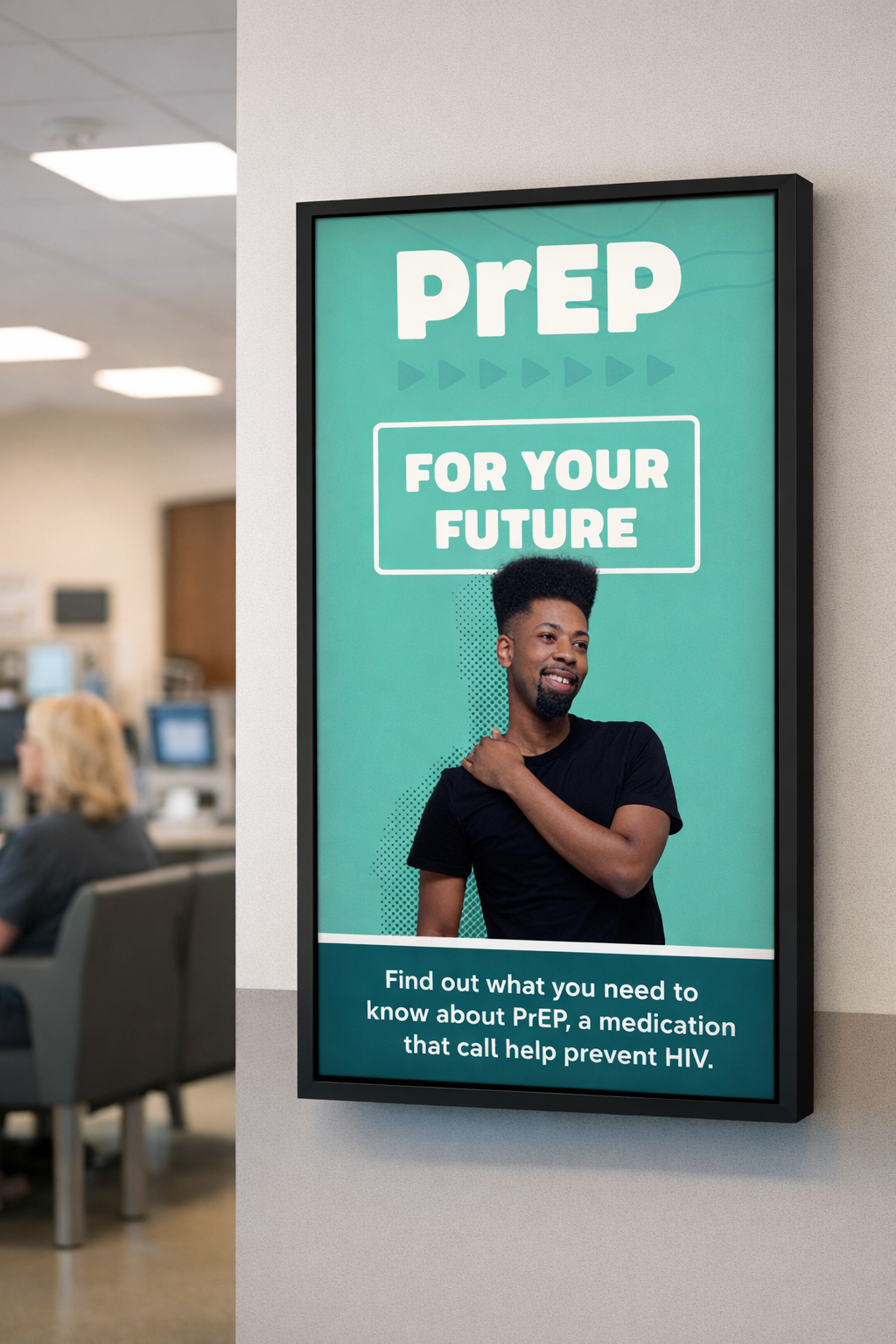
Point-of-care advertising refers to any marketing message delivered within a healthcare setting where patients receive medical services or make health-related decisions. This includes doctor's offices, outpatient clinics, hospitals, pharmacies, urgent care centers, specialty practices, and behavioral health facilities.
Unlike traditional OOH formats like billboards or transit ads, point-of-care placements are defined by their clinical context. Patients encounter these messages while they're already thinking about their health, waiting for a provider, or preparing to discuss treatment options. That context is what makes POC uniquely powerful for pharmaceutical brands — the audience is primed for health information at the exact moment it's most relevant.
Common Point-of-Care Advertising Formats
Point-of-care media has evolved far beyond the fading pharmaceutical posters that once lined exam room walls. Today's formats include:
Waiting room digital screens display rotating brand messages, disease awareness content, and patient education videos on wall-mounted or freestanding displays. Patients spend an average of 20 minutes in waiting areas, creating extended dwell time with limited distractions.
Exam room displays reach patients during the most private, focused portion of their visit. With 10 to 15 minutes typically spent alone in the exam room, this is the highest-attention placement in point-of-care media — and the most directly tied to treatment conversations with the provider.
Wallboards and poster frames in waiting areas and hallways provide persistent brand visibility throughout the patient journey, from check-in to checkout.
Take-one brochure displays placed at reception desks and checkout counters put physical materials directly into patients' hands, giving them something to reference after they leave the office.
Pharmacy counter and aisle displays reach patients at the point of purchase — the moment they're filling prescriptions or browsing OTC alternatives.
Digital health kiosks in clinic lobbies combine interactive patient education with brand sponsorship, offering check-in functionality or health assessments alongside promotional content.
Each format serves a different role in the patient journey, and the most effective campaigns combine multiple touchpoints within the same healthcare environment to reinforce messaging from the waiting room through the pharmacy counter.
Why Pharma Brands Are Shifting Budgets to Point-of-Care
The growth of POC advertising isn't happening by accident. Several converging forces are driving pharma media planners toward healthcare OOH and away from over-reliance on digital and broadcast channels.
1. The FDA Compliance Advantage
In September 2025, the FDA and HHS announced a broad enforcement initiative targeting DTC pharmaceutical advertising, including a wave of warning letters focused on social media, influencer marketing, broadcast, and the adequate provision requirement. For pharma brands, this has created real anxiety about creative compliance across digital and TV channels.
Point-of-care advertising offers a structural compliance advantage. Static and digital displays in clinical settings provide ample space for Important Safety Information (ISI) and fair balance disclosures. The controlled, brand-safe environment of a doctor's office eliminates the risk of a pharma ad appearing alongside harmful or contradictory content — a persistent problem on social media and programmatic display. And because POC creative is reviewed and approved by practice administrators or network operators before placement, there's an additional layer of quality control that digital channels simply don't provide.
As one pharma executive recently noted, point-of-care ensures brand messaging is present during pivotal conversations between patients and their care teams, rather than hoping the right message reaches the right audience at the right time through a fragmented digital ecosystem.
2. Unmatched Contextual Relevance
Context is everything in pharmaceutical advertising. A patient sitting in a cardiologist's waiting room is thinking about cardiovascular health. A parent in a pediatrician's office is thinking about their child's wellbeing. A patient picking up a prescription at the pharmacy counter is actively engaged with their treatment.
This contextual alignment is what separates point-of-care from every other advertising channel. Research consistently shows that patients are significantly more receptive to health-related messaging when they encounter it in a clinical environment. According to industry data, 82% of patients value health information received at their doctor's office or hospital, and 91% report that POC advertising supports them in becoming more active participants in their own care.
For pharma brands, this means POC isn't just reaching the right audience — it's reaching them in the right mindset, at the right moment, in an environment that lends inherent credibility to the message.
3. Measurable Prescription Lift
The ultimate question for any pharma media planner is: does this drive prescriptions? Point-of-care advertising delivers some of the strongest performance metrics in the industry.
According to the Solomon Partners 2025 Point of Care Report, 58% of patients who notice in-office advertising ask their physician about the advertised treatment, and 34% actually receive a prescription for the newly advertised drug. Additionally, 68% of patients have requested a pharma brand after being exposed to POC marketing, and 65% indicated a willingness to switch brands based on POC messaging.
In one documented case study, point-of-care advertising accounted for 35% of new patient starts while representing just 14% of the total media spend. That kind of efficiency is difficult to replicate in broadcast, digital display, or even paid search.
4. Privacy-Safe, HIPAA-Compliant Targeting
As third-party cookies continue to deprecate and digital privacy regulations tighten, pharma media planners face growing challenges in reaching patients through programmatic digital channels without running afoul of HIPAA or state privacy laws.
Point-of-care advertising sidesteps these concerns entirely. Targeting is based on geography, venue type, and medical specialty — not personal health information. A pharma brand can reach cardiology patients by placing ads in cardiology practices, or reach diabetes patients by targeting endocrinology clinics, without ever accessing or inferring an individual's health data. This makes POC one of the most privacy-compliant advertising channels available to pharmaceutical marketers.
5. Reaching HCPs Where Sales Reps Can't
More than half of U.S. physicians are now employed by health systems that restrict or block pharmaceutical sales representatives from entering their facilities. Younger physicians who entered practice during or after the pandemic are accustomed to digital-first communication and may prefer not to meet with reps at all.
Point-of-care advertising fills this gap by placing brand messaging directly in the clinical environment — on screens in break rooms and back-office areas, on wallboards near nurses' stations, and through educational content integrated into the practice's daily workflow. This ensures HCPs see your brand messaging even when a rep can't get through the door.
How to Build a Point-of-Care Advertising Strategy for Pharma
Launching a successful POC campaign requires more than selecting a few doctor's offices and hoping for the best. Here's a framework for building a data-driven point-of-care strategy that delivers measurable results.
Step 1: Define Your Target Specialty and Patient Population
Start with the clinical context. Which medical specialties are most relevant to your therapeutic area? Which patient demographics are you trying to reach? The answers determine everything that follows — from venue selection to creative messaging to measurement approach.
For example, a brand marketing a GLP-1 receptor agonist for Type 2 diabetes would prioritize endocrinology practices, primary care offices with high diabetes patient volumes, and pharmacies in zip codes with elevated diabetes prevalence. A brand launching a new oncology treatment might focus on oncology clinics, infusion centers, and hospital outpatient facilities.
Step 2: Use Data to Select Locations with Precision
Not all doctors’ offices are equal. The most effective POC campaigns use socioeconomic, demographic, and prescribing data to identify the specific locations where the target patient population is most concentrated.
At PlaceBased, we use proprietary technology that maps socioeconomic data at the census block group level alongside Medicaid and provider-specific data to identify high-value locations for each campaign. This allows us to target not just by specialty, but by the specific practices and communities where your message will have the greatest impact — whether that's high-volume primary care clinics in underserved urban neighborhoods or specialty practices in suburban communities with specific demographic profiles.
Step 3: Develop Compliant, Action-Driving Creative
POC creative for pharma must balance regulatory compliance with persuasive messaging. Best practices include:
Lead with the patient benefit. What will this treatment do for the patient's daily life? Frame the value proposition in terms that resonate with real patient concerns — not just clinical endpoints.
Include a clear call to action. The most effective POC ads prompt patients to "ask your doctor about [brand]" or provide a QR code linking to patient resources. The goal is to initiate a conversation with the provider during the visit.
Design for the environment. Waiting room screens compete with phones and magazines. Exam room displays have a captive audience. Pharmacy counter ads need to communicate in seconds. Each format requires creative tailored to the specific attention context.
Ensure ISI compliance from the start. Work with your medical-legal-regulatory (MLR) team to design creative that incorporates fair balance and ISI requirements naturally, rather than treating them as an afterthought.
Step 4: Integrate POC into Your Omnichannel Media Plan
Point-of-care advertising is most powerful when it works in concert with other channels. The modern pharma media plan uses POC as the contextual anchor — the moment when a patient is most receptive — and surrounds it with reinforcing touchpoints.
Digital retargeting can reach patients who have been geofenced near targeted healthcare facilities, serving reinforcing messages on mobile and display after their visit.
Connected TV (CTV) can deliver disease awareness content to households in the same geographies where POC campaigns are running, building familiarity before the doctor's visit.
Paid search captures patients who search for the branded or unbranded condition terms after seeing a POC ad, closing the loop from awareness to information-seeking.
HCP-targeted digital can complement patient-facing POC by ensuring the prescribing physician is also aware of the brand through EHR messaging, medical journal ads, or email campaigns.
Johnson & Johnson's immunology division recently demonstrated the power of this integrated approach, combining third-party health data with localized OOH placements and mobile retargeting of exposed audiences. The result was an 8 to 20% lift in consideration intent — far outperforming typical digital-only benchmarks.
Step 5: Measure What Matters
The metrics that matter for pharma POC go beyond impressions and reach. Key performance indicators include:
Prescription lift — the incremental increase in new prescriptions (NRx) or total prescriptions (TRx) attributable to the POC campaign, measured through claims data or prescription data overlays.
Patient-physician conversation rate — the percentage of patients who discuss the advertised treatment with their provider after exposure, typically measured through post-visit surveys.
Brand recall and favorability — aided and unaided message recall among patients exposed to POC advertising versus a control group.
QR code / NFC engagement — scan rates from interactive elements in the POC creative, indicating active patient interest.
Cost per new patient start — the total campaign cost divided by the number of new patients attributable to the campaign, providing a direct ROI metric that can be compared across channels.
Point-of-Care vs. Other Pharma Advertising Channels
For pharma media planners evaluating where to allocate budget, here's how POC compares to other common channels:
Broadcast TV / CTV: Broad reach but expensive, increasingly fragmented, and facing heightened FDA scrutiny on DTC creative. POC complements broadcast by reaching patients closer to the point of decision.
Programmatic digital display: Scalable but plagued by ad fraud, viewability concerns, brand safety risks, and growing privacy restrictions. POC delivers guaranteed, viewable impressions in brand-safe environments.
Paid search (SEM): High intent but limited to patients who are already searching. POC creates the awareness and conversation that drives the search in the first place.
Print journal advertising: Declining readership and long lead times. POC reaches HCPs in their working environment with more timely, dynamic messaging.
Sales representatives: Restricted access to more than half of U.S. physicians. POC fills the gap with in-office brand presence that doesn't require a scheduled meeting.
The data support the shift: pharma spend on HCP digital display and print has declined 22% since 2019, while DTC advertising is up 26% and POC is growing at 15% annually. The trend is clear — precision and contextual relevance are winning out over broad, less targeted reach.
Case Study: How POC Drove 35% of New Patient Starts on 14% of Media Spend
A major pharmaceutical brand launched a point-of-care campaign targeting primary care and specialty practices across key geographic markets. The campaign included waiting room digital screens, exam room displays, and pharmacy counter placements, all integrated with a broader omnichannel media plan that included CTV, digital, and paid search.
The results demonstrated the outsized efficiency of the POC channel:
POC represented just 14% of the total media budget
POC drove 35% of all new patient starts attributed to the campaign
Cost per new patient start through POC was less than half the cost of the next most efficient channel
Patient recall of the in-office messaging was 3x higher than recall of digital display ads
These results illustrate why pharma brands that once treated POC as a supplemental tactic are now making it a foundational element of their media strategy.
The Future of Pharma Point-of-Care Advertising
Several trends are shaping the next generation of POC for pharma:
Programmatic DOOH is bringing automated, data-driven buying to point-of-care environments. Pharma brands can now activate POC campaigns programmatically through demand-side platforms, enabling real-time optimization based on geography, daypart, and audience data — without compromising patient privacy.
Dynamic creative allows POC messaging to adapt based on real-time conditions. Allergy brands can trigger campaigns based on local pollen counts. Flu and respiratory brands can scale messaging based on regional epidemiological data. This kind of contextual dynamism was previously impossible in static clinical environments.
Cross-channel attribution is improving, allowing pharma marketers to connect POC exposure to downstream outcomes like website visits, prescription fills, and patient-physician conversations with greater accuracy. As measurement matures, POC's role in the media mix will only grow.
Specialty and rare disease targeting is expanding the addressable market for POC. As more specialty clinics and infusion centers join place-based media networks, pharma brands in oncology, immunology, neurology, and other specialty areas gain access to highly targeted patient populations that are difficult to reach through other channels.
Build Your Pharma Point-of-Care Strategy with PlaceBased
At PlaceBased, we operate a national network of place-based OOH and DOOH media across physician offices, clinics, pharmacies, community health centers, and specialty practices. Our proprietary data platform maps socioeconomic and health data at the block group level, enabling pharma brands and their agencies to identify and activate the highest-value locations for every campaign.
Whether you're a pharma brand team building your 2026 media plan, a healthcare agency managing POC strategy for multiple brands, or a media planner sourcing compliant advertising solutions for a new product launch, we can help.
What we offer pharma advertisers:
National reach across thousands of healthcare and community venues
Specialty-level targeting by practice type, geography, and patient demographics
HIPAA-compliant, privacy-safe media placement
Integrated static and digital formats including wallboards, digital screens, take-ones, and branded displays
Campaign measurement including impression delivery, engagement metrics, and attribution support
MLR-friendly creative processes with practice-level approval workflows
Related Reading: