What an HIV Prevention Pilot in the U.S. South Can Teach Public Health Marketers About Reaching Hard-to-Find Audiences
Three weeks into the TelePrEP digital campaign, the dashboard looked fine. Hundreds of thousands of impressions. Hundreds of clicks. The kind of numbers that justify a Friday update email.
Then the team looked at the tracking pixels on the landing page.
Almost nothing was happening there. People were clicking the ads, arriving at the site, and bouncing. The campaign was reaching its target audience — sexual and gender minority young adults in one of the most HIV-impacted regions of the country — and losing them at the door.
That moment, captured in a 2023 PLOS ONE study by researchers at Tulane and Nova Southeastern, is the most useful thing I've read all year for anyone running awareness campaigns on a tight budget for a hard-to-reach community. Not because the campaign was a runaway success. Because the team caught the problem early, diagnosed it honestly, and pivoted — and they documented every step.
For public health and nonprofit marketers, the lessons translate directly. Here are the four that matter most, plus a thought on what becomes possible when you pair this kind of measurement discipline with place-based media.
Lesson 1: Your ad and your destination have to feel like the same thing
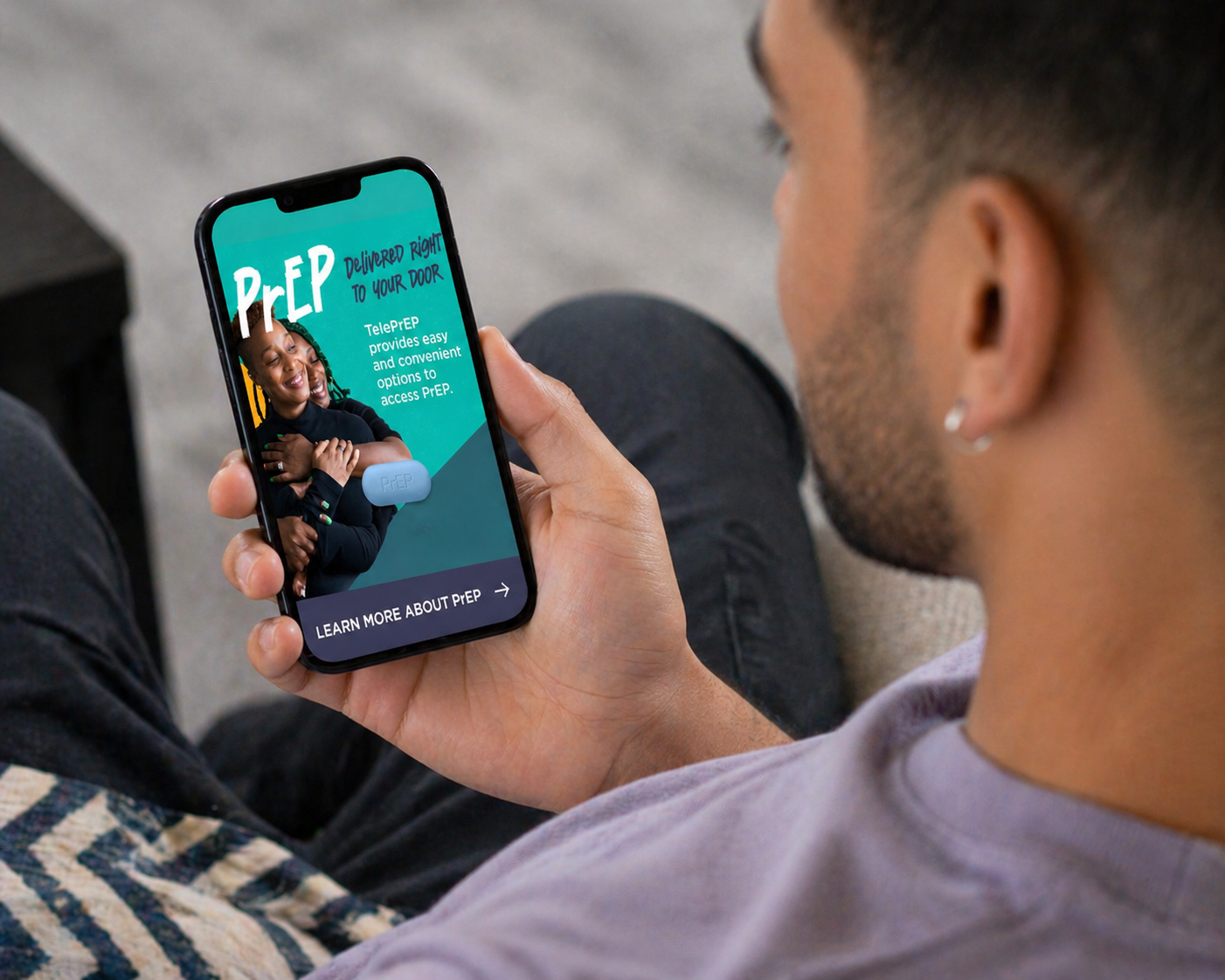
The TelePrEP ads were bright orange, pink, and turquoise. Hand-lettered display type. Photos of racially diverse, overtly queer young adults laughing together. Focus group participants had specifically asked for this — they wanted ads that signaled "this is for you" at a glance.
The landing page they pointed to was a state department of health page. Muted greens and blues. Generic sans-serif. Comprehensive program information laid out like a brochure.
Both pieces were doing their jobs separately. Together, they broke the user's trust. The ad promised one kind of experience; the landing page delivered another. Users showed up, registered the mismatch in about a second, and left.
For nonprofit campaigns, this happens constantly. Funders and partners often own the destination — a department of health page, a 211 portal, a coalition microsite — and the campaign creative gets developed separately. The handoff is where the budget leaks.
The fix isn't always a redesign of the partner's site. Sometimes it's a campaign-specific landing page that bridges the two aesthetics. That's exactly what the TelePrEP team built during their pause, and it more than doubled landing-page activity (from 185 to 382 tracked actions) in a comparable run time.
Lesson 2: One call to action beats a menu of them
The original TelePrEP page offered visitors several paths: schedule a consultation, text the e-navigator, read the FAQ, browse program details, click to enroll. All useful. All on the same screen.
Across 28 days of campaign traffic, exactly one person clicked "Click Here to Enroll."
The revised landing page had a single call to action: text the PrEPBot. That's it. And while the campaign-specific page was running, 21 mobile users tapped through to the chatbot — a small absolute number, but a meaningful jump from a baseline of nearly zero.
For sensitive health topics, this is especially important. Someone considering PrEP is already navigating stigma, uncertainty, and a lot of personal risk assessment. Asking them to also choose between four next steps is a cognitive tax most won't pay. Pick the one action that matters most for the campaign goal, and let everything else live a click deeper.
Lesson 3: Real-time measurement is the difference between a pivot and a post-mortem
The single most replicable contribution of this study is methodological. The team used tracking pixels — small bits of code embedded in the landing page — to monitor user behavior in real time, by traffic source. That's how they spotted the engagement gap in three weeks instead of three months.
Most public health campaigns don't have this instrumentation. Funders ask for impressions and clicks; agencies report impressions and clicks; nobody finds out until the close-out report that the destination experience was the bottleneck.
This isn't a budget problem. Tracking pixels from Meta, Google, and most analytics platforms are free. The cost is the upfront work of defining what counts as engagement (button visibility, scroll depth, link clicks, chatbot taps) and committing to look at the data weekly while there's still time to change something.
Build that loop in from day one. Set a midpoint review on the calendar before the campaign launches. Give yourself permission to pause and pivot — the TelePrEP team paused for 33 days, which felt like an eternity at the time, and the revised campaign meaningfully outperformed the original.
Lesson 4: Audience self-report is not the same as audience behavior
In the formative survey, 86% of participants said they used Instagram, and 40% said they used it more than any other app. The campaign budgeted accordingly.
Facebook outperformed Instagram on every metric — more impressions, higher click-through rate, lower cost. The audience said one thing about their habits and behaved differently when ads showed up in their feeds.
This is worth sitting with. Formative research is essential — the focus groups are what produced the creative direction that worked. But what people say about their media habits and how they actually engage with paid content are two different data streams. Treat your audience research as the starting hypothesis, not the media plan, and let in-flight performance data do the reallocating.
Where place-based media changes the calculus

Here's the limitation the TelePrEP authors flag most clearly in their discussion: tracking pixels tell you what users did, but not who they were. The campaign was designed for sexual and gender minority young adults, and the creative and targeting were built around that — but the team had no way to confirm the people they reached were actually in the target community. That's a real constraint when you're accountable to funders, communities, and evaluation frameworks that ask whether you reached the right people.
This is where place-based mobile targeting opens up a different approach. Rather than relying on platform algorithms to infer identity from interests and demographics, geofencing builds the audience from physical presence at community spaces. At PlaceBased, our network of LGBTQIA+ nightlife venues, gay bars, bathhouses, and hormone clinics gives us a behavioral signal that algorithmic targeting can't replicate — and we can retarget those devices with mobile ads in the days and weeks after.
For a campaign like TelePrEP, that means the audience question stops being a limitation in the discussion section and starts being a defensible claim. You're not hoping you reached SGM young adults. You're targeting devices that have been to spaces where SGM community members gather, and serving creative shaped by that community.
Pair that with the measurement discipline the TelePrEP team modeled — pixels on the landing page, weekly reviews, willingness to pivot — and you have a campaign architecture that can both reach the right people and prove it.
The takeaway
The TelePrEP pilot didn't enroll thousands of new patients. It generated 730,000 impressions, 475 link clicks, and a few hundred meaningful actions on the landing page. By traditional campaign-scale metrics, modest.
What it produced instead is a methodology: engage the community in formative research, build creative that earns trust, instrument the entire funnel, watch the data weekly, and pivot when the data tells you to. For public health and nonprofit marketers working on short timelines with tight budgets and high accountability, that's worth more than a campaign that hit big without anyone understanding why.
The communities most underserved by traditional outreach deserve campaigns built this way. The tools to do it — including place-based targeting that meets people where they actually are — are more accessible than they've ever been.
Want to go deeper on how place-based targeting and mobile retargeting can support your next public health campaign?
Reference: Ocasio MA, Fernandez MI, Cortese S, Kampa K. Piloting a digital campaign to promote awareness of the TelePrEP program among sexual and gender minority young adults. PLoS ONE. 2023;18(8):e0290149.