Personal Injury Advertising & Media Planning Guide - 2027
Advertising benchmarks, media strategy and market-saturation tactics for personal injury law firms

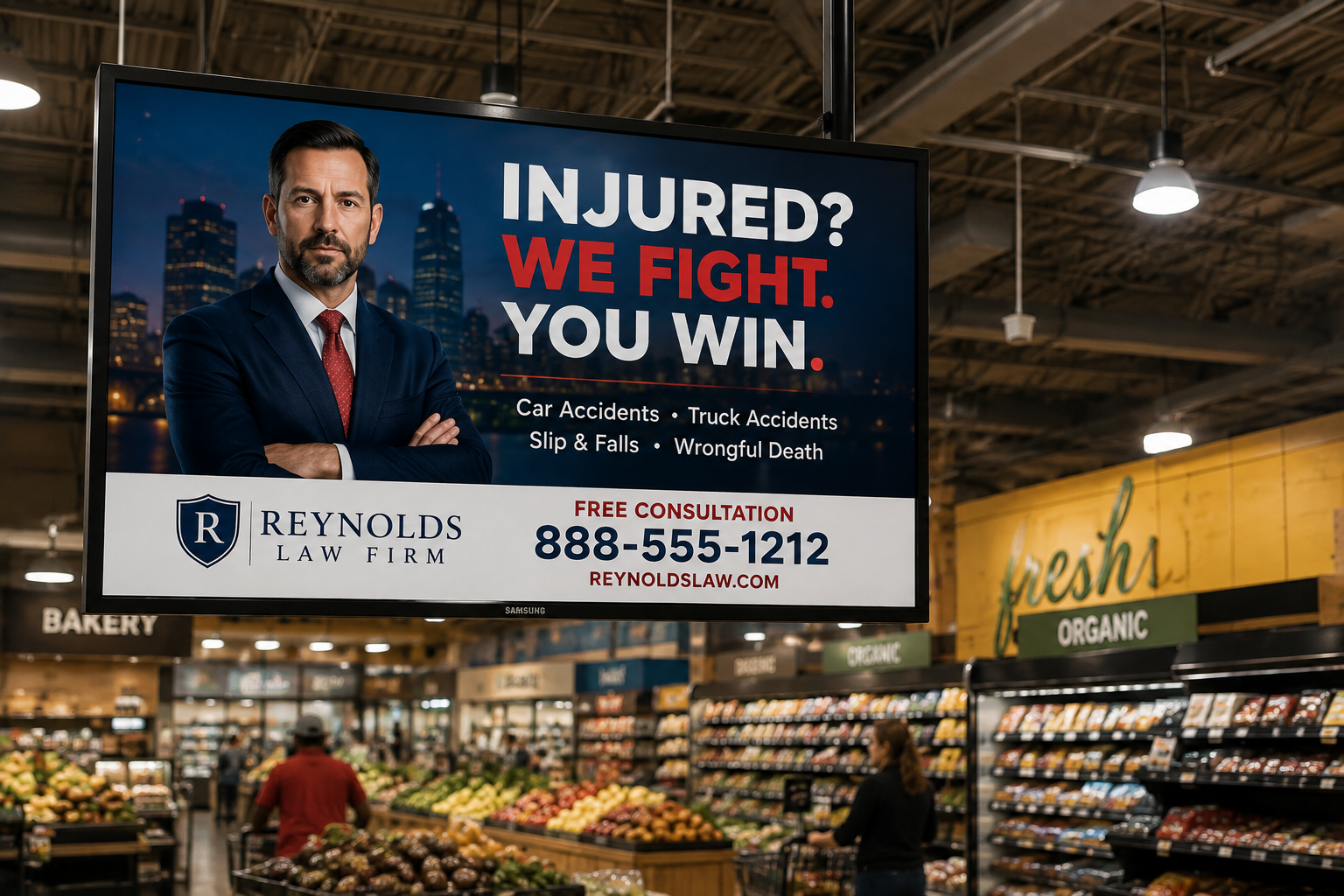
How to Plan Personal Injury Advertising
Advertising benchmarks, media strategy, audience targeting and market-saturation principles for personal injury law firms.
Personal injury firms face one of the most competitive media environments in advertising.
Law firms compete across television, streaming, billboards, paid search, social media, sponsorships and nearly every other major consumer advertising channel.
The objective is rarely simply awareness. Personal injury firms need to build enough familiarity that when an unpredictable accident or injury occurs, their brand is already part of the consumer's consideration set.
That makes media planning particularly important.
This guide provides a practical framework for planning personal injury advertising campaigns, including market-level brand strategy, paid media planning, out-of-home and place-based media, audience targeting, campaign duration, budgeting, measurement and sample planning approaches.
The $2.5 Billion Fight for Attention
Legal advertising has become big business.
Measured U.S. legal-services advertising exceeded an estimated $2.5 billion in 2024 across nearly 27 million advertisements. Spending increased approximately 39% between 2020 and 2024.
Out-of-home has become an increasingly important part of that advertising mix.
The challenge isn't simply buying more media. It's earning enough consumer attention to actually be remembered.
Source: American Tort Reform Association, Legal Services Advertising Report . Figures are industry estimates based on Vivvix data.
The Personal Injury Recall Gap
Billions are being spent. Most consumers still can't name a firm.
A July 2026 consumer study found that approximately 66% of respondents could not name a single personal injury law firm in their area without being prompted.
In other words, roughly two out of every three consumers entered the survey without a personal injury brand immediately available in memory.
Could Not Name a Firm
Most respondents could not identify a local personal injury law firm without prompting.
Could Name at Least One
Outside dominant national brands, consumer recall tended to be heavily regional and market-specific.
The Local Recall Advantage
A personal injury firm doesn't necessarily need to become the most recognized law firm in America.
It needs to become one of the most recognized law firms within the markets it serves.
For a regional firm, the competitive battlefield isn't the entire United States.
It's the DMA, county, suburb or cluster of ZIP codes where the firm wants to generate cases.
Planning Question: How difficult would it be for someone in your target market to go through an ordinary week without encountering your brand?
Source: Market My Market, The Recall Vacuum in Personal Injury Law, July 2026 .
Brand Before the Accident. Capture After It.
Personal injury marketing naturally gravitates toward the moment when someone needs an attorney.
Search engines, Local Services Ads, SEO, Maps and review platforms can reach consumers at precisely the moment legal intent exists.
But by the time someone searches for a personal injury attorney, the competition has already begun.
Brand media plays a different role: establishing familiarity before the legal need exists.
Build Memory
TV / CTV
OOH
Place-Based OOH
Radio
Sponsorships
Social & Video
Capture Intent
Google Search
Local Services Ads
SEO
Maps
Reviews
Direct Traffic
Convert
Phone Call
Form Submission
Chat
Consultation
Signed Case
Search Is Capture. Brand Is Creation.
There is an important difference between someone searching for "personal injury lawyer near me" and someone searching for a specific law firm by name.
The first search begins a competition.
The second suggests that part of the competition may have already been won.
Win the moment before the search.
Beyond the Billboard
Billboards are an exceptionally natural medium for personal injury advertising.
Drivers are an important audience. Auto accidents represent a major personal injury case category. Roadway advertising also creates broad, repeated visibility throughout a market.
The opportunity for place-based OOH isn't to replace that strategy.
It's to extend it.
The billboard reaches them during the drive. Place-based OOH reaches them after they park.
A Consumer's Day
7:30 AM — Commute
The consumer passes the firm's billboard on the way to work.
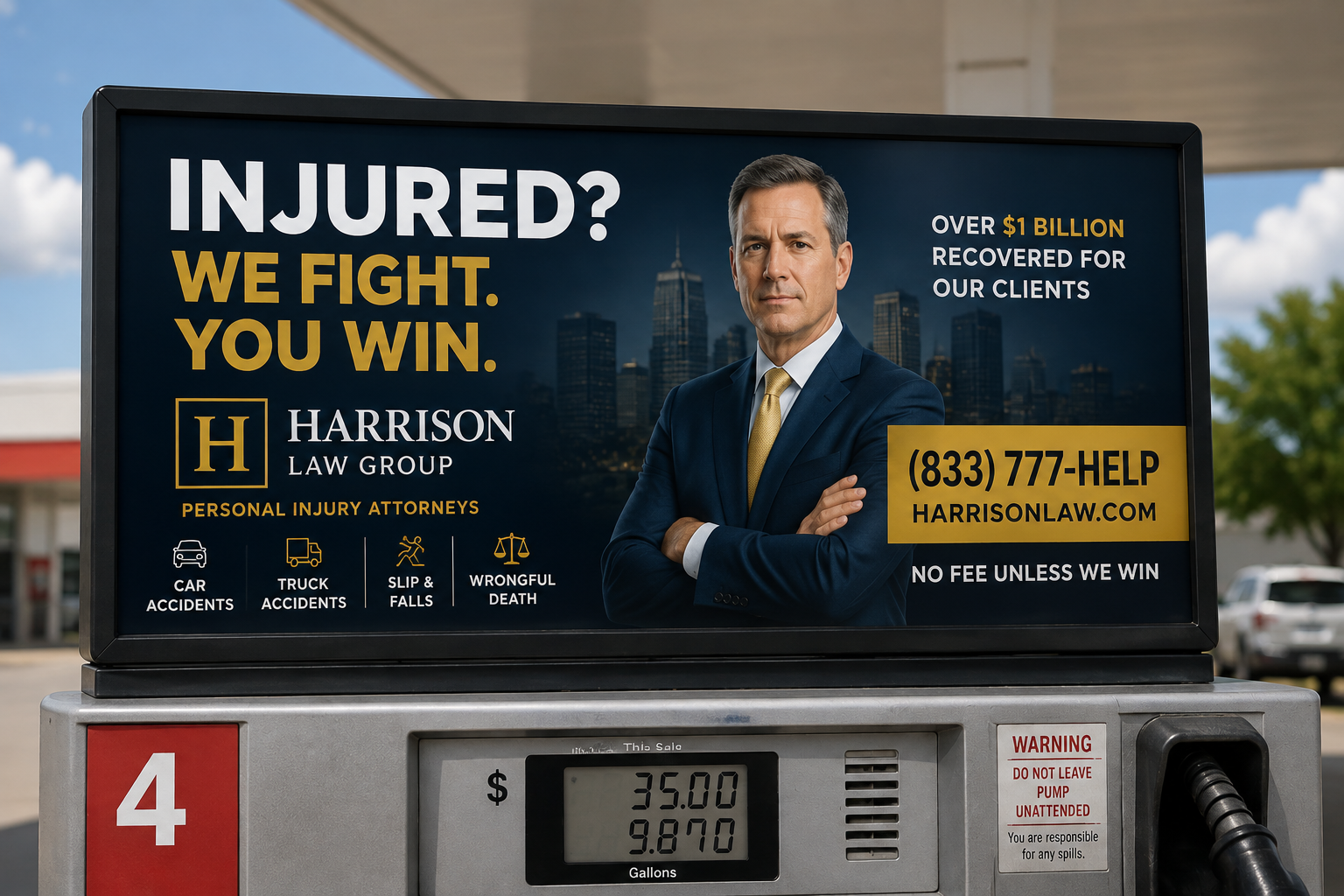
8:00 AM — Gas Station
The same attorney or law firm appears again while the consumer stops for fuel.
5:30 PM — Pharmacy or Grocery
Another physical-world exposure reinforces the firm's name and visual identity.
6:30 PM — Fitness or Community Environment
The brand appears again during another part of the consumer's normal routine.
9:00 PM — Streaming Television
CTV reinforces the same brand on another screen.
No individual exposure needs to do all the work. Collectively, the exposures create familiarity.
The Personal Injury Market Saturation Framework
Traditional media plans often begin with impressions, reach, frequency and CPM.
Those metrics remain important.
Personal injury firms should also consider another question:
How much of the physical environment within our target market does our brand occupy?
1. Roadway Presence
Billboards, digital billboards, transit and other roadside environments build broad visibility during consumer movement.
2. Community Presence
Gas stations, convenience stores, pharmacies, grocery, fitness, community venues and retail extend the brand into everyday destinations.
3. Screen Presence
Television, CTV, streaming, social and video reinforce the same identity across digital screens.
4. Demand Capture
Paid search, LSAs, SEO, Maps, reviews and direct navigation capture consumers once a legal need appears.
Be Seen → Be Remembered → Be Searched → Be Chosen
Build Audiences, Not Venue Lists
Gas stations, pharmacies, gyms, grocery stores, community centers and retail locations are media environments.
They aren't the strategy by themselves.
The audience is the strategy.
A personal injury firm should begin with the people, case types and geographic areas it wants to influence, then identify the physical environments most likely to create meaningful, repeated exposure.
Everyday Driver Audience
Designed to build familiarity among consumers who regularly spend time on the road.
- Gas stations and convenience stores
- Auto-related environments
- Grocery and neighborhood retail
- Pharmacies
- Other commuter-oriented locations
Potential fit: Auto accidents, truck accidents, motorcycle accidents, rideshare-related cases and general PI awareness.
High-Frequency Community Audience
Designed to create broad awareness across frequently visited neighborhood destinations.
- Pharmacies
- Grocery environments
- Gas and convenience stores
- Community centers
- Libraries
- Recreation centers
- Laundromats
- Neighborhood retail
Potential fit: General personal injury, workers' compensation, premises liability and broad local awareness.
Multicultural Audience Strategy
Multicultural advertising should consider the audience, environment, language, geography and creative together rather than simply translating a general-market advertisement.
- Multicultural grocery and retail
- Hispanic-focused retail environments
- Barbershops and salons
- Community organizations
- Neighborhood convenience stores
- Pharmacies
- Community and recreation centers
Potential fit: Spanish-language campaigns, multilingual outreach, market expansion and community-level brand building.
Younger Adults & Drivers
- College campuses
- Fitness centers
- Gas and convenience stores
- Entertainment environments
- Nightlife
- Recreation environments
Potential fit: Auto accidents, motorcycle accidents, rideshare-related incidents and younger-consumer brand awareness.
Planning Principle: The strongest plan isn't necessarily the one containing the most venue categories. It is the plan where audience, geography, environment and creative work together.
Match the Environment to the Objective
| Environment | Driver Reach | Community Reach | Frequency | Multicultural | Younger Adults |
|---|---|---|---|---|---|
| Gas / C-Store | High | High | High | Medium | High |
| Pharmacy | Medium | High | High | Medium | Medium |
| Grocery / Retail | Medium | High | High | High | Medium |
| Fitness | Medium | Medium | Medium | Medium | High |
| Community Venues | Medium | High | Medium | High | Medium |
| Multicultural Retail | Medium | High | High | Very High | Medium |
| College | Medium | Low | High | Medium | Very High |
| Nightlife | Medium | Medium | Medium | Medium | High |
Fund the Market Before Adding the Market
Personal injury firms should resist the temptation to spread limited brand budgets too thinly across large geographic footprints.
Brand building requires repetition.
A $60,000 investment distributed across ten markets may create much less meaningful presence than the same investment concentrated within two strategically important markets.
Strategy A
$60,000 across 10 markets
Approximately $6,000 per market. Greater geographic coverage, but limited local media weight.
Strategy B
$60,000 across 2 markets
Approximately $30,000 per market. Less geographic coverage, but substantially greater potential for local presence and frequency.
Planning Principle: Concentration can outperform coverage when the objective is building local familiarity.
Creative That Builds Recall
Media creates the opportunity to be seen. Creative determines whether the firm is remembered.
Personal injury advertising often contains many competing elements: attorney portraits, settlement figures, phone numbers, practice areas, awards, disclaimers and multiple calls to action.
In place-based OOH, simplicity becomes particularly important.
The Five-Second Test
A consumer should be able to understand the most important elements of the advertisement within a few seconds.
- Who are you?
- What category are you in?
- What should the consumer remember?
- What makes the brand recognizable?
- What should someone do if they need you?
Creative Planning Principles
One Recognizable Brand
Make the firm's name visually dominant and immediately identifiable.
One Distinctive Visual
Use a consistent attorney image, visual device, typography system or other recognizable brand asset.
One Core Message
Avoid trying to communicate every practice area in a single advertisement.
One Clear Action
Use a simple phone number, memorable URL or other appropriate response mechanism.
The objective isn't to communicate everything someone could learn about the law firm. It's to make the firm recognizable later.

How Much Should a Personal Injury Place-Based Campaign Cost?
There is no single correct personal injury advertising budget.
Market size, competitive intensity, geography, existing brand awareness, media availability, campaign duration, desired case types and growth objectives can all influence the investment required.
The following ranges are intended as practical planning starting points rather than fixed rate-card pricing.
Illustrative Place-Based Planning Ranges
| Campaign Scope | Approximate Planning Range |
|---|---|
| Focused local market test | $15,000–$25,000 |
| Targeted DMA presence | $25,000–$50,000 |
| Competitive single-DMA campaign | $50,000–$100,000 |
| Market-saturation strategy | $100,000–$250,000+ |
| Multi-market expansion | Custom |
These are planning ranges rather than fixed pricing. Actual costs vary by geography, format, audience, campaign duration, inventory availability, production requirements and number of markets.
Planning Principle: Fund each market sufficiently before dividing the remaining budget among additional markets.
How Long Should a Personal Injury Brand Campaign Run?
Personal injury presents a unique advertising challenge: firms cannot predict when an individual consumer will suddenly need legal representation.
That makes continuity and repetition particularly valuable.
| Campaign Length | Planning Consideration |
|---|---|
| 4 Weeks | Useful for testing creative, formats or tactical market opportunities. |
| 8–12 Weeks | A stronger starting point for concentrated market-awareness campaigns. |
| 3–6 Months | Appropriate for firms seeking sustained presence and repeated exposure within a priority market. |
| Always-On | Potentially appropriate for established PI advertisers seeking continuous baseline visibility. |
You don't know when someone will need you. You want them to know you when they do.
What Could a Place-Based PI Campaign Look Like?
The following examples demonstrate how place-based media might be deployed at different investment levels.
These are illustrative planning scenarios rather than predetermined packages.
$50,000 Focused DMA Strategy
Objective: Build greater awareness within one defined portion of a priority market.
Potential duration: Approximately 8–12 weeks.
A potential venue mix might include gas and convenience stores, pharmacies, fitness environments and selected neighborhood or multicultural locations.
Rather than maximizing the number of locations, inventory can be concentrated around priority ZIP codes and consumer movement patterns.
$100,000 Competitive DMA Strategy
Objective: Build meaningful share of market presence within one competitive DMA.
Potential duration: Approximately 12–16 weeks.
Media can extend an existing billboard, CTV, television or digital strategy into gas stations, pharmacies, grocery and retail environments, fitness locations, community venues and multicultural environments.
At this investment level, planning should consider existing billboard locations, competitor visibility, historically valuable ZIP codes and the firm's existing search investment.
Strategic Goal: Make the firm feel larger than any individual media channel would make it feel on its own.
$250,000 Market Saturation Strategy
Objective: Build sustained physical-world presence across a major priority market.
Potential duration: Approximately 4–6 months.
The strategy can combine broad geographic reach, high-frequency neighborhood clusters, specialized audience environments and both static and digital formats where appropriate.
At this investment level, measurement should be established before launch so market-level changes can be evaluated over time.
Strategic Goal: Become difficult to overlook within the markets that matter most.
Measure More Than Impressions
One of the most common mistakes in brand advertising is trying to evaluate it exactly like paid search.
Search offers relatively direct performance signals. Brand advertising often influences consumer behavior across a longer and less linear journey.
That does not mean it shouldn't be measured. It means measurement should occur at multiple levels.
Media Delivery
- Number of locations
- Geographic distribution
- Estimated impressions
- Reach and frequency where available
- Campaign dates
- Media format
- Proof-of-performance documentation
Brand Response
- Branded search volume
- Direct website traffic
- Organic branded traffic
- Google Trends where appropriate
- Call-volume trends
- Brand-lift research for larger campaigns
Business Outcomes
- Qualified inquiries
- Signed cases
- Cost per signed case
- Case mix
- Market-level case volume
- Revenue or case-value trends within the target geography
Not every signed case can or should be attributed to one poster, billboard or screen. The more useful question is whether markets receiving additional brand pressure show meaningful movement across brand, demand and business outcomes.
Track Branded Search Share
Personal injury firms can consider tracking not only their own branded search volume, but their share of branded search demand relative to major competitors.
A simple framework:
Your Firm's Branded Searches ÷ Total Branded Searches Across the Competitive Set = Branded Search Share
For example, if four major firms generate a combined 50,000 branded searches in a market and one firm accounts for 22,000, that firm would represent approximately 44% of branded search activity within that defined competitive set.
Tracking movement over time can provide another indication of whether the firm's mental availability within the market is strengthening or weakening.
The 90-Day PI Market Presence Playbook
Establish the Baseline
Document current branded search volume, direct traffic, calls, qualified inquiries, signed cases, case mix and existing media presence before additional media launches.
Identify the Battlefield
Define the DMA, counties, suburbs, ZIP codes or commuting corridors the firm most wants to influence.
Build the Exposure Map
Identify where target consumers drive, fuel, shop, receive services, exercise, socialize and spend time during everyday life.
Build One Recognizable Brand
Coordinate billboard, TV/CTV, digital, social and place-based creative so each exposure reinforces the others.
Measure Market Movement
Evaluate media delivery, branded demand, calls, qualified inquiries and signed cases throughout the campaign.
Before Approving Your Next PI Media Plan
- Who is the primary audience?
- Which case categories are most important?
- Which markets or ZIP codes are the highest priority?
- Where do the firm's strongest cases currently originate?
- Which competitors dominate awareness in the market?
- Where is the firm already investing in billboards, TV or CTV?
- Where does the intended audience spend time offline?
- Are brand and performance media reinforcing one another?
- Is the creative simple enough to recognize quickly?
- Is campaign duration sufficient to build frequency?
- Is each market funded sufficiently before adding more markets?
- Has a pre-campaign measurement baseline been established?
- Will branded search and direct traffic be monitored?
- Can results be evaluated geographically?
- Is the intake operation prepared to convert increased demand?
Be the Firm They Know Before They Need One
No personal injury firm can predict when someone will have an accident.
That uncertainty is exactly why brand matters.
The consumer may not need an attorney today, tomorrow or next month. But when that moment eventually arrives, the competitive landscape can change dramatically depending on one simple question:
Which firms do they already know?
The objective of personal injury brand advertising isn't merely generating impressions.
It's earning a position in memory.
Television builds familiarity. Billboards build physical-world presence. Place-based OOH extends that presence into everyday destinations. Digital media reinforces the brand. Search captures intent. Reviews provide validation. Intake converts the opportunity.
Build Memory → Capture Intent → Convert the Case
About PlaceBased Media
PlaceBased Media helps advertisers and agencies reach priority audiences through out-of-home and place-based media across consumer, community, healthcare, retail, education and lifestyle environments.
Personal injury campaign strategies can include static OOH, digital OOH, pharmacy media, gas station and convenience-store media, grocery environments, fitness locations, community venues, multicultural retail and other audience-specific networks.
Planning a Personal Injury Campaign?
PlaceBased Media can develop market-specific OOH and place-based media recommendations based on your target audience, geography, case priorities, existing media strategy, timing and budget.
Let’s Work Together

Independent Verification. Greater Accountability.
PlaceBased Media uses independent auditing and proof-of-performance practices to strengthen campaign accountability. AAM recently featured our approach to verified campaign delivery, transparency and building advertiser trust.
Read the AAM Media Matters Feature