Fentanyl Awareness Campaigns: Examples That Work and Why
The most effective fentanyl awareness campaigns combine urgent, plain-language messaging with placement in the physical environments where at-risk audiences actually spend time — schools, clinics, bars, and community centers. This post breaks down real campaign examples from state agencies, federal partners, and PlaceBased Media clients, and explains what made each one work.
Why Fentanyl Awareness Campaigns Are Urgent
Illicit fentanyl has fundamentally changed the drug supply in the United States. A single counterfeit pill — indistinguishable from a legitimate prescription — can contain a lethal dose. The CDC reported more than 107,000 drug overdose deaths in a recent 12-month period, with fentanyl involved in nearly 70% of cases.
For public health communicators, this creates a specific challenge: the audience doesn't know what they don't know. Many young people who have never intentionally used opioids are at risk from counterfeit pills sold as Adderall, Xanax, or Percocet. The awareness gap is the danger.
Effective fentanyl awareness campaigns close that gap — not through fear alone, but through repeated, contextually relevant exposure that changes knowledge, shifts attitudes, and prompts action.
What Makes a Fentanyl Awareness Campaign Effective
Before diving into specific examples, it helps to understand the evidence base. Public health research on substance use prevention campaigns consistently identifies several characteristics shared by campaigns that actually move the needle:
Plain-language urgency. Fentanyl messaging that works doesn't hedge. "One pill can kill" is more effective than "prescription pills may sometimes contain dangerous substances." Audiences process simple, direct messages — especially in place-based environments where dwell time is limited.
Repeated exposure. A single impression rarely changes behavior. Campaigns that deploy across multiple venues and run for sustained periods build the repetition needed to shift attitudes. This is one of the core advantages of place-based OOH: audiences in schools, clinics, and community centers encounter the same message week after week.
Contextual relevance. Where a message is delivered matters as much as what it says. A fentanyl awareness message in a high school hallway reaches a different audience — and carries different weight — than the same message on a social media feed. Physical environments carry implicit credibility.
Action orientation. The best campaigns don't just inform — they tell audiences what to do. Whether that's "carry naloxone," "never use alone," or "call 1-800-662-4357," effective fentanyl campaigns close with a clear, low-barrier action step.
Campaign Example: Texas "One Pill Kills"
Funder: Texas state agency
Target audience: Teens and young adults
Media channel: Place-based OOH
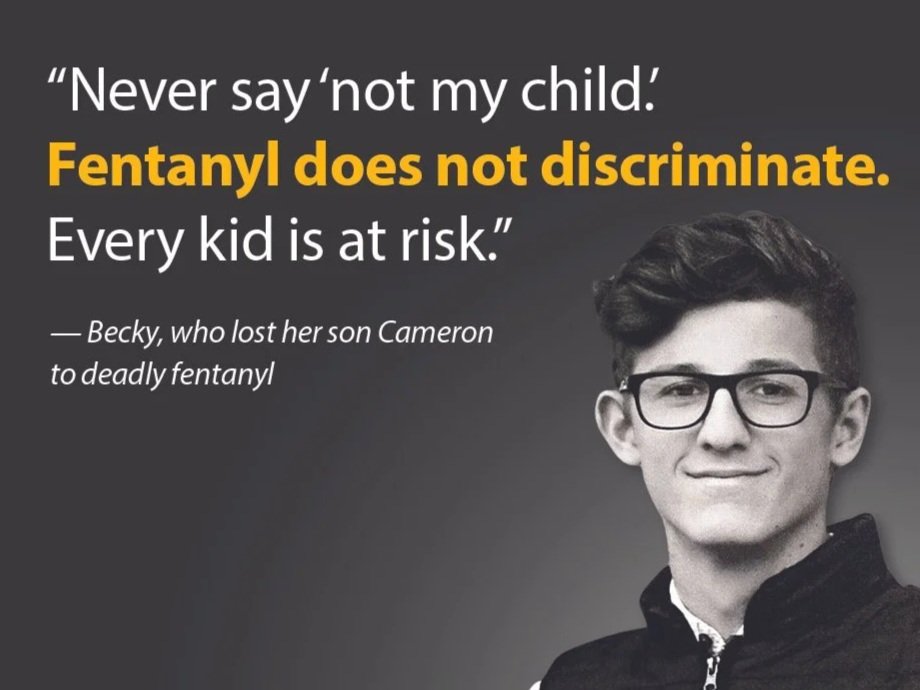
Texas's "One Pill Kills" is among the most direct fentanyl awareness campaigns executed at the state level. PlaceBased Media deployed the campaign across high school environments and community venues throughout Texas.
The campaign's power is in its simplicity. "One Pill Kills" communicates the core fentanyl risk — that a single counterfeit pill can be lethal — in three words. There is no ambiguity, no hedging, and no complicated explanation required. Teens in a school hallway grasp the message immediately.
The venue strategy was equally deliberate. High school environments were prioritized because teens are a primary target for counterfeit pill distribution — and because school-based place-based media reaches them in an environment where parents and school administrators have already established a culture of safety messaging. The message lands differently in a school than it does on a phone screen.
Key takeaway: Short, direct messaging paired with venue placement in youth environments maximizes both reach and resonance with the highest-risk age group.
Campaign Example: Fentanyl Awareness Outreach Initiative
Funder: Federal public health agency
Target audience: Young adults across urban and rural communities
Media channel: Place-based OOH
This fentanyl awareness campaign demonstrates how federal public health funding can be activated through place-based media to reach underserved populations at scale. PlaceBased Media executed the campaign across a mix of healthcare, community, and youth-facing venues spanning both urban centers and rural areas where digital advertising reach is limited.
Where "One Pill Kills" leads with a single devastating fact, this campaign takes a broader approach — addressing the contaminated drug supply, fentanyl risk across multiple drug categories, and the availability of naloxone as a life-saving response. The campaign recognized that the at-risk population included not just teens but young adults across a range of community types.
The federal funding context matters here. Federally funded campaigns require verified impression reporting and documentation of reach. Place-based OOH is well-suited to these requirements because proof-of-play reporting can confirm exactly which venues ran which creative, for how long, and how many impressions were delivered — a level of verification that is difficult to achieve with social media or digital-only campaigns.
Key takeaway: Federally funded campaigns benefit from place-based OOH's verified reporting capabilities, and multi-venue strategies effectively reach both urban and rural at-risk populations.
Campaign Example: Truth Initiative "The Truth About Opioids"
Funder: ONDCP / Ad Council
Target audience: Young adults ages 18–25
Media channel: Multi-channel including OOH
Truth Initiative's "The Truth About Opioids" is one of the most rigorously evaluated opioid awareness campaigns in recent years. Launched in partnership with the Office of National Drug Control Policy (ONDCP) and the Ad Council, the campaign used an integrated strategy that included out-of-home advertising alongside digital, social media, video, and experiential activations.
The campaign's measured results provide some of the strongest available evidence for OOH-inclusive multi-channel strategies in substance use prevention:
46% increase in young adults strongly agreeing that opioid dependence can happen in as few as five days
36% increase in agreement that anyone can become addicted to prescription opioids
27% reduction in willingness to share prescription opioids
These are not soft awareness metrics. These are measurable shifts in knowledge and intended behavior — the kind of outcomes that state and federal funders are increasingly requiring campaigns to demonstrate.
Key takeaway: Multi-channel campaigns that include OOH alongside digital and social consistently outperform digital-only approaches on awareness and behavior change metrics among young adults.
What These Campaigns Have in Common
Across Texas "One Pill Kills," the Fentanyl Awareness Outreach Initiative, and Truth Initiative's national campaign, several patterns emerge:
State and federal funding drives scale. The most impactful fentanyl awareness campaigns aren't grassroots efforts — they're funded by state behavioral health agencies, federal public health grants, and national health organizations. Place-based media partners with experience in grant-funded campaigns can help agencies activate those dollars efficiently and document results for compliance reporting.
Youth and young adults are the primary target. All three campaigns concentrated resources on the 15–25 age range, where fentanyl risk is highest and counterfeit pill exposure is most likely. Venue strategy for this audience prioritizes high schools, college campuses, community centers, and nightlife environments.
Simplicity wins. The most memorable fentanyl campaign creative is short, direct, and visually arresting. Complex messaging gets lost in place-based environments where audiences are moving and dwell time is measured in seconds.
Place-based OOH fills the gaps digital can't. Young people who are offline, in school, or in community settings that restrict phone use are still reachable through venue-based media. Place-based OOH closes the coverage gap that digital-only campaigns leave open.
Planning Your Own Fentanyl Awareness Campaign
If you're a state agency, county health department, or SAMHSA-funded organization planning a fentanyl awareness campaign, place-based OOH should be part of your media mix. Key steps:
Define your geography and audience — county, zip code, or statewide; youth vs. young adult vs. general community
Select venue types — schools and community centers for youth; clinics and pharmacies for naloxone messaging; bars and nightlife for young adult reach
Develop simple, direct creative — lead with the risk, close with an action step (naloxone, hotline, QR code)
Plan for sustained flight — a 4-week campaign rarely moves the needle; 8–12 weeks of continuous exposure builds the repetition behavior change requires
Build in verification — ensure your media partner can provide proof-of-play reporting for grant documentation
Target by Venue and by Data
Pick venues where the at-risk audience already spends time: college campuses, nightlife venues, and music events for young adults; high schools and community centers for teens; clinics and pharmacies for anyone who may need naloxone. Then let local data narrow the map — overdose and EMS data, treatment admissions, and county health rankings show where to concentrate budget, down to the ZIP code.
Design for a Few Seconds of Attention
People see OOH in passing, so each placement should carry one message, not a page of statistics. "One pill can kill" works because it needs no explanation. Lead with the risk, but don't rely on fear alone: close with a specific, low-barrier action — carry naloxone, never use alone, call 1-800-662-4357, or scan a QR code for local resources. Use imagery that's respectful of people who use drugs and their families; stigma keeps people from asking for help.
Measure More Than Impressions
Run a pre/post survey to track awareness and knowledge of fentanyl risk. Then watch the action signals: helpline calls, QR scans, visits to treatment and harm reduction services, and naloxone distribution in campaign areas. Pair those with verified proof-of-play so you can show funders exactly where and when the campaign ran.
Pair OOH With Digital
OOH puts the message in the physical places your audience moves through; digital follows up. A QR code on every placement can route people to a landing page with naloxone locations, treatment resources, and the helpline, while social and search ads reinforce the same message in the same geographies. Keep the creative consistent across both so each exposure builds on the last.
Work With Community Organizations
Recovery centers, harm reduction programs, healthcare providers, and schools know their communities' needs and already have their trust. Bring them in early: they can sharpen the message, point to the right venues, and connect the campaign to services people can actually use. Involving people with lived experience in creative development makes the message more credible and helps reduce stigma.
For a comprehensive overview of substance use prevention advertising strategy across all substance categories, see our Substance Use Prevention Advertising Guide.
Frequently Asked Questions
What is the most effective messaging for fentanyl awareness campaigns? The most effective fentanyl awareness messaging is short, direct, and action-oriented. Campaigns like Texas "One Pill Kills" succeed because the core risk — that a single counterfeit pill can be lethal — is communicated in plain language with no ambiguity. Effective campaigns also close with a clear action step, such as carrying naloxone or calling the SAMHSA National Helpline (1-800-662-4357).
What venues work best for fentanyl awareness campaigns targeting teens? High schools, community centers, after-school programs, and point-of-care settings (pediatric and family medicine clinics) are the most effective venue types for teen-focused fentanyl awareness campaigns. These environments provide repeated exposure to the same audience over time and carry institutional credibility that reinforces the seriousness of the message.
Can place-based OOH advertising be used for federally funded fentanyl campaigns? Yes. Place-based out-of-home advertising is an eligible paid media channel for federally funded awareness campaigns. Media partners experienced with grant requirements can provide verified proof-of-play reporting and impression documentation required for compliance.