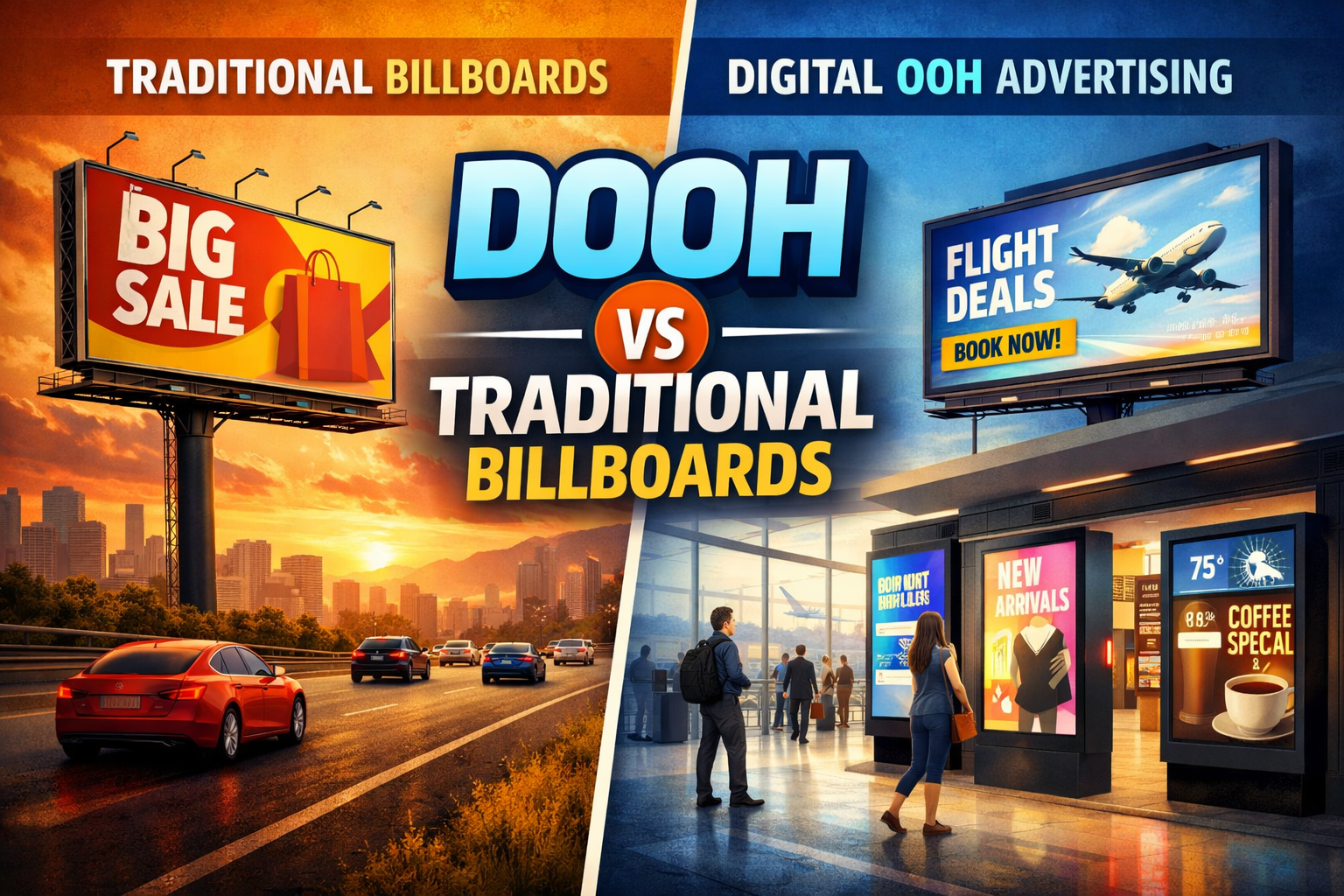
Every brand evaluating out-of-home advertising eventually lands on the same comparison: Digital Out-of-Home (DOOH) vs. traditional billboard advertising. Which performs better? Which offers more flexibility? Which is worth the investment?
Those are the right questions — but they're missing a variable that matters more than format: environment.
At PlaceBased, we've planned and placed OOH campaigns across both static and digital formats nationwide. What we've found is that whether an ad is printed or pixelated matters far less than where it lives and who it reaches. This guide covers the full DOOH vs. traditional billboard comparison — and explains why the most effective place-based campaigns often come down to venue, not format.
What Is Traditional Billboard Advertising?
Traditional billboard advertising refers to static, printed ads displayed on large-format outdoor structures — typically along highways, commuter corridors, and high-traffic urban routes. One advertiser, one message, 100% share of voice for the campaign duration.
The core strength is frequency and market dominance. Commuters traveling the same route daily build strong brand recall over time, and the uninterrupted visual presence is hard to replicate in other channels.
Traditional billboards perform best for:
Broad geographic awareness campaigns
Long-term brand presence in a market corridor
Messages that stay consistent for weeks at a time
High-reach campaigns where scale is the primary objective
Traditional billboard advertising excels at one thing: owning a location. The tradeoffs are real — fixed creative, no targeting beyond geography, and an audience moving past at speed with seconds of exposure.
What Is DOOH Advertising?
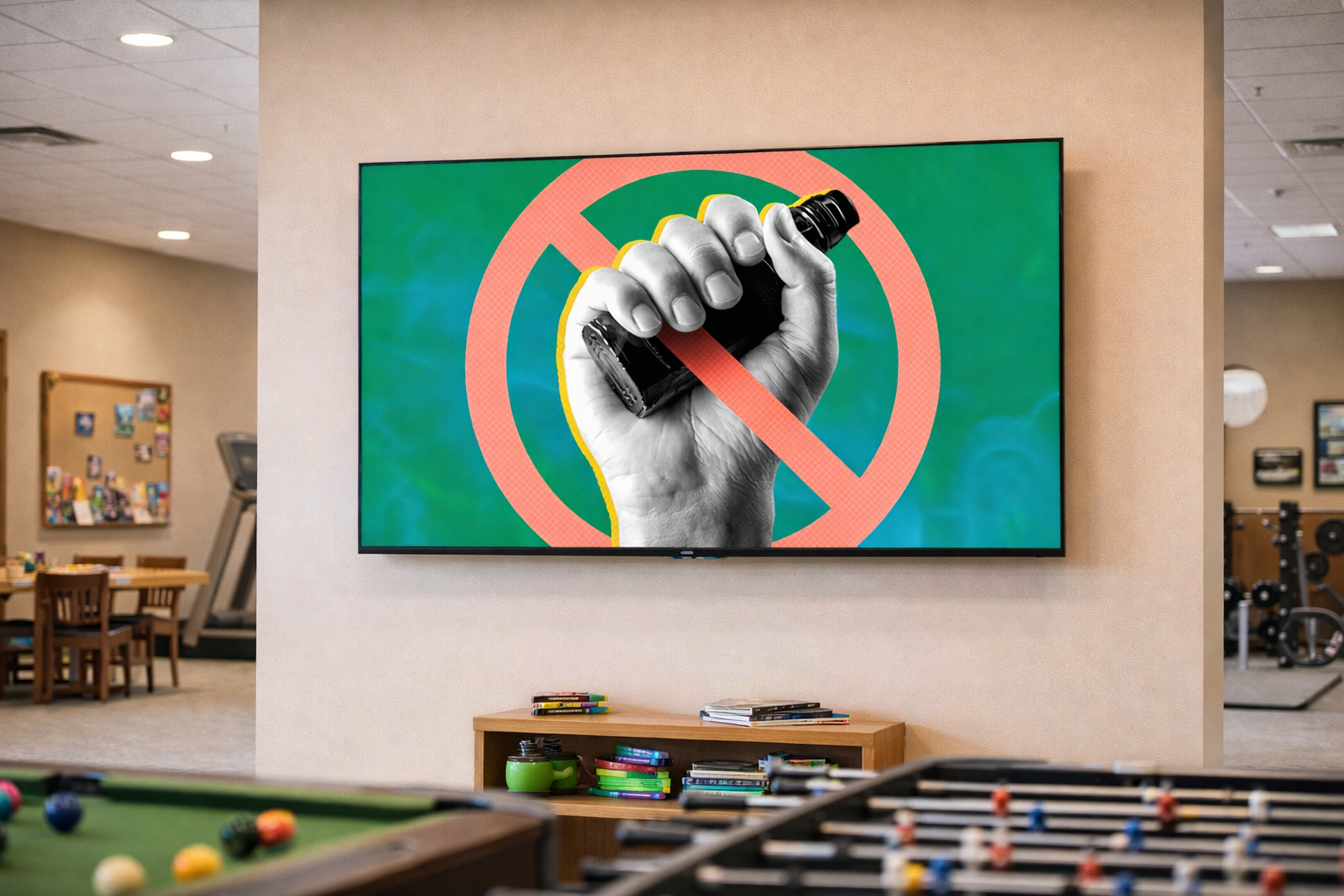
Digital Out-of-Home (DOOH) advertising refers to digital screens placed in real-world environments where people live, work, shop, and travel. It's a broad category — one that includes roadside digital billboards but extends well beyond them into what's known as place-based DOOH.
Roadside DOOH vs. Place-Based DOOH
This distinction matters and is often overlooked.
Roadside DOOH — digital screens on highways and major corridors — shares the same core dynamic as traditional billboards: audiences in transit, exposure measured in seconds, creative that must communicate at a glance. The main upgrade over traditional is creative flexibility and the ability to rotate messaging.
Place-based DOOH is a different product entirely. These are digital screens inside venues where audiences already dwell — airports, transit hubs, retail centers, fitness networks, office buildings, healthcare facilities, university campuses, entertainment venues. The audience isn't passing by. They're present, engaged, and often close to a point of decision.
Place-based DOOH offers everything roadside DOOH offers in terms of creative flexibility — real-time updates, daypart targeting, programmatic buying, contextual messaging — plus the audience quality that only comes from reaching people in high-dwell environments.
Place-based DOOH performs best for:
Reaching consumers close to the point of purchase
Contextual alignment between message and environment
Campaigns requiring multiple creative variations or time-sensitive messaging
Programmatic buyers seeking brand-safe, premium inventory
Targeting specific lifestyle or behavioral audiences by venue type
DOOH vs. Traditional Billboard: Side-by-Side
DOOH vs. Traditional Billboard Advertising: Side-by-Side
Audience State Traditional Billboard: In transit | Roadside DOOH: In transit | Place-Based DOOH: Dwelling, engaged
Exposure Duration Traditional Billboard: Seconds | Roadside DOOH: Seconds | Place-Based DOOH: Minutes
Share of Voice Traditional Billboard: 100% exclusive | Roadside DOOH: Rotational | Place-Based DOOH: Rotational
Creative Updates Traditional Billboard: Reprint required | Roadside DOOH: Instant | Place-Based DOOH: Instant
Targeting Traditional Billboard: Geographic corridor | Roadside DOOH: Geographic + daypart | Place-Based DOOH: Environment, lifestyle, context
Proximity to Decision Traditional Billboard: Low | Roadside DOOH: Low | Place-Based DOOH: High
Buying Options Traditional Billboard: Direct | Roadside DOOH: Direct + programmatic | Place-Based DOOH: Direct + programmatic
Best For Traditional Billboard: Market dominance | Roadside DOOH: Flexible reach | Place-Based DOOH: Contextual engagement

The Variable Everyone Underweights: Environment
The DOOH vs. traditional billboard debate focuses heavily on format — static versus digital, fixed versus flexible, exclusive versus rotational. These distinctions matter. But the more powerful variable is where the ad lives.
A static poster inside a gym locker room is seen by the same person three to five times a week, in a low-distraction environment with time to absorb the message. A digital billboard on a highway is seen by a driver doing 65mph with two seconds of exposure. Same OOH channel. Categorically different audience experience.
This is why place-based media — whether static posters or digital screens — consistently punches above its weight on engagement and recall. Dwell time is the multiplier that roadside formats, traditional or digital, simply can't match.
At PlaceBased, we operate across both static poster placements and digital screens in place-based venue environments. Our view: lead with environment, then determine whether static or digital is the right execution for that placement, audience, and objective.
Static OOH in Place-Based Environments
It's worth addressing static formats specifically — because static OOH is not synonymous with highway billboards, even though it's often treated that way.
Printed poster placements inside transit stations, fitness centers, retail corridors, and lifestyle venues offer something roadside static can't: a captive audience with time to actually read and retain a message. A transit station poster reaches daily commuters during platform wait time. A gym poster is seen repeatedly by members throughout their visit. The format is static. The audience experience is not.
Place-based static works particularly well for brand awareness campaigns targeting specific lifestyle audiences, markets or environments where digital inventory isn't available, and campaigns that benefit from premium, uncluttered creative placements.
Is DOOH More Measurable Than Traditional Billboards?
Yes — particularly place-based DOOH. Measurement capabilities expand significantly when you move from roadside impression modeling to venue-level data.
Place-based DOOH campaigns can be measured through venue audience data, dwell time analytics, mobile retargeting, foot traffic attribution, and cross-device measurement. Traditional billboard measurement relies primarily on traffic-count impression modeling, which is broad by design. Roadside DOOH offers some improvement, but without dwell time, attribution remains limited.
Place-based static placements also benefit from known venue traffic and audience composition data — a fitness network, for example, carries member demographic and behavioral data that informs media value well beyond raw impression counts.
Cost: DOOH vs. Traditional Billboard Advertising
Costs vary significantly by market, format, and environment.
Traditional billboard pricing is driven by traffic counts, location quality, market demand, and production and installation fees. Campaigns are typically sold in four-week cycles.
DOOH pricing reflects environment type, screen density, dwell time, loop position, and programmatic availability. Place-based DOOH eliminates production costs for creative updates and often offers more flexible campaign structures.
Traditional billboards can carry lower CPMs in secondary markets. Place-based DOOH often delivers superior cost-efficiency on a quality-adjusted basis — fewer impressions, but impressions from audiences who are present, engaged, and closer to a purchasing moment.
DOOH vs. Traditional Billboard: Which Should You Use?
There's no universal answer. The right format depends on your objective.
Choose traditional billboard advertising if you need broad geographic dominance, your message stays consistent for weeks, and sustained high-frequency awareness is the primary goal.
Choose roadside DOOH if you need the scale and reach of traditional OOH with the ability to update creative, run daypart targeting, or access programmatic buying.
Choose place-based DOOH or static venue placements if contextual relevance matters, you want to reach audiences during dwell time, your message needs to work close to a point of decision, or you're targeting specific lifestyle and behavioral audiences by venue type.
For many brands, the strongest OOH strategy layers formats — using roadside for broad awareness and place-based media for contextual amplification closer to conversion.
Is DOOH Replacing Traditional Billboard Advertising?
Not replacing — evolving alongside. Traditional billboards remain powerful for mass awareness and market dominance. DOOH, and place-based DOOH specifically, is growing rapidly because it addresses what traditional OOH has always lacked: contextual relevance, audience proximity, and measurement depth.
The trend among sophisticated OOH buyers is toward environment-first planning — identifying where target audiences spend time, then selecting format. That shift benefits place-based media disproportionately, regardless of whether the execution is static or digital.
FAQ
What is the difference between DOOH and traditional billboard advertising? Traditional billboard advertising uses static, printed ads on large outdoor structures with 100% share of voice. DOOH (Digital Out-of-Home) uses digital screens that rotate multiple advertisers and allow for real-time creative updates, targeting, and programmatic buying. DOOH spans both roadside digital billboards and place-based screens inside venues like airports, retail centers, and fitness networks.
What is place-based DOOH advertising? Place-based DOOH refers to digital screens positioned inside specific venues and environments — airports, transit hubs, retail centers, fitness networks, office buildings, healthcare facilities — where audiences dwell rather than pass through. It offers higher engagement and contextual relevance than roadside DOOH because exposure happens during minutes of dwell time, not seconds of transit.
Is DOOH better than traditional billboard advertising? Neither is universally better. Traditional billboards provide uninterrupted geographic dominance and strong frequency. DOOH — particularly place-based DOOH — provides creative flexibility, contextual targeting, and proximity to decision moments. The right choice depends on campaign objectives.
What is the difference between roadside DOOH and place-based DOOH? Both use digital screens, but the audience experience differs significantly. Roadside DOOH reaches people in transit with seconds of exposure, similar to traditional billboards. Place-based DOOH reaches audiences inside venues during dwell time — gyms, airports, transit stations, retail stores — with minutes of engagement and much greater contextual relevance.
Can you combine traditional OOH with DOOH? Yes. Many effective OOH strategies use traditional or roadside formats for broad awareness and place-based DOOH for targeted, high-relevance amplification. The formats serve different funnel stages and work well together.
How is place-based DOOH measured? Place-based DOOH can be measured through venue audience data, dwell time analytics, mobile retargeting, foot traffic attribution, and cross-device measurement — offering significantly more attribution depth than traditional billboard impression modeling.
PlaceBased specializes in place-based static poster and digital OOH campaigns across premium venue environments nationwide — including retail networks, transit environments, airport media, fitness centers, and lifestyle venues. If you're evaluating your OOH strategy and want a recommendation built around your audience and objectives, get in touch with our team.