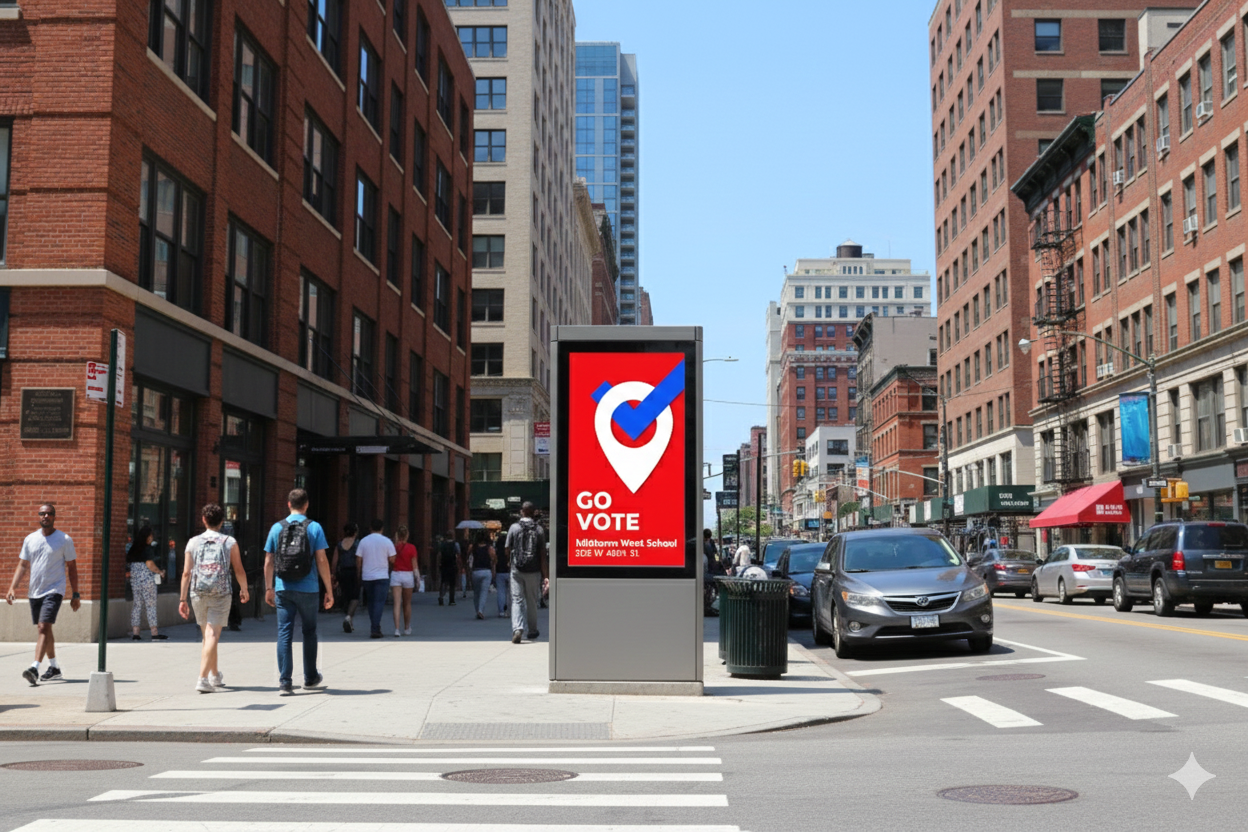
Political campaigns used to be simple: buy TV ads, send mailers, knock on doors. But voters don't consume information that way anymore. They're at the grocery store, waiting at the pharmacy, dropping kids at school, commuting through transit hubs, and scrolling their phones between errands.
That's where Digital Out-of-Home (DOOH) advertising has become essential. It reaches voters in the real-world moments that matter — not interrupting their day, but becoming part of it. For political campaigns and advocacy groups, DOOH offers something traditional media can't: precision targeting combined with community trust.
Why DOOH Has Become Essential for Political Campaigns
Reach Voters Where They Actually Are
Traditional political ads face a credibility problem. Around 28% of users have abandoned trust in online ads, and voters skip TV commercials, delete campaign emails, and toss mailers without reading them. But they can't avoid the places they go every day:
Grocery stores where families shop weekly
Pharmacies where people pick up prescriptions
Gas stations in rural and suburban communities
Transit hubs in urban centers
Community centers hosting local events
Health clinics serving underserved populations
Schools and universities engaging younger voters
DOOH places political messaging directly in these high-traffic environments, creating unavoidable touchpoints with your target audience.
Build Trust Through Context
Not all advertising channels are created equal. Research shows that 73% of consumers view DOOH ads favorably — significantly higher than television at 50%, social media at 48%, online ads at 37%, audio at 32%, and print at 31%. A political ad on social media might feel like manipulation. A mailer might land in the trash. But a message displayed in a trusted community space — a clinic, a school, a local grocery store — carries implicit credibility.
Premium DOOH exposure in high-traffic areas can boost brand trust by 13% compared to brands without such exposure. When you advertise where people already feel safe and informed, your message benefits from that environment. A Morning Consult study found that 56% of likely voters trust political information in OOH ads to be truthful, making it one of the most credible channels for political communication.
Target with Precision That Traditional OOH Can't Match
Unlike billboards that broadcast to everyone, modern DOOH networks allow sophisticated audience targeting based on:
Geographic precision down to specific neighborhoods or districts
Demographic data including age, income, and household composition
Behavioral patterns like shopping frequency or healthcare utilization
Proximity to community resources like polling places or government offices
Health indicators for public health advocacy campaigns
For issue-based advocacy — whether it's healthcare access, education funding, or environmental policy — this means reaching the voters most affected by and most interested in your cause.
Move Fast When Politics Demands It
Political realities shift overnight. A new poll drops. A candidate makes a gaffe. A legislative vote gets scheduled. Traditional media buys take weeks to execute, but DOOH campaigns can pivot in hours:
Swap creative instantly in response to breaking news
Test multiple message variations in real-time
Deploy reactive content tied to debates or policy announcements
Scale up or down based on polling data
Contextually relevant DOOH content triggered by factors like time, weather, or live updates increases ad effectiveness by an average of 17%. When your opponents are still waiting for new yard signs to print, you're already running updated messaging across dozens of locations.
Amplify Every Other Channel in Your Strategy
DOOH doesn't replace your digital strategy — it supercharges it. Studies show that 74% of mobile device users take action on their phones after seeing a DOOH ad, with 44% searching for more information online, 38% visiting advertiser websites, and 30% checking social media pages. When voters see the same message across multiple channels, persuasion and recall increase exponentially through frequency stacking.
An impressive 76% of recent DOOH ad viewers reported taking action because of a DOOH ad — making it one of the most action-driving media formats available. PlaceBased's integrated approach combines DOOH with complementary channels for maximum impact:
Social media ads targeting the same demographics
Connected TV for at-home reinforcement
SMS outreach with coordinated messaging
Grassroots organizing through local partners
Email campaigns timed to DOOH flight dates
A voter who sees your healthcare message on screens at their pharmacy, in their Facebook feed, and in a text message is far more likely to remember it — and support it.
The Numbers Behind Political DOOH Success
The political advertising landscape is shifting dramatically toward DOOH. Political ad spending in OOH reached its highest levels ever in 2024, with US House and Senate OOH campaign spending in the first half of 2024 quadrupling from 2020 and increasing 70% from 2022.
In 2024, OOH advertising revenue surpassed $9 billion for the first time, with DOOH accounting for 34% of total OOH ad spend and growing by 7.5%. Political advertising was a major driver of this record spending. Total political ad spending in 2024 exceeded $12 billion, representing the costliest election year in US history.
The global DOOH market is experiencing explosive growth. Global DOOH advertising revenue increased by 17% in 2024, reaching more than $15.5 billion, with projections showing an additional 34% growth by 2028, approaching $21 billion. This momentum reflects advertisers' recognition that DOOH delivers results traditional media simply can't match.
Research shows that DOOH recall for political ads reaches as high as 48%, with 22% of viewers stating that DOOH ads have influenced their opinion of an issue or candidate. These engagement metrics far exceed most traditional advertising formats.
How Political Organizations Are Using DOOH Right Now
Issue Advocacy That Shapes Public Opinion
Political campaigns aren't just about candidates. Some of the most effective DOOH campaigns focus on moving public sentiment around:
Climate policy and clean energy
Housing affordability and homelessness
Substance use prevention and treatment
Infrastructure investment
These campaigns don't ask for votes directly. They shift the narrative, build support for legislation, and create pressure on decision-makers.
Voter Mobilization and Civic Engagement
Nonprofits and civic organizations use PlaceBased's community-focused networks to drive democratic participation:
Voter registration drives in low-engagement communities
Ballot measure education explaining complex initiatives
Early voting promotion highlighting convenience and access
Turnout campaigns in historically low-propensity neighborhoods
DOOH has a pronounced influence on over 60% of Gen Z and Millennials and is viewed favorably by 61% of adults, making it particularly effective for engaging younger and more diverse voter segments. DOOH excels here because it reaches voters in their daily routines, making civic participation feel accessible rather than intimidating.
Legislative Pressure and Policy Campaigns
During legislative sessions, DOOH becomes a rapid-response tool for government communications:
Building public pressure on lawmakers considering key votes
Rallying community support for pending legislation
Educating constituents about new policies and their impact
Countering misinformation before it takes root
Screens placed near capitol buildings, government districts, or in legislators' home districts create direct accountability.
Local Candidate Awareness
While less common than issue-based messaging, DOOH helps down-ballot candidates overcome their biggest challenge: name recognition. It's particularly effective for:
State legislative races in competitive districts
County-level offices like sheriff or commissioner
School board and municipal elections
Special elections with low baseline awareness
When voters have heard your name and seen your face before they get to the ballot box, you've already won half the battle.
Why Local Politics Especially Benefits from DOOH
National campaigns have massive budgets and media attention. Local campaigns have neither — but they have something more valuable: community connection. DOOH advertising is physically embedded in those communities, making it ideal for:
School bond proposals displayed near schools and family venues
Public health measures at clinics and pharmacies
Local tax initiatives in grocery stores and gas stations
Infrastructure projects along affected transit routes
Community ballot measures in neighborhood gathering spaces
When the message is about the place where people live, work, and raise families, physical placement creates relevance that digital ads simply can't match.
Best Practices for Political DOOH Campaigns
Keep Messaging Sharp and Value-Driven
Political attention spans are measured in seconds, not minutes. The most effective DOOH political ads:
Use 7–10 word headlines that communicate the core message instantly
Focus on voter benefits rather than fear or negativity
Lead with strong visuals that anchor meaning before words do
Include clear calls to action like "Vote Yes on Measure 5" or "Learn More at [URL]"
If your message requires a paragraph to explain, it's not ready for DOOH.
Match Venue to Message
Strategic placement multiplies campaign effectiveness:
Healthcare initiatives → Clinics, pharmacies, senior centers
Education campaigns → Schools, libraries, youth sports venues
Economic messaging → Grocery stores, gas stations, transit hubs
Environmental issues → Parks, outdoor recreation areas, farmers markets
Rural advocacy → Gas stations, agricultural co-ops, community centers
The environment where people see your message shapes how they receive it. Explore PlaceBased's venue options across 300+ markets.
Build Frequency Across Multiple Touchpoints
Political persuasion requires repetition. The most successful campaigns ensure voters encounter their message:
Multiple times per week across different venue types
In combination with digital ads for frequency stacking
At different times of day to reach varied audiences
Across a sustained flight rather than short bursts
Seeing a message once creates awareness. Seeing it seven times creates conviction.
Integrate DOOH Into Broader Campaign Infrastructure
Research shows that 80% of consumers are likely to take action after seeing DOOH ad content they deem entertaining or visually appealing. DOOH should never stand alone. The strongest campaigns use it to drive action:
QR codes linking to donation pages or volunteer signups
Custom landing pages tracking DOOH-driven traffic
SMS keywords for immediate engagement
Social media hashtags creating cross-channel conversations
Event promotion driving attendance at rallies or town halls
Studies show that 51% of consumers who noticed directional DOOH ads subsequently visited the advertised business, demonstrating the medium's power to drive real-world action. Every screen should be a gateway to deeper engagement.
Leverage Dynamic Content for Real-Time Relevance
Dynamic DOOH content attracts 55% of Gen Z respondents, a key demographic that many advertisers try to reach through social media. Static ads work, but dynamic content performs better:
Countdown timers to election day, early voting deadlines, or legislative votes
Live polling updates showing momentum for ballot measures
Weather-triggered messages promoting vote-by-mail during storms
News-responsive creative addressing breaking developments
Dayparting strategies showing different messages morning vs. evening
When your ad feels timely and responsive, it earns more attention and trust.
Reaching Diverse Voter Segments
Political success requires reaching all constituencies. PlaceBased specializes in multicultural marketing, offering targeted solutions for:
Hispanic and Latin-X communities through culturally relevant messaging
African American communities in trusted neighborhood venues
LGBTQ+ populations with inclusive advocacy campaigns
Rural voters via gas stations and community centers
Young voters through schools and digital integrations
Effective political advertising recognizes that different communities consume information differently, respond to different messengers, and prioritize different issues. PlaceBased's audience targeting capabilities ensure your message resonates with the voters who matter most to your campaign.
The Future of Political Advocacy Runs Through Community Spaces
Political advertising is undergoing a fundamental shift. OOH's position as a highly relevant consumer medium is reflected particularly in the political arena, driven by its ability to deliver location-based targeting and strong resonance with younger and multicultural audiences. Voters are tired of being bombarded online, skeptical of traditional media, and hungry for authentic connection to the issues that affect their lives. They want to be informed, not manipulated. Engaged, not exploited.
By 2029, global DOOH advertising spending is forecast to grow by 46%, potentially reaching nearly $30 billion, reflecting the industry's recognition that this medium delivers unmatched results. DOOH meets this moment by combining the targeting precision of digital advertising with the community credibility of local media.
For advocacy organizations, nonprofits, political campaigns, and government agencies, DOOH has evolved from experimental channel to essential infrastructure. Political advertising generated record OOH spending in the 2024 presidential election year, cementing its role as one of the most powerful tools available for shaping public opinion, driving civic participation, and creating lasting policy change.
The question isn't whether DOOH belongs in your political strategy. It's whether you can afford to run a campaign without it.
Sources
Out of Home Advertising Association of America (OAAA) & The Harris Poll. (2024). "The Effectiveness of Digital OOH Advertising." Survey conducted April 2-9, 2024.
Eskimi. (2024). "30+ Digital Out-Of-Home (DOOH) Statistics For 2024."
Market.us. (2024). "Digital Out-Of-Home (DOOH) Advertising Market."
Statista. (2024). "Global DOOH ad spend 2024-2029."
Out of Home Advertising Association of America. (2024). "Out of Home Advertising Continues Momentum with Record-Breaking Quarter and First Half Growth."
Out of Home Advertising Association of America. (2025). "Out of Home Advertising Revenue Surpasses $9 Billion, Highest Revenue Volume to Date."
The Drum. (2024). "OOH advertising: Political advertising strategies for the 2024 US presidential election."
TV Tech. (2024). "OOH and CTV: The Winning Ticket for More Efficient and Effective Political Advertising."
Ready to reach voters where they live? Contact PlaceBased Media to learn how our DOOH networks in clinics, pharmacies, grocery stores, and community spaces across 300+ markets can amplify your political advocacy campaign.