Overdose Prevention Marketing: Reaching Communities When It Matters Most
Overdose deaths continue to rise across the United States, leaving families, communities, and health systems searching for effective ways to deliver life-saving information. While treatment, recovery services, and policy play crucial roles, public communication is often overlooked — and yet it’s one of the most powerful tools for preventing overdose.
Overdose Prevention Marketing is about bridging that gap. It delivers clear, timely, culturally relevant messages where people already live, work, learn, and gather. In other words — it meets people exactly where they are.
At PlaceBased Media, that’s our mission: to help organizations activate evidence-based overdose prevention campaigns across community environments that matter most. Check out how we roll this out on our Media Solutions page.
Why Overdose Prevention Marketing is Essential
The stakes are high — and growing
In 2023, approximately 105,000 people died from drug overdoses in the U.S., and nearly 80,000 (about 76%) of those deaths involved opioids. (CDC)
The crisis has shifted sharply over time: deaths involving illicit synthetic opioids (like fentanyl) have multiplied dramatically since 1999. (HHS)
More than ever, overdose prevention can — and should — be a central part of public-health communication and outreach strategies. (CDC)
That makes fast, widespread awareness and education critical — and that’s where strategic marketing comes in.
Evidence shows outreach works — especially when paired with harm-reduction tools
Community-based naloxone distribution programs — which often go hand-in-hand with education campaigns — have been shown to dramatically reduce overdose mortality. In one study, survival after naloxone administration remained high even as overdose deaths climbed nationally. (PMC)
A landmark study in Massachusetts found that enrolling at-risk individuals and bystanders in overdose education and naloxone distribution (OEND) programs correlated with a 46% reduction in opioid overdose mortality in those communities. (CDC)
When large-scale communication campaigns are deployed, they help raise public awareness, shift behaviors, and reduce stigma — which encourages help-seeking and adoption of harm-reduction practices. (PMC)
In short: pairing education + prevention tools + strategic placement works.
Where Overdose Prevention Messaging Works Best
To have real impact, overdose-prevention messages must be high-visibility, frequent, and placed where people already are. Below are the key venues that consistently drive results.
Clinics, Hospitals & Behavioral Health Centers
These are critical sites for:
Patients experiencing substance use challenges
Family members seeking support
People returning from treatment or hospital visits
Messaging can focus on: overdose response steps, how to use naloxone, safe-use practices, and where to find help.
Pharmacies
Pharmacies are often:
Widely accessible
Trusted health destinations
Key access points for naloxone
Therefore, they’re an ideal location for “carry naloxone” messages, medication-safety tips, and overdose-prevention materials.

Schools, Community & Youth Centers
Young people and families can benefit from prevention messaging — especially around risks of counterfeit pills, fentanyl contamination, and overdose first-aid awareness. Outreach in schools, community centers, sports facilities, and other youth venues can help catch rising risks early.
Gas Stations, Convenience Stores, Shelters, and Service Centers
These “nontraditional” but high-traffic venues reach often-overlooked populations, including people experiencing homelessness, shift workers, travelers, and individuals with limited access to traditional media. Overdose prevention prints or digital displays here can provide repeated reminders and resource access when people are already on the move.
Best Practices for Overdose Prevention Campaigns
Drawing on research and public-health guidance, here’s how to maximize effectiveness:
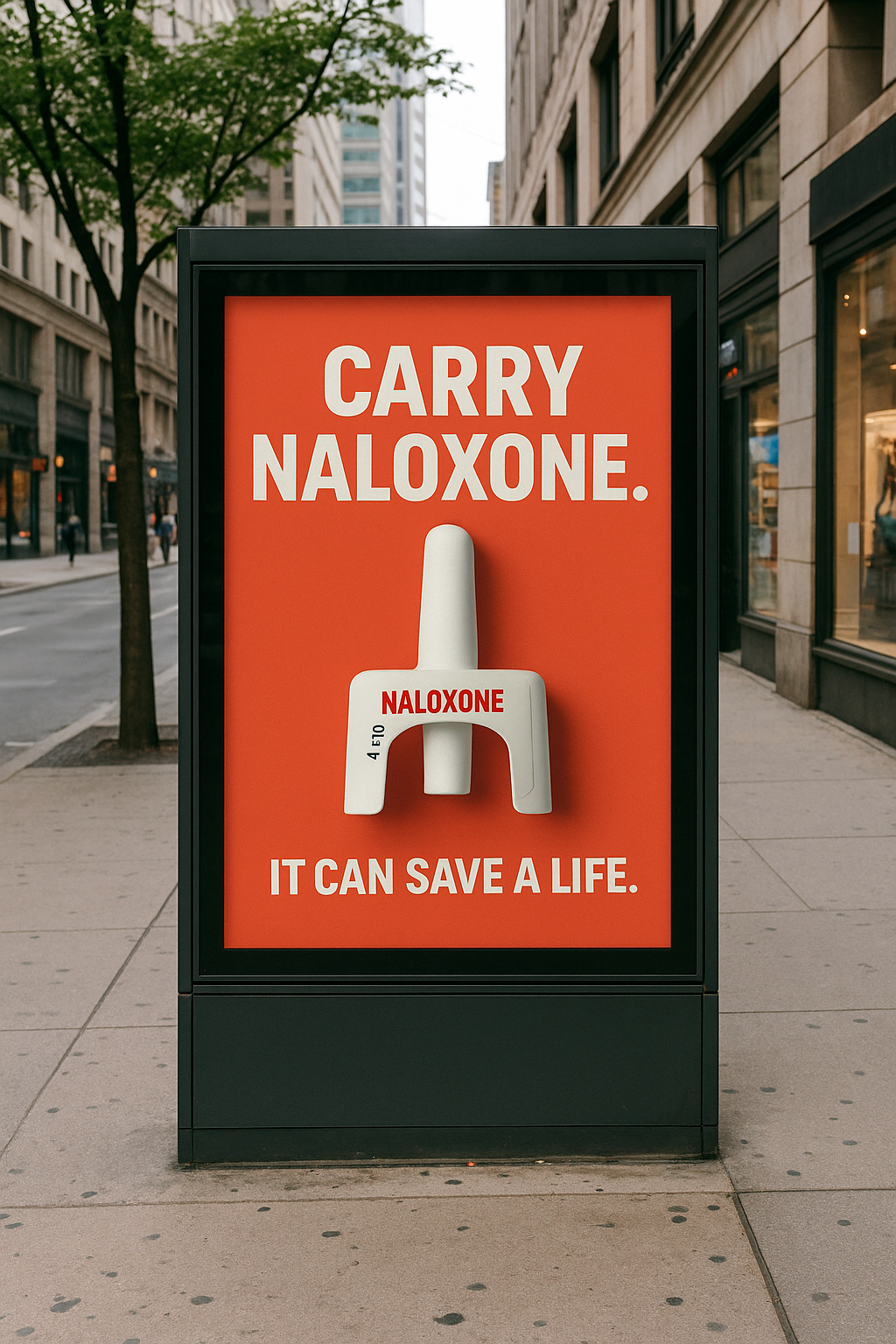
Speak plainly and clearly. Use language that is easy to understand at a glance — for example: “Carry naloxone. It can save a life.”
Normalize harm reduction and reduce stigma. Campaigns should be supportive, factual, and free of shame. Highlight that overdose can happen to anyone, and that help is always available.
Provide actionable steps. For instance: “If someone isn’t waking up, call 911. Use naloxone if available.” Help people know what to do, not just what’s wrong.
Link to local resources. Use QR codes or short URLs that point to local treatment centers, naloxone distribution sites, informational videos, or recovery hotlines.
Combine outreach with harm-reduction tools. Education is vital — but it works best when paired with distribution of naloxone, test strips, or other resources proven to reduce overdose risk.
For more guidance on how to build and evaluate campaigns, the Centers for Disease Control and Prevention (CDC) offers a solid framework. (CDC)
How PlaceBased Media Supports Overdose Prevention Campaigns
PlaceBased Media offers a powerful platform for overdose-prevention outreach at scale. Our strengths:
Statewide and hyperlocal reach — we deliver educational OOH content across communities, from urban to rural, targeting by ZIP code, demographic, or risk profile.
Diverse, high-impact environments — our network includes clinics, pharmacies, community centers, shelters, gas stations, school properties, and other venues where at-risk individuals and their support networks frequent. (See our Media Solutions page for the full venue list.)
Multi-format deployment — print, digital (DOOH), and hybrid campaigns that can include QR codes, brochures, take-aways, and multilingual materials.
Built-in evaluation & accountability — we provide reporting and proof-of-performance so you can see exactly where your messaging went and who it reached.
Overdose Prevention Marketing: A Critical Step Toward Saving Lives
The overdose crisis is one of the most urgent public-health challenges of our time. In 2023 alone, tens of thousands lost their lives — but the crisis is not inevitable. With smart, targeted outreach, backed by evidence and delivered in trusted community spaces, we have the power to save lives.
If your organization is planning an overdose-prevention initiative, we’d be honored to help.
👉 Explore how — drop by our Media Solutions page and reach out to start a conversation.